I will confess that I have limited patience for the “evolution controversy,” so I will move quickly. The argumentation on both sides would shame your average high-school debate team. In brief: science does not deal in “truths;” it deals in data and theory. There is no third category in science. Evolution is most emphatically a theory (scientists who do not know this may be scientists but they are not thinkers).
Theories are evaluated in science by their capacity to predict data. They are valuable because they save you the pain of gathering voluminous amounts of data which a little intelligent conjecture can sidestep.
For the Biblical creationists (or their mask, “intelligent design”), the question is: what data does your theory predict? The theory of evolution provides a framework for predicting things like how many bones a capybara will have if you know how many a mouse has, or where the gene affected by HIV will be on a human if you find it on a monkey. In fact, it predicts so many things that scientists have taken on the unfortunate habit of calling it a “fact,” which is nonsense but shows just how useful a theory it is.
The last time a Biblical explanation was in line with scientific discovery was when it was being discovered that limestone, a very common rock even in mountain ranges, forms under water. This could be predicted from the Bible, because it mentions a flood covering the entire earth. That’s a very meager record of prediction, and the Bible offers little more.
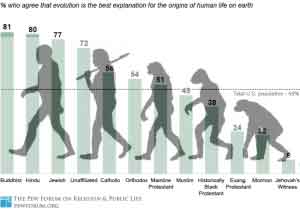
Many scientific triumphalists, with their shoddy messianic thinking, are to blame for the current debacle, in which 48% of Americans were found to give credence to the theory of evolution. But of course I will not exempt the 52% from culpability. Ignorantia legum naturae neminem excusat.
The chart, showing religion’s shame in this whole affair, is below. Obviously, someone needs to superimpose the chart on a reverse-image of the classic evolutionary icon [now done below]. From left to right you see the evolution of religion into know-nothingism (interesting to note that with only one or two exceptions the religions get younger as you proceed from left to right).
4 Comments
The theory of “intelligent design” originally existed independently of Christians. It is synonymous with the teleogical argument, which was espoused by the likes of Aristotle, Plato, and Cicero (cf. http://en.wikipedia.org/wiki/Teleological_argument ). Whereas they theorized simply that there is a rational force that formulates nature, the Christianists co-opted this idea and appended to it that this rational force *is the God of the Christian bible.* The latter requires a much greater leap of faith than some might be willing to make, yet in the minds of most people, the Christianists’ cooption of “intelligent design” is the definitive version.
Personally I think it’s self-evident that evolution is true to some degree, but I think it’s just as much a leap of faith to say that it explains *everything*, as evolutionists are wont to do.
I don’t see why the two theories are mutually exlusive. Just as a person can program a computer how to learn through artificial intelligence, I don’t see why a DNA programmer couldn’t include algorithms for adapting autonomously to different environments.
I realize now I could have said “Christians” instead of “Christianists”, but there is something more aggressively activist about the latter term that I think is appropriate in this context.
Criticism taken concerning the origins of intelligent design. You are correct, there’s nothing “mutually exclusive” about the two theories, but isn’t that simply because one isn’t scientific, i.e. it predicts nothing. Declaring that hydrogen sulfide is the work of an intelligent designer (or beautiful designer, or fashionable designer, or any other subjective determination) doesn’t really tell you very much about it, does it? But this brings us to another point: “intelligent design” isn’t a counter-theory to evolution, it’s a different way of looking at the universe entirely. It could apply to astronomy as much as biology. But that’s rather a sign that it’s a completely different way of thinking, as history and science are different ways of thinking, and as such it has no place in a science curriculum. Its origins, as you note, are from philosophy and not science.
Oh wow. It’s JBK!
Anyway I think the opening few lines to your rant are interesting. First of all I think that when scientists say that evolution is a fact, they’re referring to the observations that things have evolved in controlled environments. Not actually to the theory of evolution. I think it serves two purposes. It helps to bridge the communication gap between scientists and laymen while countering the creationist objection that “evolution can’t be observed”.
Secondly, I find it interesting that you differentiate between “truth” and scientific truth. I would argue that the only kind of truth that is obtainable is the scientific sort of truth. Data and theories (induction based on data) is all we possibly can have access to. If these aren’t truth, then truth doesn’t exist.