Skip to content

In the Republic of Swellendam.

26-Jun-15

http://venturearchitecture.com/400ethrird June 22nd.

purchase Lyrica canada The tourism guide to the region notes that Swellendam revolted from Dutch Rule in 1795, declaring itself a Republic after the French and American style and the “capital of the world.” Four years later the British navy sailed in and put an end to the Republic.

In the Cape Floral Province.

23-Jun-15

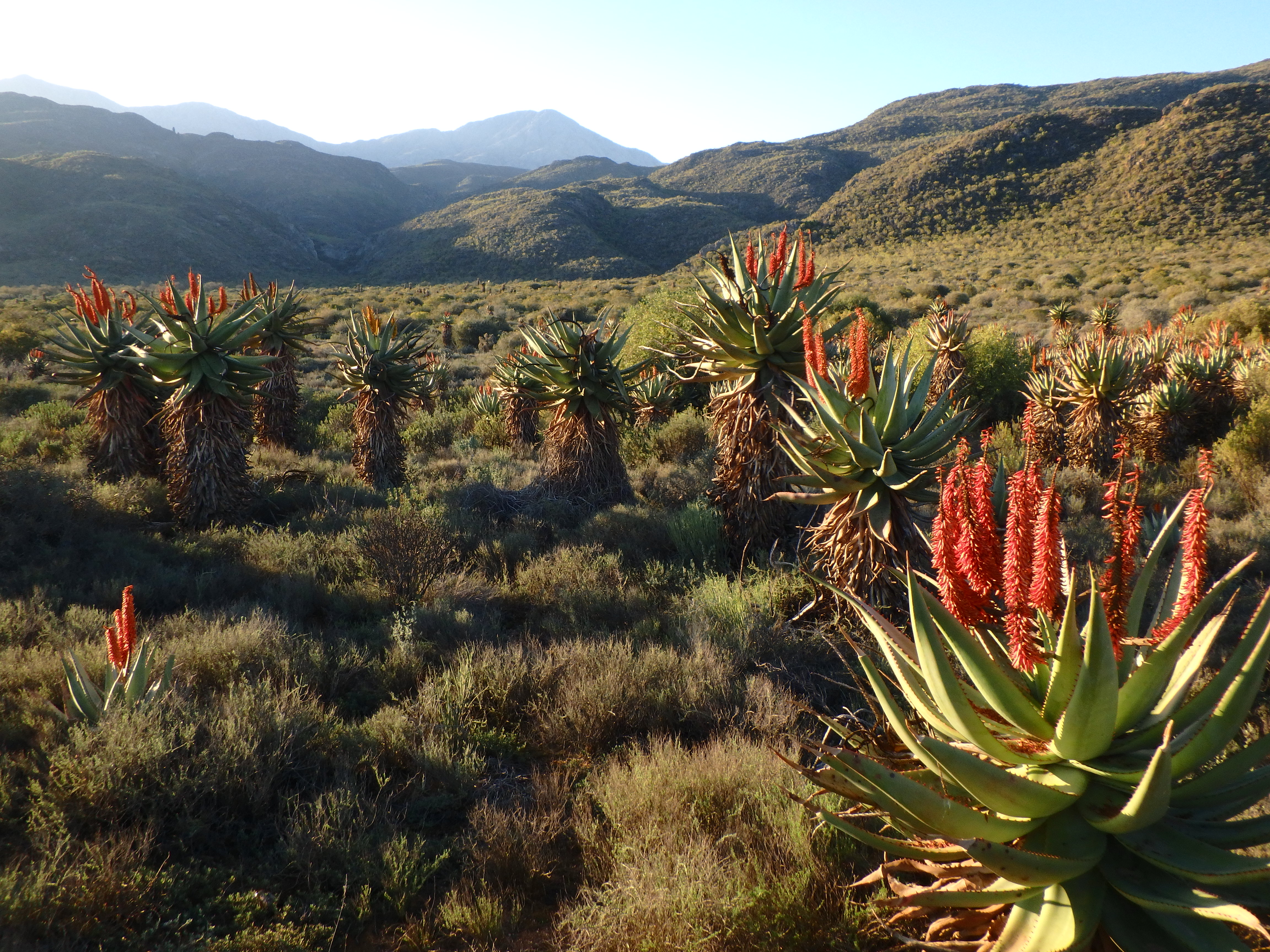
Saw these aloes on the side of the road and had to hop out and have a look.  Amazing!  We’ve come into the Cape Floral Kingdom.

Into a Blackout.

23-Jun-15

June 21st.

We had left Oudtshoorn much later than we wanted, and the road was gorgeous – in farm country at the foot of a superlatively beautiful range of mountains – and so we were stopping constantly to get out and enjoy views. Night fell and it became time to look for a place to stay. We passed through a town which we thought was so poor it didn’t even have electricity – there were almost no lights at all. The people seemed to have night vision – they were walking through the streets without flashlights or streetlights. Then we passed into the next town, Swellendam: it too had no streetlights. We saw a restaurant, with a little bonfire out in front, and candles in the windows. We got out to ask directions – our guide book listed a place to stay there in town, and we needed help finding it. We also needed dinner.

As we got out of the car, and saw that in fact this was not just mood lighting, but in fact the restaurant appeared to be operating without electricity, it suddenly struck us that something was wrong. This was a blackout! And so it was. But it was a scheduled blackout – the country’s electric grid is in such peril that now there are mandatory rolling two-hour blackouts in certain areas, called “load sharing.” Even in Cape Town, we learned: at major banks and large corporate office towers, people will be working late and whoosh, oh it must be six o’clock, there goes the power. After years proclaiming that there are no problems, apparently now there was a recent admission that in fact the situation is so bad that a complete failure of the grid is not out of the question. As with all things here it then becomes a race problem: the whites note that this never happened during apartheid when they were in charge, and blame it on politically correct incompetency being valued over actual skills: government sectors in particular, such as utilities, have seen purges of white staff, who necessarily had a monopoly on training and experience during the apartheid years. My outsider perspective is this: Mandela was elected in 1994. It’s been twenty-one years now. Things need to be in order enough for the electric grid to function. South Africa is rich in coal, and in addition it has nuclear capability (one plant operating, more could be built), and is rich in wind and solar possibilities as well.

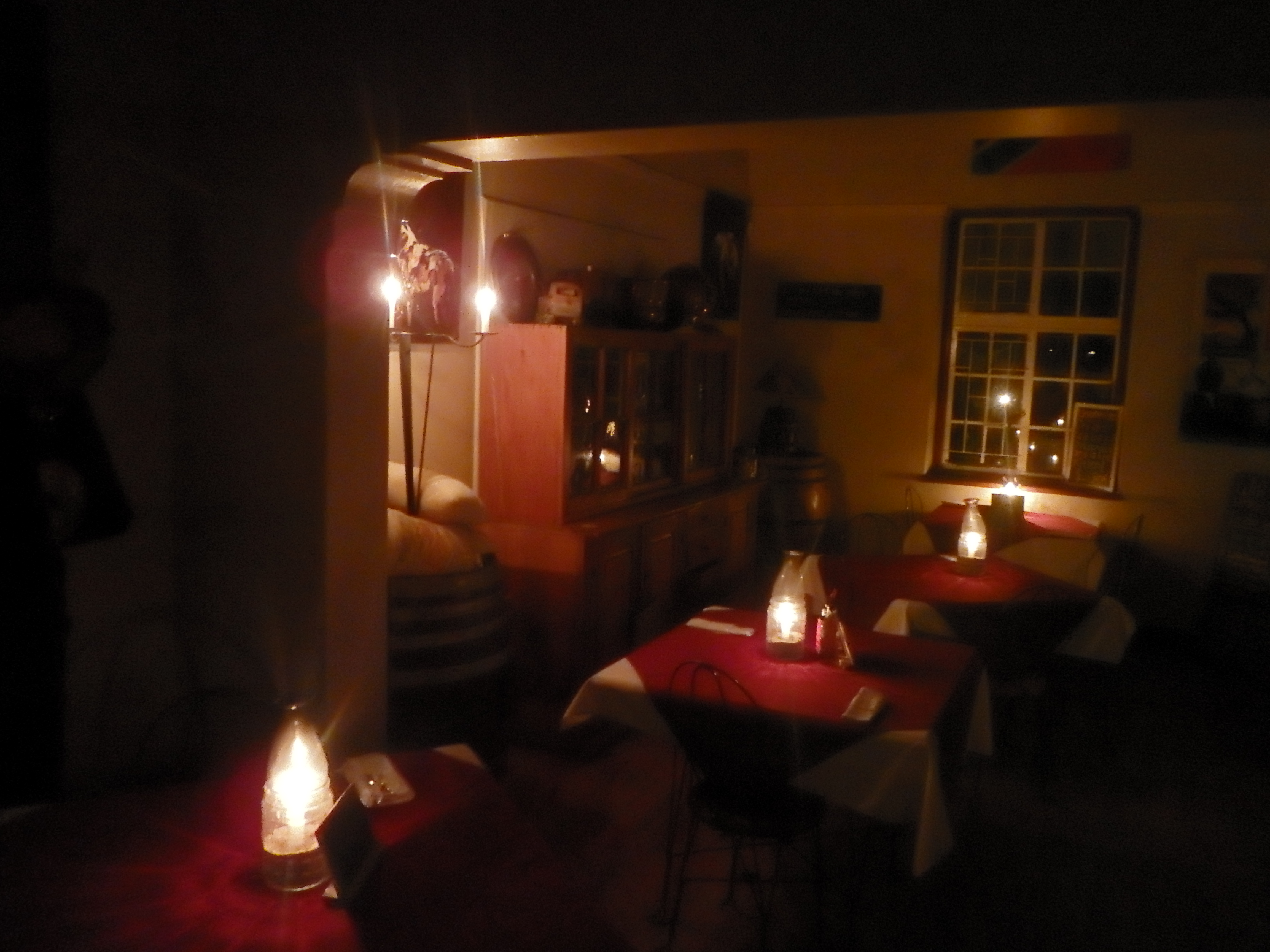
This restaurant is doing a completely fabulous job, and they don't even have electricity.

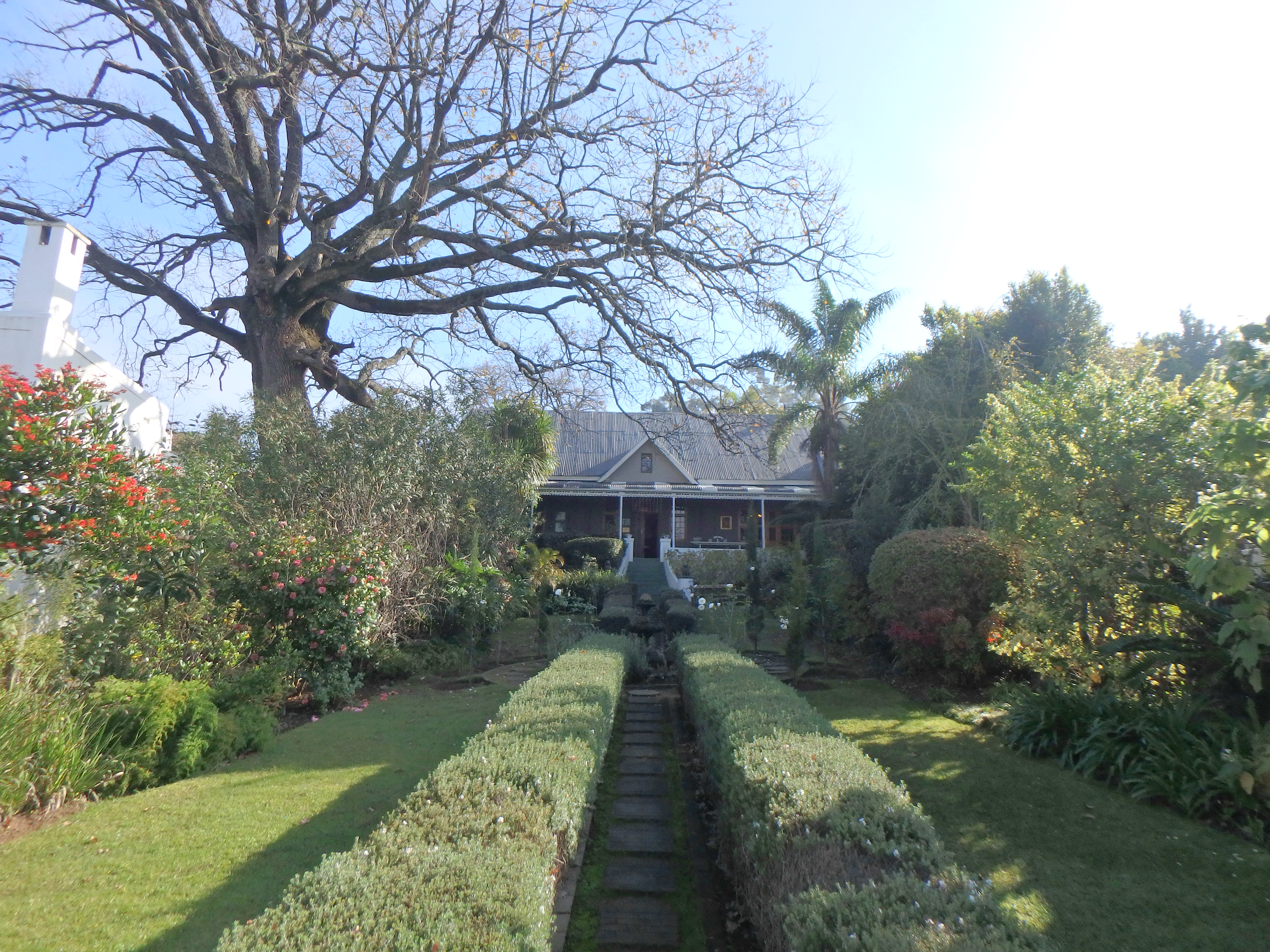
Anyway, we got directions to our chosen guesthouse by candlelight at the restaurant, and then we went off to find it, and find it we did, though with some difficulty, signs not being visible in the night. The proprietor of the place showed us to our room by candlelight, and everything was magical about it all. The house is an 18th century Dutch house, with thick stone walls and yellowwood floors, and our room has a big clawfoot tub and old furniture and is just lovely by candlelight. Even just approaching it, through the old formal hedges up the walk, with no light but the candles in the windows, is incredible. After dropping off our bags we returned to the restaurant, which was itself really a large old house, and where we ate by candlelight as the waiter strolled through the dark rooms. It was amazing, it was beautiful, it was another crazy adventure. It was also incredibly quiet. As usual there was no one in the restaurant, and we had the place to ourselves, having more fabulous local wines and having dessert and in general having a blast.

And then, as our long dinner dragged on into the African winter night, suddenly the lights came on: the coffee machine lurched on, the refrigerators started whirring, and all the normal background noises returned. The radio came on, right in the middle of Boston’s “More Than A Feeling.” We felt like something had been taken from us. We had the waiter turn the lights off, but the loss of the silence could not be repaired.

Now back at our guesthouse, the Cypress Cottage, in the tub. Just about to finish Out of Africa. This is turning out to be a most interesting and enjoyable honeymoon.

In the Ostrich Capital of the World.

23-Jun-15

June 21st.

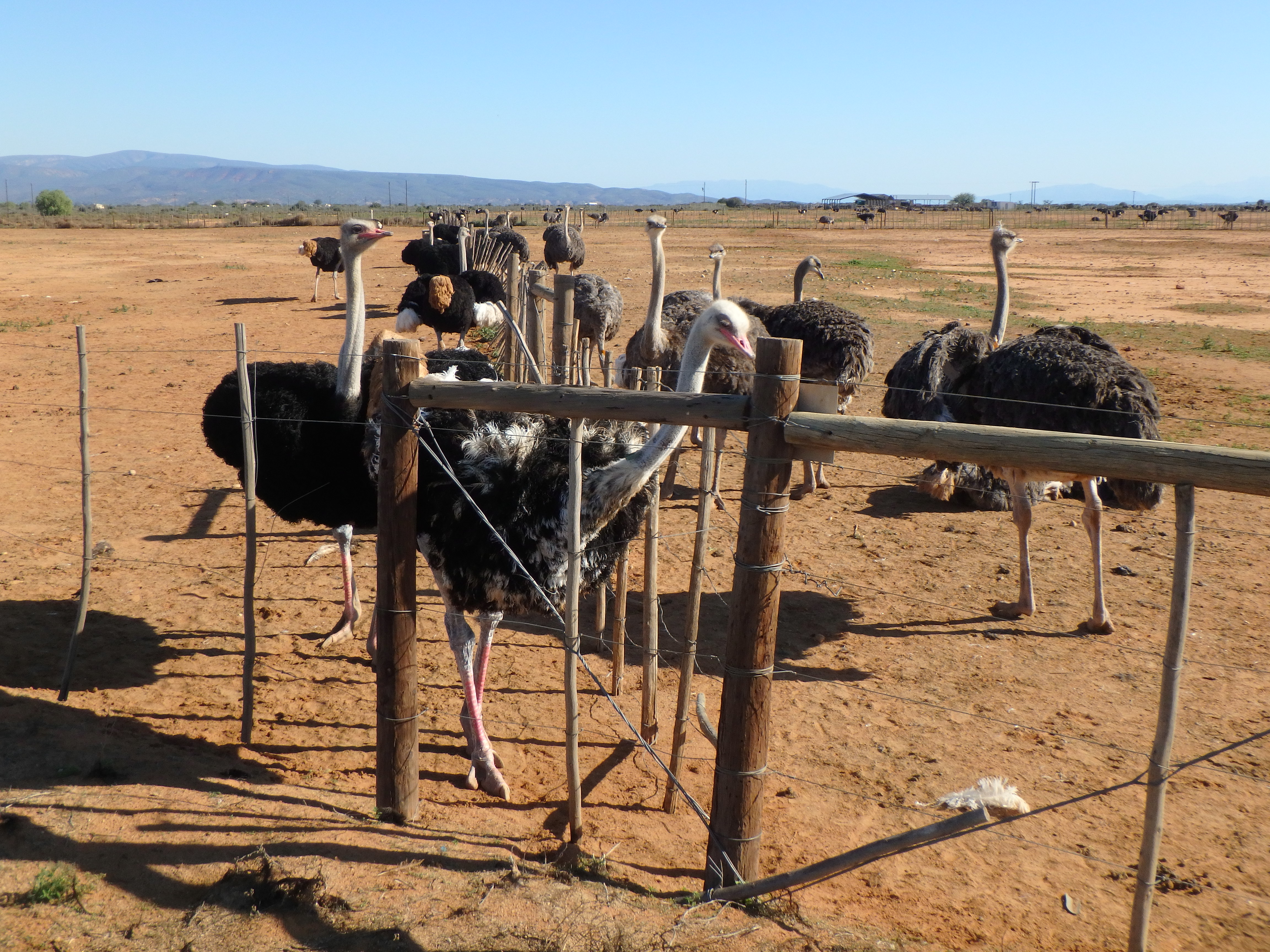
They're actually quite friendly and will come right up to you.

Oudtshoorn is the first really nice place we’ve seen here. It has trees and finally it feels like we are out of the desert. Lovely old houses on large properties – it reminds me of some prosperous upstate New York towns, but with different details: the houses here are built of sandstone, and their ample wraparound porches have cast-iron filigree, and the lovely gardens surrounding them are filled with tropical plants. The fine 19th century houses and stout stone-built banks downtown are apparently the queer result of European millinery fashions, for there were several decades when women’s hats simply had to have ostrich feathers. Oudtshoorn had the ostrich farms to provide the feathers. The World War ended the trade, and the fashion never returned, but the comfortable homes are still all here, and the town is now a resort of sorts.

We continue to be amazed at the power of the American dollar against the rand – here we can eat in the best restaurants in town, have wine and dessert and steak (or whatever we wish), leave a twice- or thrice-normal tip, and never spend as much as thirty dollars. And there’s never anyone around. The backpackers – the local term for hostel – where we’re staying is empty, as were the restaurants.

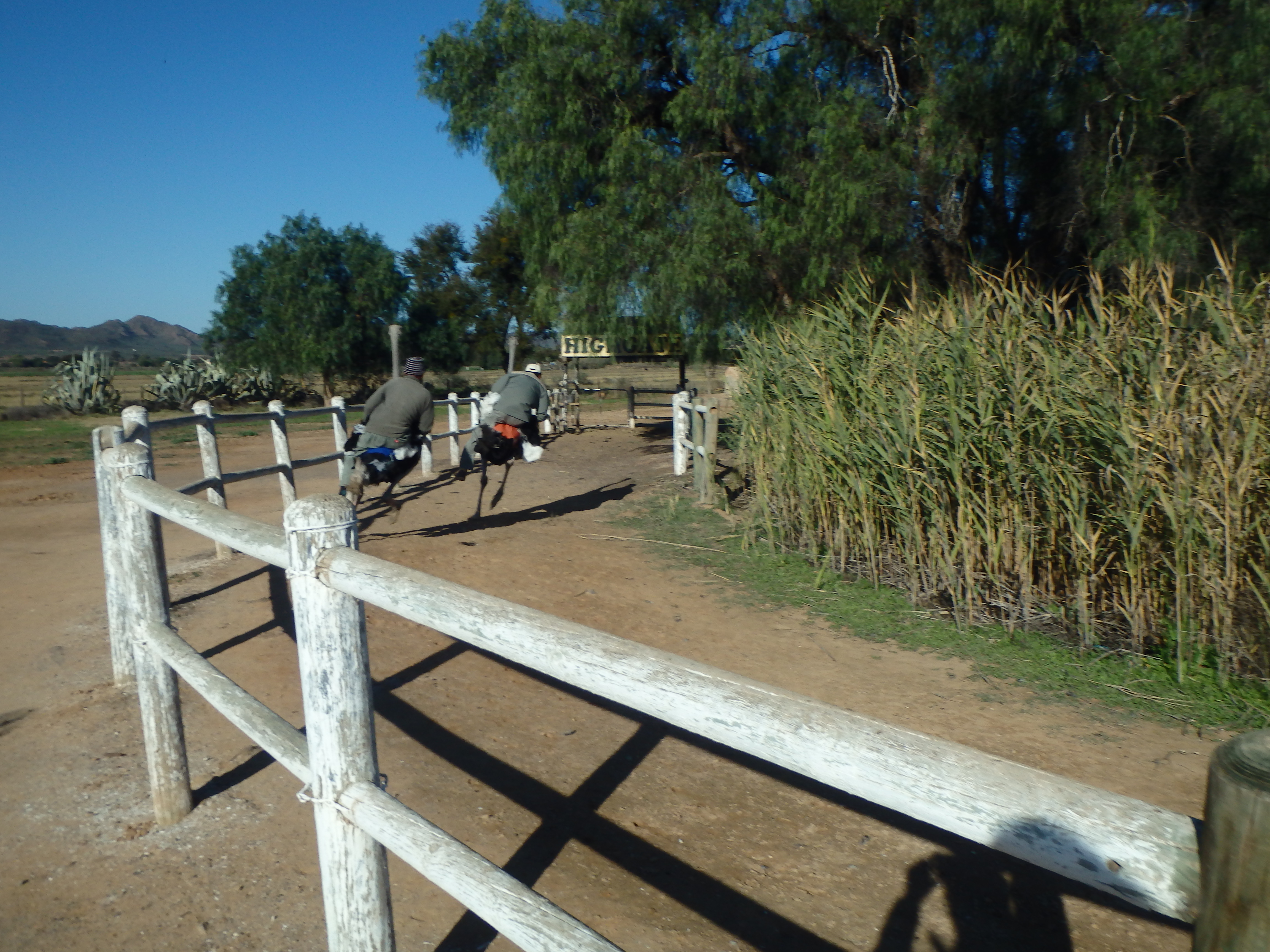
Yup, they're racing ostriches.

We went to an ostrich farm just before we left town. It too was empty – we were the only people who showed up for a tour on a Sunday of beautiful weather. The ostrich farm was gorgeously situated, in the midst of farms and vineyards under the brow of gorgeous mountains.  We got a tour of the whole ostrich industry: raising the birds for meat, making featherdusters, selling the eggs and eggshells, using ostrich leather, etc. We fed the birds, stood on the eggs (which are almost unbreakable), etc. but the real highlight was watching two men hop on ostriches and race them down a course. The ostriches apparently cannot be steered by any means when they are ridden, so the track has to be long and narrow, but to see these two men holding on to the ostriches for dear life while they took off at thirty miles an hour was quite a sight. It was all over too fast for good pictures, but I have to say I’m glad it exists in the world. I would take a much greater interest in the Triple Crown if people were riding ostriches. There should be a palio for ostriches as well as for horses.

Our guide, Danian, was fabulous but behind it all there lurked a sense that he was wasting away giving ostrich tours. He was intelligent, articulate, and sensitive. He said he was one of eight finalists for the job, and they were given a test and heavily scrutinized, and he got the job. He was glad to have any job at all. But in winter there was little money, because there were so few tourists.

Across the Great Karoo.

23-Jun-15


June 20th.

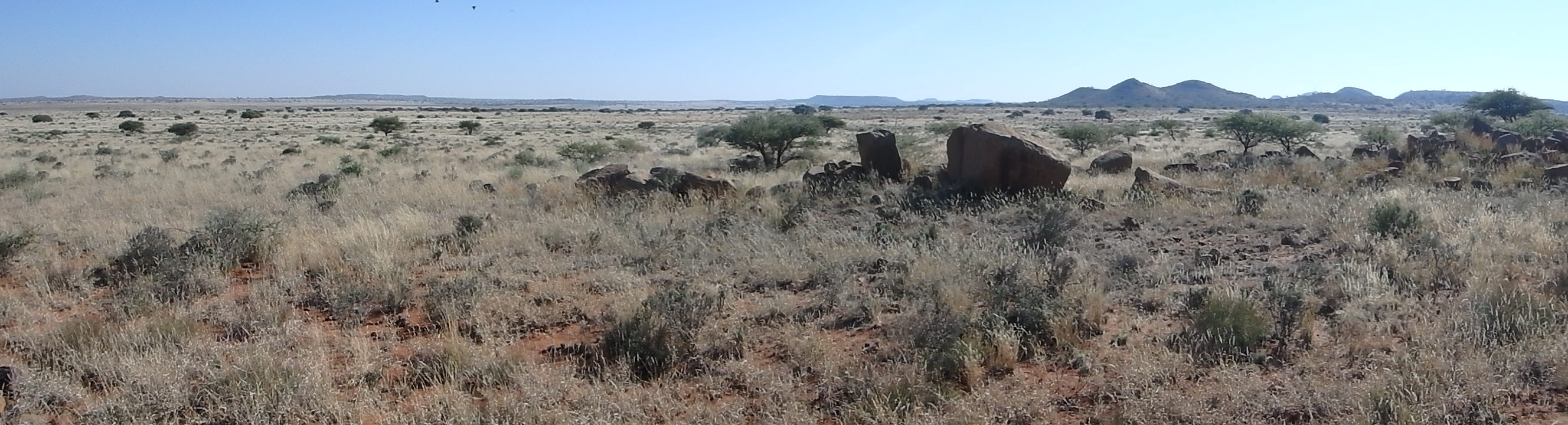
Almost everyone we spoke with thought it was a bit crazy to drive across the Great Karoo, but we assured them we Americans like open spaces. I think for people from other countries, it seems like a long drive. To us it was an adventure – across the entire country, blasting through the desert, finding A-Ha’s “Take On Me” while flipping around the radio, talking about everything we’d seen so far, getting used to driving on the left side of the road, working through a big bag of fresh oranges I had picked up at a market on the way, marvelling that we were on the other side of the ocean, utterly free, going as we pleased. We saw some ostriches on the side of the road and I chased after them to make them run – Catherine was terrified that one would kick me in the chest and it would be the death of me. But they ran away. We saw a lot of cows too and sheep, but mostly it was just lightly rolling semidesert, like eastern Wyoming or Colorado. We were still driving as night fell, and for the last stretch it was a bit terrifying: the darkness was utter and complete, and the road utterly unknown ahead of us. There were no other cars: if someone blocked the road there would be no law to help us out there in the desert night. But there was no one out there at all, and when we stopped to get out, above us was a canopy of completely unfamiliar white stars on a black sky, the Milky Way looking thicker and more irregular than it does up north, and two little wisps of what looked like motionless, undissolving vapor – the Large and Small Magellanic Clouds, our two companion galaxies. Directly overhead was the Southern Cross, the only part of all this that was familiar. We are gasoline junkies, we Americans, I will confess, but who can resist the intoxication of it all?

We passed through a fabulous mountain pass in our descent off the high plain, from the Great Karoo into the Little Karoo.  Now at Oudtshoorn, the self-proclaimed “ostrich capital of the world.”  You can’t make this stuff up.

The Latinosphere.

23-Jun-15

June 20th.

A detail I forgot, from the Latinosphere, the small world we Latinists live in: the day after our arrival, before going to Pilanesberg, I met the Classicists in Potchefstroom. We had lunch together, and in the afternoon we all attended a lecture via Skype, from San Antonio, Texas. The lecture was given by Bill Short – Brevis – a friend from Rome. He was one of the “simii Reginaldianii,” the Reginaldus-monkeys, who sat in the front row of all of Reginaldus’s classes and got very, very good at Latin. I hadn’t seen him since leaving Rome in 2000. His lecture, about the way the Romans conceived of the word “truth” – the dominant metaphor of it is as something one proceeds towards, like a pilgrim to a shrine, and on which journey one can get lost – showed signs of the Reginaldian method – I’m sure many of his quotes for the usage of the word were directly from Lewis and Short.  By knowing the way the Romans used their words, you can understand the metaphors underlying their thought, which offer interesting ways of understanding life and experience itself.

Another Latinosphere moment: there is a visiting lecturer here from Brazil. He knew one of Catherine’s friends who was studying at the University of Kentucky, also from Brazil.  He was returning to Brazil shortly, and she asked him to salute her friend.

The Big Hole.

22-Jun-15

June 20th.

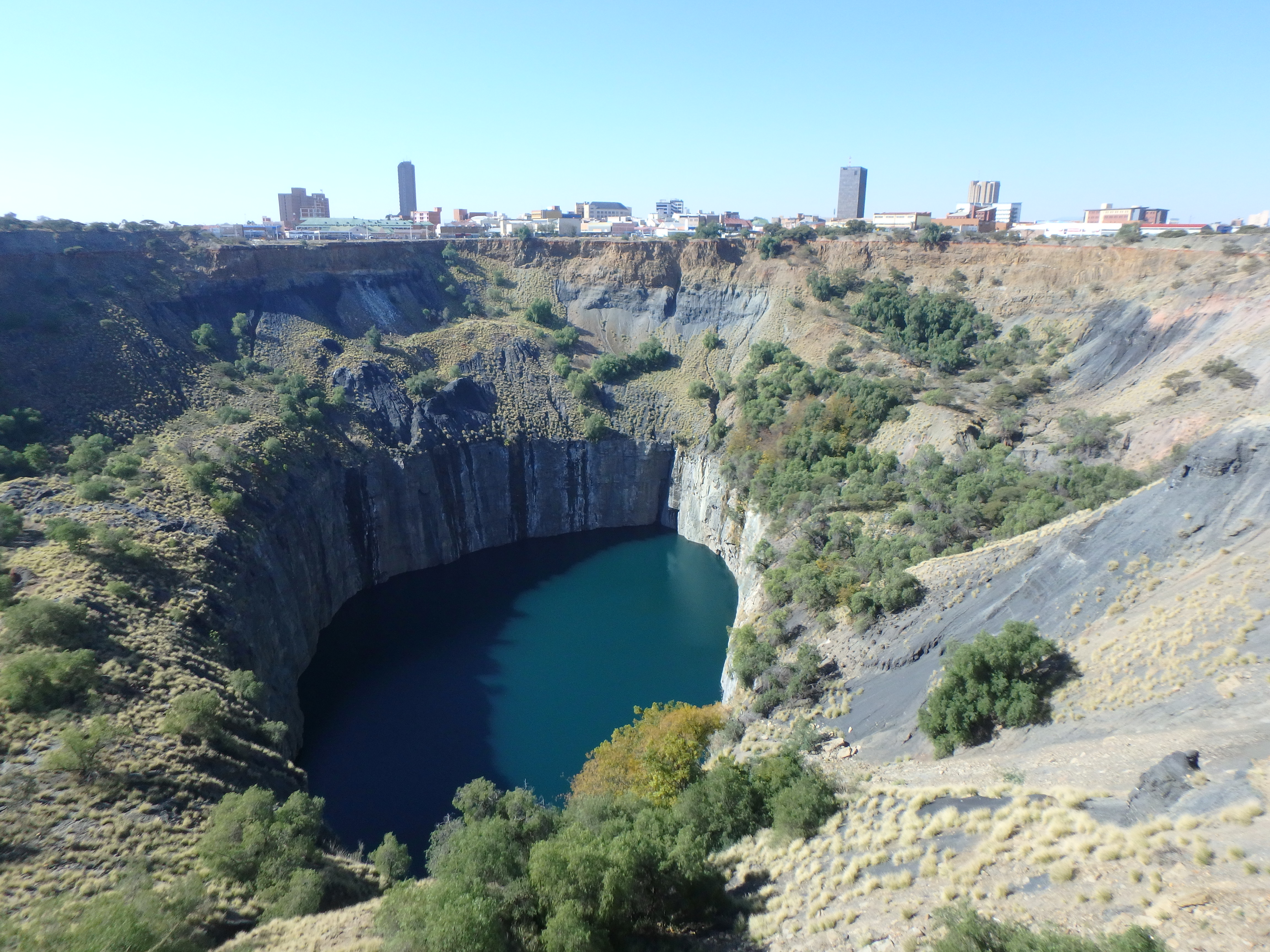
This took some shoveling.

We visited the Big Hole before leaving Kimberley. The Big Hole is a massive crater at the edge of Kimberley’s center: it looks so large as to be a natural feature, but it was excavated entirely by hand, through bedrock. The open pit is more than 600 feet deep, and via underground shafts the entire pipe of Kimberlite – the vertical fissure of diamond-bearing ore – was removed to a depth of more than three thousand feet. Twenty-two-and-a-half million tons of rock were removed from the mine, which produced fourteen-and-a-half million carats of diamonds. It is warm here in the dead of winter, and in summer the place must have been a hellhole. Major mining operations were finished in 1914.

There is now a little tourist village adjacent to the hole, with a kind of Wild West theme. And I suppose it was in many ways like the Wild West, with a special racist lean.

Cape Gooseberries.

22-Jun-15

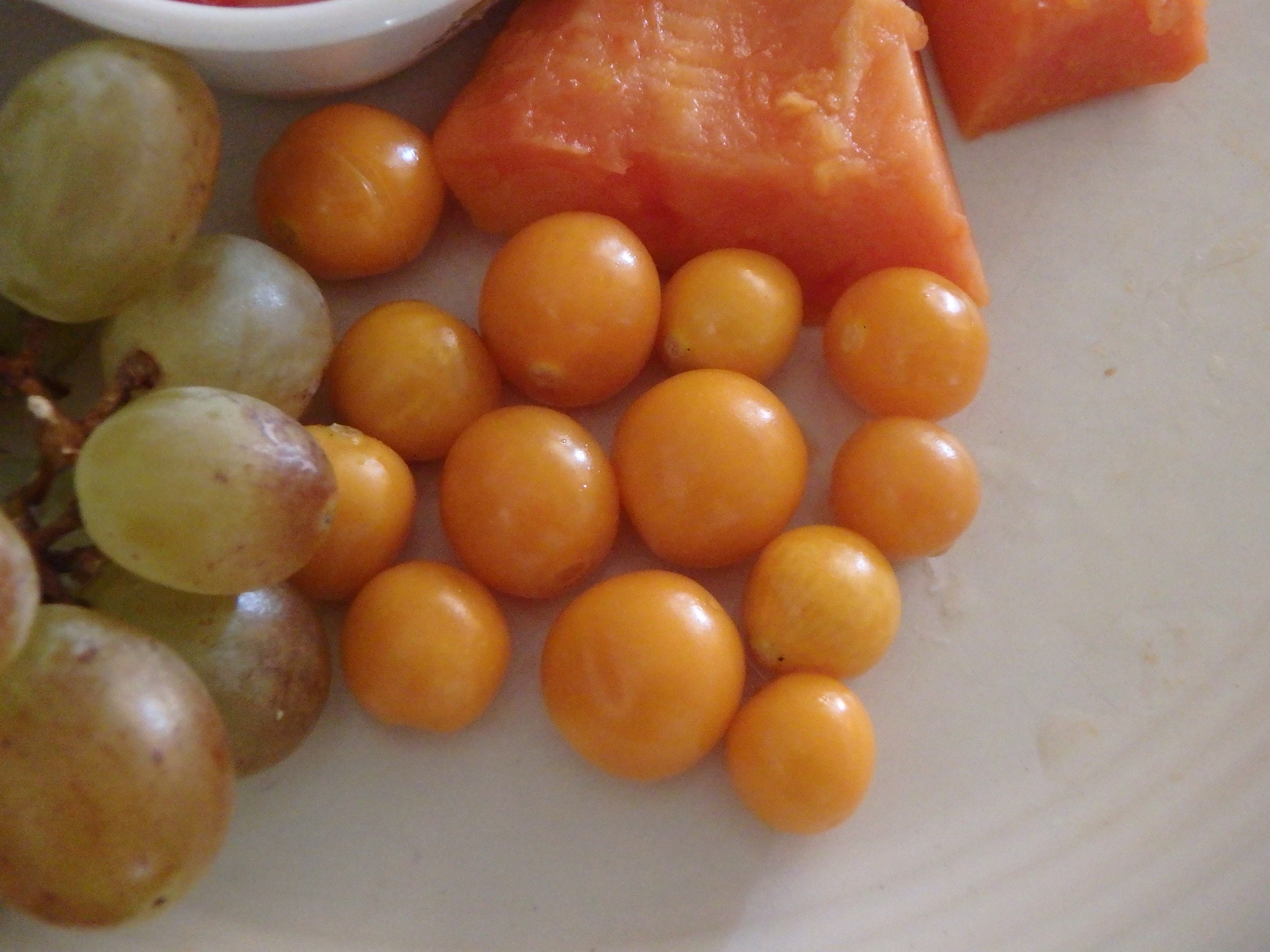
That's Physalis peruviana to you.

For breakfast here several times I have had what are called “Cape Gooseberries” – which, while I am not an expert on gooseberries, I was fairly sure were not gooseberries.  They looked solanaceous to me – like ground cherries, and so I presumed they were from the New World, though their association with the Cape seemed off in that context.  They are, in fact, solanaceous, and hence related to tomatoes and nightshade.  They are in the same genus as ground cherries (Physalis pruinosa), which I am growing in my garden this year, but are a different species – the “Cape gooseberries” are Physalis peruviana.  They apparently need a long growing season.  They produce very well here apparently, and are very tasty.

At Cecil Rhodes’ Club in Kimberley.

22-Jun-15

June 19th.

Got up late this morning, after breaking the fever and soaking through my clothes. Feeling much better, in general. Got a “map” – really a kind of travel guide to South Africa with decent maps, as I can’t even be sure that maps, say of the various provinces of the country, are actually commercially available. The book we got is hardly great but will have to do. South Africa is odd in this way: it will seem utterly modern and civilized in one sense – water-systems are excellent here, for instance, and there are malls which look exactly like ours – but then some other thing we might consider normal will just be absent here. The central heating which is lacking at the house where we are staying is apparently lacking everywhere: I met a woman from Greece who is teaching at the university here, just arriving two weeks ago. She was a bit scandalized that there was no heat anywhere – it was cold, and there was really nowhere to go to warm up. She would have to wait another month for the brief winter to end.

We drove across the desert – I suppose not technically a desert, rather a semiarid plateau – which is featureless and bare. It looks like many of the blander places in the American West. The physiological demands that aridity places on plants are so extreme that the vegetation of these places seems to bear a general resemblance: brown grasses, gray-green twiggy shrubs, and occasional small thorny trees seem to be the template. Almost all the land on either side of the highway was fenced, and I presume is used for cattle: we saw cows but also camels and ostriches.
Here in Kimberley now, and staying at the Kimberley Club, the old imperial hub of the country, which is a bit fallen from grace, being listed as a budget accommodation option for the likes of us. Cecil Rhodes was one of the founding members and the establishment is littered with memorabilia of the Boer War. This is the border today of the Cape Province, then the limit of the British sphere of influence. Dutch Afrikaaners established their own republics beyond this limit in the 19th century to get away from British control – the Orange Free State and the Transvaal Republic – and only later, in the 20th century, were they brought under British sovereignty, largely because, much to their enrichment and grief, great veins of gold were found in their republics.
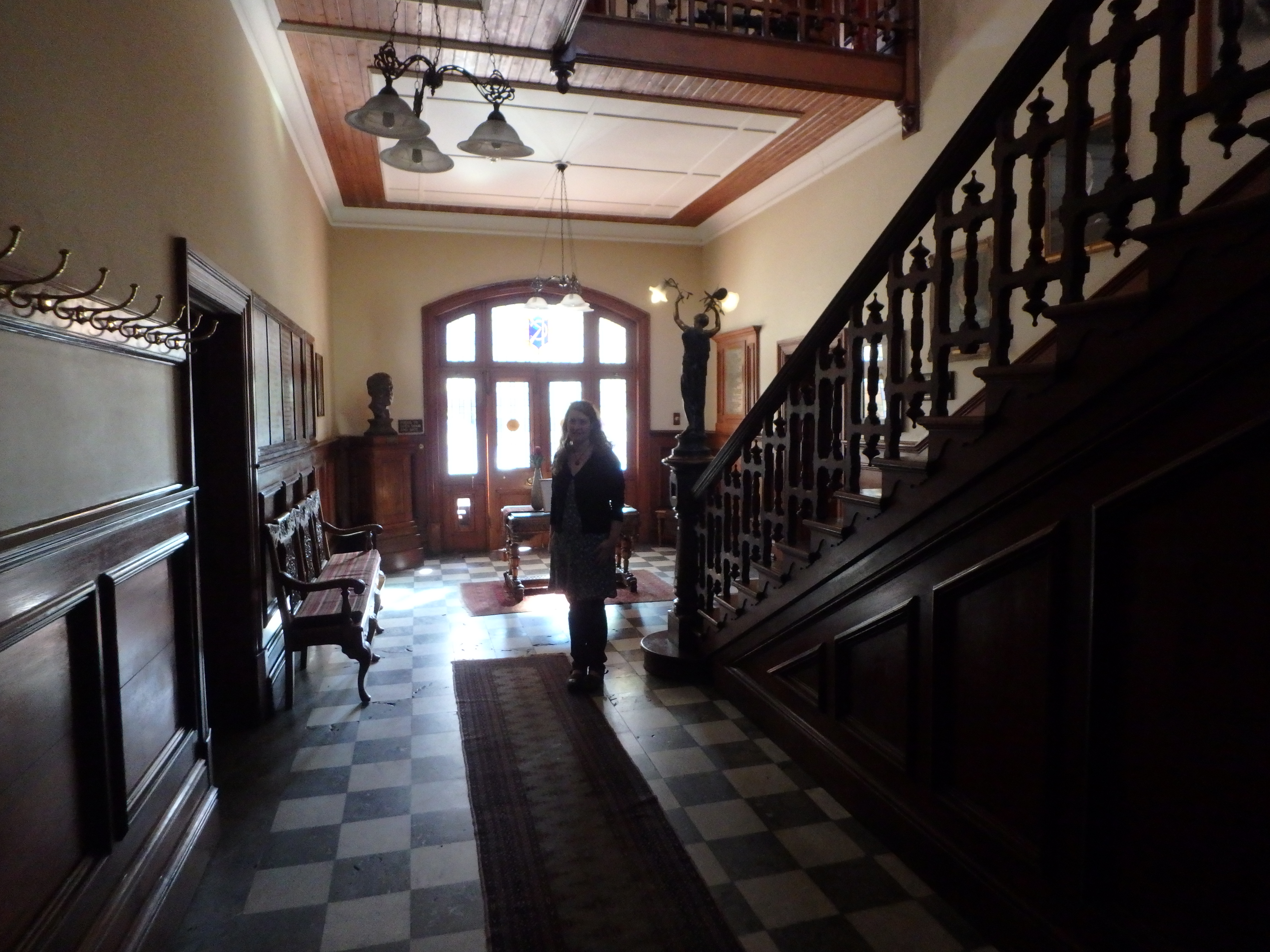
In the Kimberley Club.

The club is refreshing to my eyes: South Africa is not a timber-producing country, and wood is only rarely found in interiors (and almost never used on exteriors). But this club is all oak panelling and mahogany details. There is nothing really exquisite – Mark Twain probably visited five hundred clubs of this architectural quality over the course of his travels – but everything has that solid, late 19th century comfort and polish to it. It ages beautifully too. We took our dinner in the dining room here, which was excellent and for us very cheap – a glass of wine with the meal was $1.50.

The town itself feels quite past its glory: even the Kimberley Club has closed off its main entrance, for “security reasons,” and is accessed only by its back door, which is closer to a parking lot. The 19th century buildings around the club have been mostly ripped down, and replaced by ugly modernist things, without ornament and without beauty.

I am a slave to beauty in the end. I mostly forgive Henry Frick because of the museum he left us; Justinian is acceptable to me as an emperor because of Hagia Sophia; Omar I take because of his mosque. The 19th century imperialism left us fine things, which have a chance now of outlasting the misdeeds. But the wealth created in Kimberley in the 20th century – mining still goes on here – has not paid us sufficiently in beauty, and for this I blame it. As much as we can root into the injustices behind the great works of art, in the end there is something right about something beautiful, which justifies itself. I imagine the Taj Mahal would never have been certified Fair Trade, but it makes no difference anymore.

But Rhodes is still a controversial figure here – his statue at Cape Town University was recently taken down due to protests. All I can say about the protests is that I hope they put a better statue of a better man in his place. Of Rhodes we can say that at least he threw a few billion to conscience, and did it the honor of considering it worth the buying off. And he had his hand in things of beauty, and left them behind him for others to enjoy. Elsewise I don’t think there’s much there.  Politically, his legacy is being taken as part of the larger question, which is, whether the colonial project in Africa will endure, and in what form.  In terms of cultural prestige, it probably is stronger than ever – most people on earth would want their children to be Rhodes Scholars, which is more or less to be an ambassador to the colonial project – but politically, we will see what happens.  The locked front door felt like a symbol: there was a siege mentality, and a sense that places like the Kimberley Club, with oak panelled dining rooms and mahogany banisters, were not guaranteed a place on the continent.

But Rhodes certainly is guaranteed a place in African history.  He turned De Beers’ farm into DeBeers, a company virtually synonymous with engagements in the western world.  To this day mining is 60% of South Africa’s exports.  And after driving across the eastern part of the interior of South Africa to get here, I must say, this is an area well-made for the extraction industry. Dry and barren – the sort of place where you take what you can get and hope to retire to some other, nicer place.
The Rains Down in Africa.

22-Jun-15

June 19th.

Driving yesterday outside Pilanesberg National Park, we switched radio stations, and what was on but Toto’s Africa. We just looked at each other. I guess it does make sense that that song gets played here.