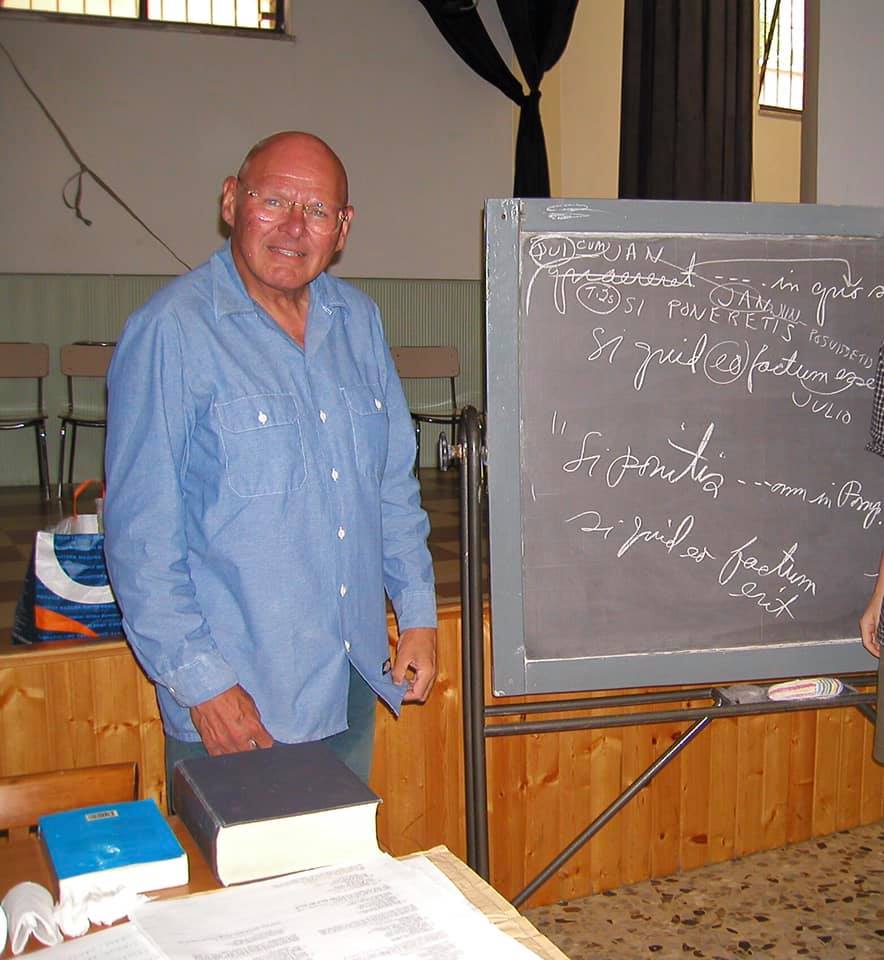
Reginald Foster in his classroom in 2001. Te amamus, dulcis magister.
Reginald Foster in his classroom in 2001. Te amamus, dulcis magister.
I wrote about the career of Rembert Weakland in a piece published today at First Things. We had to cut some of Weakland’s words in the interest of space, but I wanted to offer to readers some fuller comments of his. He claims that the Church is really at fault for his use of diocesan money to pay off a former lover: he wasn’t paid enough.
There was another way I felt hemmed in, held hostage by the Church: it went back to another of my monastic vows. As a monk, I had found my vow of poverty liberating. My personal needs were taken care of by the monastery in a way that was more than adequate. But when at the age of fifty I became a bishop that vow was suspended by church law…. My salary was a thousand dollars a month. Out of that I had to take care of clothing, toiletries, books, music, vacations, and contributions to charities and other causes that I wanted to support…. By the time the lawsuit came I was receiving around $3,000 a month. I had managed to put a minimum amount in an IRA, but never had monies sufficient for purchasing anything substantial of my own…. The fact was that as a bishop there was no way for me to take care of an extraordinary personal need. I had to fall back on my dependency on the Church.
There you have it – he Sant Just Desvern had to raid the collection basket because he had no money to pay for his personal “needs,” like burning through half a million dollars to buy his former lover’s silence.
In 1957, when Reginald Foster was sixteen years of age and a student at the Carmelite Seminary in Peterborough, New Hampshire, he was an avid reader of Latinitas, the tantum-Latine magazine produced in the halls of the Vatican. He had learned of the existence of this magazine from his Latin teacher, Conrad Fliess, who had been a subscriber since 1954, the second year of the magazine’s existence. Reading through the April 1957 issue gave the two Latin lovers an electric thrill: Peterborough, New Hampshire, had made it into the magazine! A letter which Fliess had written to Carolus Egger, who handled correspondence for the magazine (and was second-in-command handling Latin correspondence for Pope Pius XII himself), had resulted in a short article about the proper Latin term for Peterborough, New Hampshire. I think Egger did the subject full justice, and the short article he wrote on the question should be reproduced in full:
QVOMODO LATINE REDDATUR VVLGARE NOMEN “PETERBOROUGH”
Conradus Fliess, sacerdos, linguae Latinae doctor in oppido quod “Peterborough” vulgo appellatur et in finibus Foederatarum Americae Septemtrionalis Civitatum positum est, quaesivit quomodo Latine diceretur nomen loci eiusdem.
Cuius precibus libenter obsecundanti commemorandum mihi videtur de cognomini urbe Brittaniae (in regione Northantoniensi sita), quae originem traxit a pervetere coenobio sodalium Benedictinorum, anno DCLVI p. Ch. n., atque adeo Saxonum aetate, condito. Est autem “Peterborough” duobus verbis effectum: “Peter,” quo, ut liquet, Petrus significatur, et “borough,” quod est priscum vocabulum Anglorum Saxonumque atque idem quod Germanicum “burg” (Gothicum “baurgs”), cuius vis est castrum seu vicus circummunitus.
Sciendum quoque est in linguam Latinam senescentis Romanorum aetatis receptum esse verbum burgus, i (cf. VEGET. Milit. IV.10; OROS. Hist. VII, 32,12). Quam vocem viri in enodandis originibus periti e duplici fonte permanasse asseverant: e Graeco et Germanico. In Graecorum enim sermone occurrit purgos, hoc est turris ad defensionem apta, Germani autem appellant locum munimentis conclusum “burg,” quemadmodum supra dictum est.
Cum vero urbs Britannica “Peterborough,” e cuius nomine oppidum illud Americanum nuncupatum esse conici licet, in litterarum monumentis media aetate Latine conscriptis vocetur Burgus Sancti Petri, nihil impedit quominus illi oppido idem hoc nomen imponatur.
Latinius etiam nomen, si libet, est in procinctu; dixerim enim Castrum Sancti Petri vel Castrum Petrianum, quandoquidem Romani verbo castri usi sunt ad plura significanda loca; cf. Castrum Album in Hispania Tarraconensi, LIV. XXIV, 41; Castrum Inui in Latio prope Ardeam, VERG. Aen. VI, 774; Castrum Novum in Piceno (hodie audit “Giulianova”), PLIN. III, 5,6 (44), e. a.
Ita me satisfecisse puto Conrado praeceptori.
CAROLVS EGGER
I took an overnight trip to Ithaca, NY to get at some of the books there – NYC seems to be shut down for independent research. I was reading through as much as I could of Latinitas magazine, a Latin-only periodical published by the Vatican beginning in 1953 until Benedict XVI shut it down. Among the many delightful things I discovered were ads, taken out by Italian companies, in LATIN!

Olivetti ad in Latin.
Olivetti had two different ads in different magazines, but the banks were the most reliable advertisers. A Swiss bank put in some ads too.
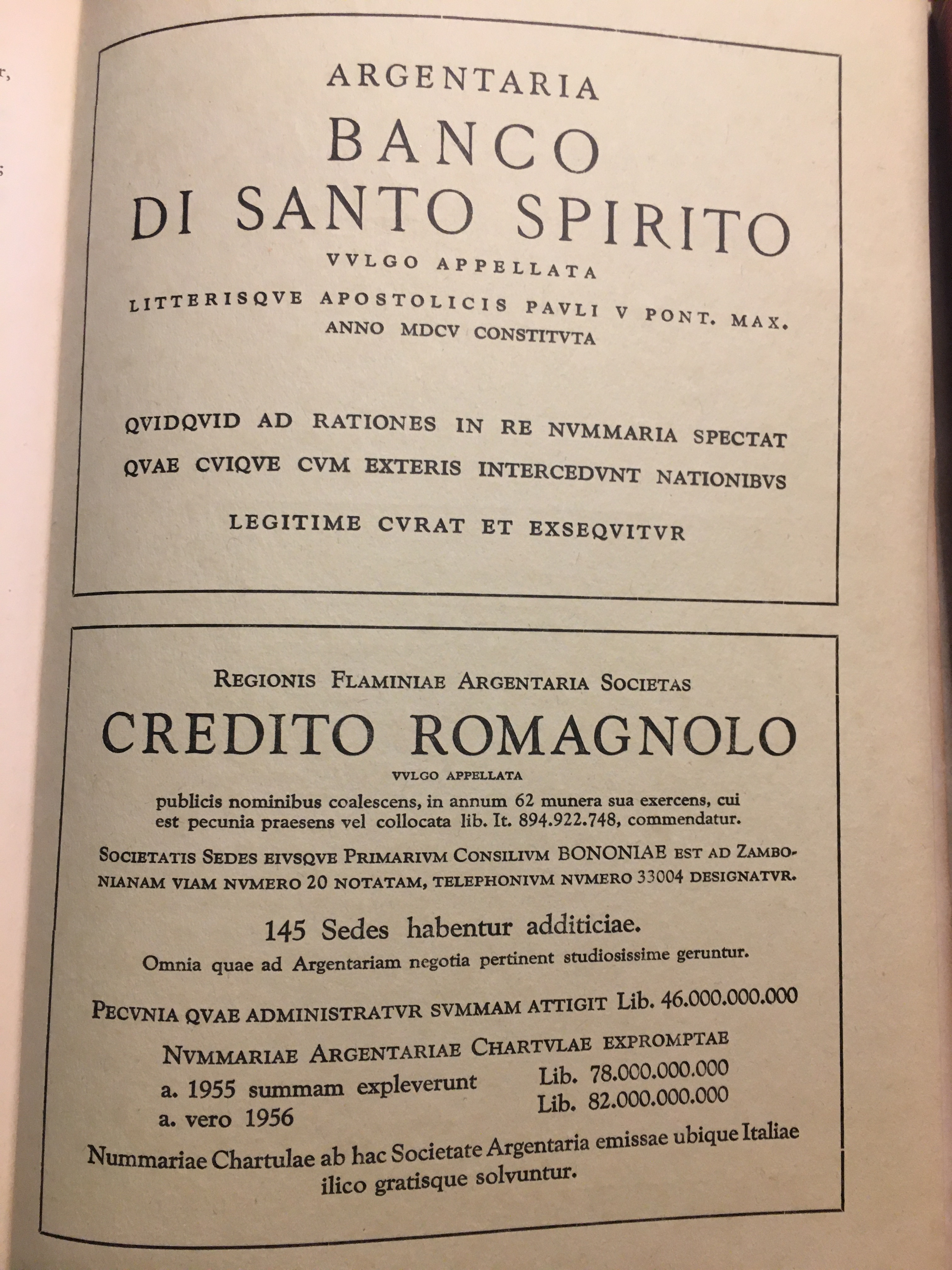
Banks.

“Some people here [at the American Academy in Rome] are snobbish about this mess but it belongs to anyone who can dig it.” – Ralph Ellison
[Scriptio haec aureo est laudis insigni honestata in Certamine Vaticano XIII]
“Octo tantummodo praeterierunt dies – dumtaxat hebdomas una – longa ea quidem; attamen haec hebdomas orbis nostri praeclarissima fuit a condita rerum natura, quoniam per hos dies quae contigerunt mundum amplificaverunt in immensum.”
Ita elate et ample locutus Foederatarum Civitatum Americae Septentrionalis Praeses, Richardus Nixon, incolumes salvere coram iussit in terris caeli viatores domitoresque lunae Americanos: Niallum Armstrong, Eduinum Aldrin, Michaelem Collins – celeberrimo ex itinere paulo ante reversos. Admirabile quidem facinus atque omnium laude, praedicatione litteris monumentisque decorandum! Horum ideo generis humani emissariorum cum facta deinceps in ore vulgi et communibus diu proverbiis versarentur, summi existimabam ad ornamentum interesse ac dignitatem studiorum humanitatis res tam illustres tamque gloriosas Latinis etiam litteris contineri. Quocirca hoc ego locupleti responsitare constitui sermone Marco Tullio percontanti:
Quae molitio, quae ferramenta, qui vectes, quae machinae, qui ministri tanti muneris fuerunt? [M.T. Cic., De Nat Deorum, Lib 1. c. 8, 19]
CAPVT PRIVS
VEHICVLVM
“Sine pennis volare, inquit Synecrastus ille, hau facilest.”
Verumtamen tres eos speculatores orbis volantes certe perniciter adventavisse novimus in “siderum reginam bicornem,” nulla usos pinnigera rate. Rursus quoque accedit, quod procul saltem ipsi conspicari videbamur tam in profectione eorum quam reliqua in navigatione expeditissimam quandam prolabendi facultatem. Quidquid vero id est, ad extremum assentiri denique oportebit comico Romano hoc nihil impeditus volatu fuisse. Et sane, si quaerimus, quam periculosum reapse vel saeculi etiam vicesimi mortalibus fuerit et asperum, ne dicam longum et difficile, negotium hisce excedere terris perque intermundia vasta remigio volitare nullo alarum, nimio plus quam satis persuadet solummodo istud summe post homines natos incredibili mole atque apparatu tortuosissimo vehiculum caeleste: SATVRNVS QVINTVS et APOLLO UNDECIMVS, quo uno emetiri feliciter valuerunt tanti aetherii longitudinem spatii, et quod mihi argumentum suppeditat ad disserendum pergratum lingua Latina perque iucundum.
Quemadmodum igitur ille apud Accium pastor, qui navem numquam ante vidisset, ut procul divinum et novum vehiculum Argonautarum e monte spexit… primo aspectu inanimum quiddam sensuque vacuum se putat cernere, post autem signis certioribus quale sit id de quo dubitaverat incipit suspicari [M.T. Cic., De Nat. Deorum, Lib. II, c.35, 89-90], ita nunc omnino penetralia nosmet gestimus et viscera palpitantia huius artium humanarum monstri reserare admirantes. Quare agedum! Si obtutu oculorum portentuosam illam contempleris “struem,” uti fabricatores Americani appellant, ingentis chalybei asseris instar, – quae non minus pendit XXIX centena milia pondo bilibrarum altitudinemque pedum CCCLX ostendit – geminos eius confestim internoscas articulos: superiorem, modica cuius amplitudo celebratissimam ilico prodit sideream lintrem; inferiorem autem, cuius partibus quattuor altero longioris sexagintaque duabus gravioris munus statuitur reconditis intus viribus scapham extrudere in vacua mundi. Eorum nimirum uterque plura concludit membra, quae universa prius structurae ordine adumbrata deinde singillatim perscribemus:
AETHERIVM NAVIGIVM = APOLLO UNDECIMVS:
8. Machinatio effugii
7. Gubernaculi conclave, “Columbia” nuncupatum.
[navis princeps] <
6. Cylindrus variae utilitatis.
[speculatoria navicula] 5. Phaselus lunaris, cui “Aquila” nomen.
MISSILE PROPELLENS = SATVRNVS QVINTVS:
4. Instrumentorum complexio.
3. Tertia pars unius machinamenti-J2
2. Quinque instructus machinis – J2
1. Membrum infimum machinamentis-F1 quinque actum.
8. = Hanc tractoriam praefigi idcirco cacumini turriculam placuit quae, si primis ascensus momentis propellens missile vitiatum fuisset aut praestituto a tramite abstractum, revelleret extemplo astronautarum conclave periclitante de vehiculo altiusque efferens longe ab discrimine in mare dimitteret.
7. = Specula omneque velut luculenti navigii cerebrum haec pergula singularis agnoscitur duodecim alta pedes formaque cuneata, quo exiens in caeli templa acutius auras diffindat rediens vicissim sufflaminetur citius aethere ex parte obtusa. Qua in habitatione undique obsignata ac scite exornata maximam cosmonautici industrie traducunt itineris sui partem ibidemque magnificentissima praesto habent cymbae moderandae armamenta lautosque vitae commeatus: hac mirifice nictant scrinia micantibus passim machinularum computantium malleolis; illac continenter percolatur incolis et redintegratus spiritus; automataria impendent aliunde gubernacula; subter susurrat apparatissima radiophonica necnon televisifica statio; alibi in angulo pilae Voltianae una cum frigidae calidaeque receptaculis asservantur; abditis hinc loculamentis inhaerent ad cuiusque vectoris munditiam corporis necessaria; penaria illinc cellula escas profundit pares subtili palato. In cubiculo autem medio culcitae tenduntur, in quibus profiscentes recumbunt redeuntesque peregrinatores, quaeque interea coram instrumentis adversis ingeniose complicantur in subsellia. Hunc tandem inter mirum instructum ornatumque funiculi sucini intertexuntur XXIV milia passuum longi. Verum non quippiam cuncta ista prohibent quin pedes cubici supersint quinquaginta habitabilis percommode loci!
6. = Hic conclave subsequitur agglutinatus usque ad iter extremum cuius praecipue “machinamentum fatale” bis summo cum capitis periculo imperat navigio toti, dum retardando adigit illud in orbitam lunae et iterum ex ea ereptum ad Tellurem versus abigit accelerando. Quod eius reliquum est spatii aliis destinatur commoditatibus: laticis igniferi dividiculis, moderaminibus inclinationis et situs, ductibus electricis.
5. = En memorabilis specieque inhabilis currus, quo exploratores primaria sensim a navi abscendentes leni delabuntur motu in lunam. Ut autem valeant postremo recedere incolumes inde, phaselus hic duobus contexitur membris: quorum inferius tamquam fundamentum, enormis araneae consimile quattuor suffultum cruribus, paene integrum potenti et gubernabili occupatur machinamento, quod praecipitem casum varie temperans huc illuc aliquamdiu volitari patitur inque tutum molliter descendi; eius insuper occulunt cavernae postmodum quae in glaeba lunari defigentur technicorum experimenta. Superior vero pars tabernaculum perangustum efficit, in quo viatores duo consistentes vigilanter regunt omnem naviculam quodque eodem exstruitur apparatu quo principalis gubernandi officina, attamen multo contractiore; ibi interquiescunt quoque viri et indutoria caelestia, calceamenta, digitabula componunt. Ipsa tandem ab inferiore seiuncta pauxillulus ecce lenunculus fit excursores revehens propriis viribus ad principem navem.
4. = Cogitandi taberna, quam dixeris, hic reperitur missilis totius propellentis, quae temporum locorumque intervalla tantisper metiatur oportet, angulum celeritatemque accurate moduletur, reminiscatur acta agendaque suadeat, donec navigium aetherium in circuitum prospere iniciatur terrarum.
3. = Supremum istud membrum, potentiam gignens ad centum milia bilibrarum, praeterquam quod novissimum subministrat ictum quo actuarius APOLLO XI in orbitam immittitur temporariam, denuo accensum post binas circuitiones valide eundem protrudit in viam intercaelestem ad lunam.
2. = Novem flagrans momenta articulus iste secundus procurrendi velocitatem usque adauget, quoad navis ad CLXXXIII milia sublevetur milium passum a sphaera terrestri.
1. = Infimae valentissimaeque partis elicere ignes revera Aetneos est, quibus aedificatio “struis” immensa humo prodigiose tollatur primisque temporis punctis per aera crassiorem vibretur.
Hoc propterea divinum habeto luninautarum vehiculum, de quo iamiamque evolaturo infiniti spectatores tacita quisque cogitatione obstupefacti mussabant:
Horrendum et dictu video mirabile monstrum. [VERG. Aen.3.v.26]
Alia multa praetereo eaque praeclara; ad laudatissimum enim huius saeculi eventum festinat oratio: ITER APOLLINIS VNDECIMI IPSVM!
CAPVT POSTERIVS
VECTVRA
Sub “itinere Apollinis Vndecimi” miraculum triplex significatum delitescit:
A] CXCV horis, XVIII momentis, XXI temporis punctis homines tres per caerula mundi decies centena quingenta octoginta septem milia confecisse milium passuum, nullo interpellatos machinarum vitio nullo intertrimento valetudinis, frequentesque praetervectos periculosissimi infestissimique scopulos itineris, quod esset unquam humanitus institutum;
B] binos eorum summam attigisse lunam, mortalium primos, ibidem XXII horas et XXII momenta bellissime commoratos, devolavisse feliciter illinc;
C] pererravisse similiter principes globum caelestem alienum, solique eius multiformi delibato specimine sumptuosa ordinavisse selenologorum utensilia.
At ne incepti huius universa prodigia, quae sunt ferme innumerabilia, consecter, summa sequar fastigia rerum [P.V. MAR, Aen, Lib.1.v.342], Americanum denotans tempus.
1. (XVII KAL. AUG.) [9:32]
E suggestu undequadragesimo astroportus Kennedei procerissimum missile Saturnus Quintus formiduloso varii ignis vomitu, exsurdante fremitu machinamentorum, falae ac munitionum fragore caelique propemodum illabentis ipsius tonitru, in aperta serena valenter sese contorquet et praefixum lunare navigium, Apollinem Vndecimum. Vix autem, absumpta infimi gradus flammivoma lympha, ille a reliquo vehiculo suapte vi secretus est inque mare praeceps relapsus, cum media missilis pars struem totam in usque celsiores regiones iaculari paulatimque in volubilem orbis ambitum deflectere contendit; quo perfuncta absolute officio exuitur iam inutilis. Inennarabili tunc pernicitate incituque accrescente novissimum membrum paulisper exardescens geminos una cum siderali cisio vectoribusque animosis circulos permetitur terrae.
2. [12:16]
Signo tempestive Houstonia dato excessui, iterum succensa interior illa machina tertia celocem aeriam vi repulsus agitans terrestri ex orbita evellit perque inane haud secus atque collineatam in destinatum sagittam Dianam versus subvehit, ut concitato navigio, cum remiges inhibuerunt, retinet tamen ipsa navis motum et cursum suum intermisso impetu pulsuque remorum [M.T. CIC, De Orat., Lib.1, c.33,153].
3. [13:48]
Vt demum navicula speculatoria, subter cylindrum utilitatis quae adhuc in summo contegitur missili:
“Columbia”
+
cylindrus ((“Aquila”)),
cum astronautarum conclavi rite coeat, navarchus Armstrong gubernacula manu exercitatissima tractans suam segregat navem omnino ab articulo illo tertio, quam aliquanto ulterius progressus axem circumvertit reversusque dein verticem ipsius copulat suprema cum cellula phaseli lunaris, quem penitus extrahit e missilis integumento. Sic tamquam retrogrediens trimembris hamaxostichos:
cylindrus
+
“Columbia”
+
“Aquila”,
iter citatus Apollo producit. Reliquiae Saturni desectae ita ab aetherio navigio vaga ad intermundia errantesque relegantur.
4. (XVI KAL. AVG.) [14:32]
Suscepti trames volatus a minutissima quadam declinatione subtiliter expediteque revocatur, dum raptim ceteroqui labentis scaphae lunipetae properatio vi nutuque tellerus gradatim remittit.
5. [19:32]
Rerum cursus eventuumque et viatorum nuntii exoptabiles aerias per undas universo hominum generi traiciuntur; ac denique, mirabile visu!, expressae coloribus interioribus navigii et inopinabilis suppellectilis eius imagines ante oculos gentium per televisificos radiorum intextus vere praesentes conspiciuntur. Nemo non terrestris stupet obtutuque haeret defixus in uno. [P.V. MAR., Aen., Lib.1.v.495]
6. (XIV KAL. AVG.) [13.26]
Lembus intermundanus optatam aliquando metam contingens – imperia Phoebes – aliped ipsam praetervolat lunam ac temporis locique praestituto vestigio ita inclusis sibi viribus curriculum praeproperum infringit, ut necessario delapsus priore ex semita in perfectum circa satellitem deducatur orbem. Tertia deinde quaque hora nautici circumvolitant sphaeram decies omnino, sollertissime dum se comparant ad excurrendum. Optico interim tubo tamquam volatili e specula diligenter crateras perlustrant et montes, planities totumque inhospitabile regnum. Mirificentissimum obiectu coloratae lucis praebent telehorasis spectaculum praeterlabentium subtus tractuum.
7. (XIII) KAL. AVG.) [13:42 – 16:17]
Tres illae horae anxietudine plenissimae terricolis fuerunt prona ad trepidationem, utpote quibus exspectatissima lunae peragratio lustratioque incoharetur, cum aerobatae [acrobatae?] duo sidereo circumclusi vestitu, Armstrong et Aldrin, per cuniculum in lunarem phaselem correperent obseratoque ostio Aquilam istam subtraherent a Columbia (cui globum circumcursanti unus praeerat Collins), inde postea, sufflaminante impetum machina Aldrin rectoris iussu, inferius pedetemptim humumque propius deveherentur, dum 16:17 ad oras ludibundi appellerent Maris Tranquillitatis. Mundus universus clamores gaudentium tollit in caelum homines primos ratem subduxisse integros in aridum lunae!
8. [22:56 – 1:11]
Fortunatiori Armstrong dudum curato bene et pranso studioque gestienti opportune a moderatoribus permittitur speculatoriae naviculae solo iam firme insistentis claustra ianuae laxare maenianumque transire anticum, unde per scalaram gradus considerate descendat. Brevi, millenis aspectantibus telehoramatis ope mortalium centenis milibus, vestigium primum in glarea figit. Iucundissima saeculorum somnia vera comprobantur! Confestim tunc inambulare assuescit in regione inexplorata, huc illuc halmaturorum ritu circumsiliens exemplaque pulveris decerpere simpulo aggrediens. Traductis naviter duodeviginti momentis comes Aldrin aeger mora et spei impatiens foras erumpit. Perpetua ambo sermocinatione omnia visenda et miranda – lapides, loci naturam, colores, ingressus facilitatem – renuntiant in terras. Gloriosi patriae vexillum ingerunt in sabulum; quod auguste sancteque venerati per telephonium colloquuntur cum Praeside Nixon. Exquisite saxis arenaque lunari in capsas conclusis, excitant multifariam experimenta technica: receptaculum venti solaris, sismographeum, machinationes. Cum tandem copia fere omnis defluxisset oxigenii, quod in sacciperiis dorsualibus una cum ceteris vitae in vacuo sustentandae apparatibus conservabatur, revenire iussi sunt exploratores in phaselum merito conquieturi profectionemque paraturi. Praeclare sic duabus horis luna primum ab hominibus inspectata contrectataque est.
9. (XII KAL. AVG.) [13:55 – 17:55]
Invitissimis denique cum recedendum est luninautis, pergula superior phaseli ultro separata a basi levis in orbitam lunae evolat, quae dum amplior usque dilatatur, recte eos reportat ad navem principem, in quam lenunculo deserto sese gaudentes recipiunt.
10. (XI KAL. AVG.) [00:56]
Procuratis igitur summa religione negotiis cunctis plagisque caeli laudabiliter percensitis, altivolans vehiculum novissimo machinae iactu vinculis Dianae laxatum terrena in domicilia versus propulsari iubetur.
11. (X KAL. AVG.) [19:03]
Non iam adeo procul solido remoti ab orbe ultimum comparent invicti praecursores in albo televisifico innumerarum mundi domorum. Spectatores intentos oraque tenentes quam lepidissime oblectant facetiis salibusque, prospectu admirabili aetheriae vastitatis, multipliciter obstupefaciente ingenii humani demonstratione. Vela autem inter haec contrahunt remosque suspendunt, dum curis sic eorum quisque solutus libere respirat lassitudinem consolans maxime illo solacio: quasi terram videre videar aliquandoque in portum ex longa navigatione esse venturus [M.T. CIC, Cato Maior, c.19.71].
12. (IX KAL. AVG.) [12:35]
Stellula veluti crinita aeris tritu candescens solum nunc gubernaculi illud conclave stato tempore gaseum orbis terrarum involucrum penetrat inauditaque velocitate pervolat angustissime petens circumscriptum Maris Magni propatulum locum. Tribus ad extremum umbellis adapertilibus tamquam lapsus moderamine usa fabulosa utique cellula cunctanter devolvitur leniterque aestuantes in fluctus, unde toto acclamante hominum genere eripiuntur Vlixis aemuli heroes adque proximam navem longam nulla mora advehuntur. Apertis bracchiis effusisque laetitiis excipit eos ipse Praeses Nixon iis alloquens honorificis vocibus aptissime quibus hanc ego sum prooemiatus scriptionem.
Restat solummodo cuique ut astronautae gratulemur:
Macte nova virtute, puer, sic itur ad astra! [P.V. MAR, Aen., Lib. IX, v.641]
Sermonisque Latini ubertate laetemur!
REGINALDVS FOSTER, O.C.D.
[From Jan. 10, 1971. By Louis B. Fleming, who wrote a column called “From Cicero’s View.”]
where can i buy antabuse online Latinist Chronicles Lunar Adventure
By Louis B. Fleming
ROME – All systems are “A-OK” and the navicula speculatoria is on the moon.
If that’s Greek to you, it’s Latin to the Rev. Reginald Thomas Foster, and there’s nothing dead about what he does with the language, either.
To prove it, Father Foster borrowed 997 words from the Living Age of Latin – that is, from 200 BC to AD 400 – and told the story of man’s first landing on the moon.
He told the story without a single concession to contemporary words of the space age, although he later admitted that there comes a time when Latin scholars sometimes are forced to compromise. Cicero simply is no help in describing communism and Maoism so he writes them communismus and Maoismus.
Father Foster, without apology, admits that he is a Latin fanatic. He has been at the subject every day for the last 17 of his 31 years.
Even more surprising than his youth is the fact that he is an American.
Doubting Roman
“This is Father Foster,” a Latin professor in Rome said, introducing his star pupil. “And to think he is an American!”
But that is one of the reasons he can be such a purist, according to Father Foster. His Latin is not corrupted by a modern Romance language, which is always a problem for Latinists whose native tongue is Italian, French or Spanish.
Of course, English has its Latin origins, too. But they are not much help to Father Foster’s adventures in keeping Latin alive.
“I had to ask myself, what shall I call the lunar module,” he explained. “Now, it would have been very simple just to convert the name into its Latin origins: modulus lunaris. But it wouldn’t have made sense. It would mean ‘little moon measure.’”
So Father Foster went back to the Golden Age of Latin.
“I came up with ‘navicula speculatoria.’ I took two words of Cicero and Caesar which literally mean ‘little reconaissance ship.’”
‘Slavery’ Module
He had the same trouble finding a name for the service module which, literally translated into “servitii modulus” would have meant “a little bit of slavery.” He used instead, “cylindrus variae utilitatis” – cylinders with various services.
So Apollo Undecimus was ready for launch.
Father Foster didn’t want anyone to think he was tongue-tied, however. So he ran 22 different words for ship into the yarn, but all of them were classical Latin, no modern corruptions, and many of them had been used by Julius Caesar to describe more earthly activities.
It is no wonder that he won the professors’ division, even though he is still a student, in the Certamen Vaticanum international contest sponsored by Latinitas, the Vatican’s Latin magazine.
And he also ended up with the secretaryship of the magazine.
Papal Translator
But that is just part of his work. Father Foster is still a student at the Pontifical Institue for Advanced Latin Studies, hoping to earn both master’s and doctoral degrees, but already embarrassed when some professors come to him with questions.
And he is one of four priests working in the Latin language section of the Vatican Secretariat of State, putting into Latin the Pope’s correspondence, speeches, and Vatican reports.
Father Foster is where he is despite the misgivings of some of the leaders of the Carmelite Order, to which he belongs, and because of an inspired nun back home in Milwaukee who taught him English grammar.
“I loved English grammar to begin with, its structures, diagramming sentences, learning participles. Then, when I was 14, I was introduced to Latin. It was the first foreign language I had met up with. I had an immediate interest in how to say things in this foreign language.”
Father Foster finds particular pleasure in conversing in Latin. He corresponds all over the world with other Latinists, able to communicate in the phrases of Cicero even though he cannot speak the native tongues of the people to whom he writes.
“Don’t you see Latin is a machine all oiled up and ready to be used. Anyone can do it just as it has been done for centuries.”
New News
Father Foster is now carrying his Latin demonstration a step farther. The next issue of Latinitas will introduce his current events column written, of course, in nothing else but.
He has chosen for the column title: “Ego si quid hic novi cognoro, scies,” which is what Cicero wrote to a friend in 49 BC, reporting, “If I learn anything new here you will know about it.”
Airplane hijacking will be reported in the inaugural column. Read all about it: “Piratae caelestes. Praedones aerii.”
Not everyone finds that Father Foster’s experiments work because not everyone has done as much homework as he has.
A school teacher sent for his Apollo 11 article and couldn’t grasp much of it because the teacher didn’t know the full vocabulary of those 600 fabulous years of Latin literature.
“I must confess that describing a moon mission in Latin may be a little bit like trying to describe snow to someone in Africa who has always lived in the jungle,” Father Foster said.
Irate Booster
He does not appear to be a violent man, as he sits in his brown habit, his round, ruddy face wreathed in smiles. But he becomes agitated when the subject of modern Latin instruction comes up.
“If they would just teach it like any other language, to be spoken and used and enjoyed,” he said, almost shouting, as he conversed with an American university student who made the mistake of admitting that she had dropped out of Latin after two years.
“For me to learn Latin and not to speak it is inconceivable,” he said.
Look out below. Here comes the command module, “gubernaculi conclave” (control room). It has unleashed its parachutes, “umbellae adapertiles” (expandable umbrellas).
“Stellula veluti crinita aeris tritu candescens solum nunc gubernaculi illud conclave stato tempore gaseum orbis terrarum involucrum penetrat inauditaque velocitate pervolat angustissime petens circumscriptum Maris Magni propatulum locum.”
“At a determined time the command module, now all alone, glowing because of air friction like a shooting star, enters into the earth’s atmosphere and flies through it at an unheard of speed heading for an extremely narrowly circumscribed open place in the Pacific Ocean.”
What a splashdown.
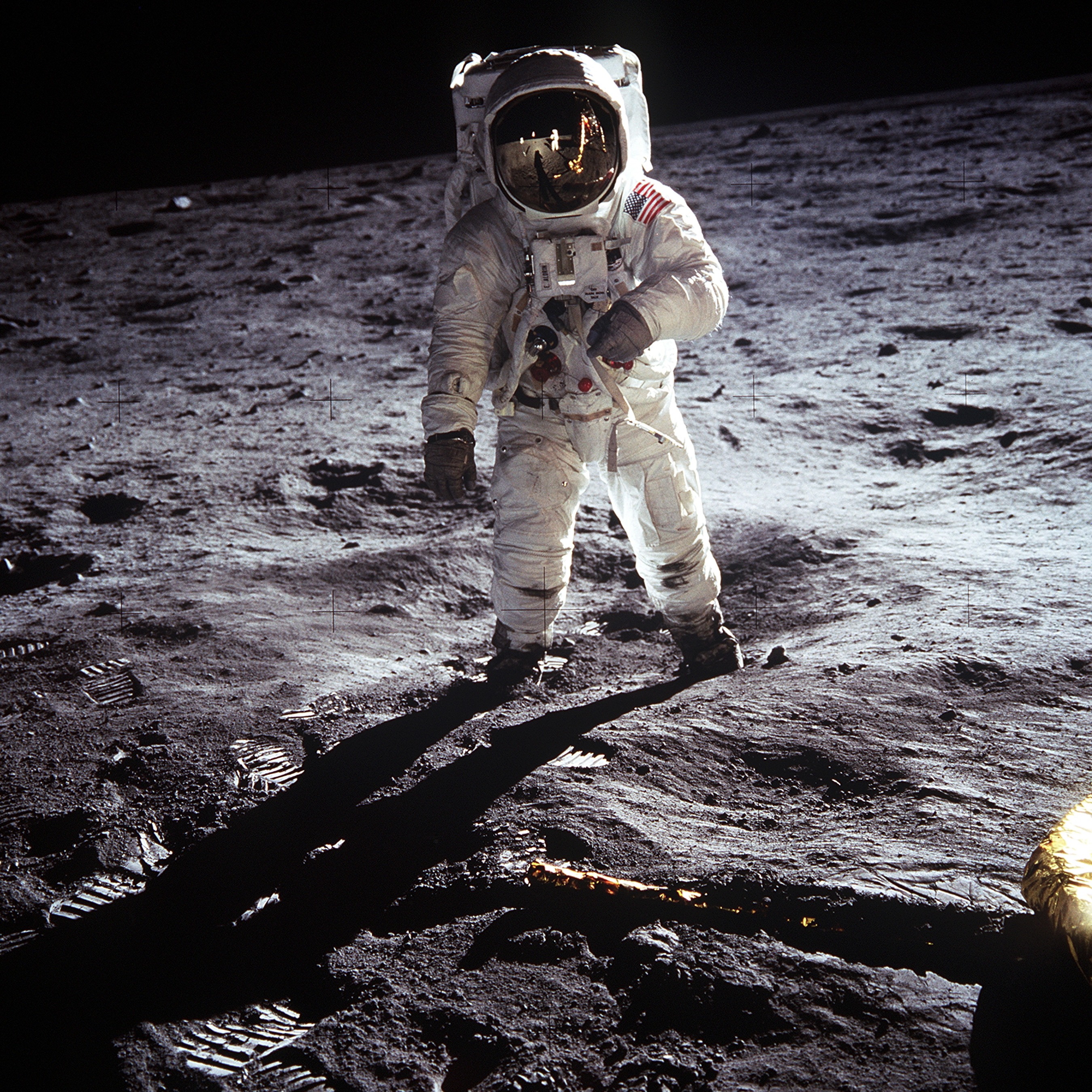
Buzz Aldrin is landing on a moon (Science and Technology) moon landing,apollo 11,nasa,buzz aldrin,1969,astronaut,astronaut suit,space travel
In a gesture of international goodwill, the Apollo XI mission requested messages from every country, which would be placed in a capsule and left on the moon. Paul VI had the Vatican message written in Latin. It read:
Domine, Dominus noster, quam admirabile est nomen tuum in universa terra! quoniam elevata est magnificentia tua super caelos.
Ex ore infantium et lactentium perfecisti laudem propter inimicos tuos, ut destruas inimicum et ultorem.
Quoniam videbo caelos tuos, opera digitorum tuorum, lunam et stellas quae tu fundasti.
Quid est homo, quod memor es ejus? aut filius hominis, quoniam visitas eum?
Minuisti eum paulominus ab angelis; gloria et honore coronasti eum;
et constituisti eum super opera manuum tuarum.
Omnia subjecisti sub pedibus ejus, oves et boves universas, insuper et pecora campi,
volucres caeli, et pisces maris qui perambulant semitas maris.
Domine, Dominus noster, quam admirabile est nomen tuum in universa terra!
Psalmus 8.
Ad Dei nominis gloriam, qui tantam praestat hominibus virtutem, miro huic incepto bene precamur.
Paulus PP. VI. A.D. 1969
The media attention which Fr. Reginald Foster has received in the past week since his death has been mostly exhilarating but sometimes saddening. The exhilarating part is seeing how many lives he touched, and how people remain interested in him. The sad part is seeing how the media outlets with the widest reach (such as the New York Times and the Telegraph) are the ones propagating the most cartoonish, incomplete portraits of the man. This has been going on for a long time. He was the stuff legends are made of. Many of the legends are true; many have grown in the telling; some were comments he made that subsequently were taken as deeds and practices; some are just false.
He cultivated some of this, so if it comes back to dominate how people speak about him after death, it is in some measure just desert. He created the myth of Reginaldus, and lived with some of its negative consequences, and I suppose he will die with some of them too. But as his friend I will say that I really think he deserves a complete portrait, better than (for instance) the Times obituary, which sounded like a description of a character from a Vatican-themed sitcom, not the man I knew. It’s not that I don’t see the other side: I do. I know that pieces of writing like that Times obituary can get people interested in learning more, the way a graphic novel of the Odyssey can get people to start learning about Homer. It has its place.
But I’m already well on my way to completing a more nuanced portrait. I’ve been working on the Reginaldus biography project for years, amassing all kinds of material, interviewing him to get to the bottom of certain stories, visiting the places where he grew up and putting together the draft of his life. In the past six months I was sending him completed chapters to review, but this stage of the writing was less successful: after he made some very useful corrections to the first chapter, about his boyhood, he kept promising to send more comments but did not. I don’t know if those corrected chapters are among the papers left after his death. But for anyone who knew him, it was amazing how much he was willing to cooperate with a biography project at all. This was the person who, after his parents’ death, raided the house and threw anything that pertained to his own life in the dumpster – letters, pictures, etc. His neighbor Judy Doster rescued two albums from the dumpster, which constitute the best source of documents we have for his early life.
But one way or another, God has now composed the final earthly chapter of Reginald’s life, and so now it’s time for me to put the summa manus on my own prose shadow of it. If anyone wishes to contribute their testimonials to this project, please do not hesitate to contact me. Written remembrances (as opposed to merely volunteering to be interviewed) and photos are the most useful. I am always collecting his obiter dicta, which make for great reading.
And if you have ideas for essays that should be written, please do send them along as well. One former student of his noted that his work and life as a priest has not been written about in the coverage since his death, though I will say that some of the most beautiful, reverent masses I ever attended were ones he celebrated. I intend to write specifically on this topic and find an outlet for it. I also intend to write about the “nudist” question, which has gotten absurd attention in the media and really is conveying a false idea.
For those looking for reasonably balanced profiles of him, I will refer to the profile I originally wrote for the New Criterion and to the tribute I wrote for First Things immediately after hearing of his death. I also really admired the obituary by Ricardo Torres in the Milwaukee Journal Sentinel.
More coverage:
I thought this profile in Smithsonian did an excellent job hunting down people who could speak effectively about his legacy. Foster taught a large number of teachers, which has had a multiplier effect on his impact:
“Father Reginald Foster Used Latin to Bring History into the Present”
John Allen is a Vatican reporter:
“Death of Legendary Latinist Leaves the Church a Grayer Place”
The Veterum Sapientia Institute is interested in the Church Latin angle:
Papal Telegram Commemorating the Passing of Fr. Foster (Veterum Sapientia Institute)
More:
“Amo, Amas, Amat: Remembering Father Reginald Foster, The Vatican’s Legendary Latin Expert”
Ad Memoriam Maximi Magistri Latinae Linguae: Fr. Reginald Foster (1939-2020)
http://theoldie.co.uk/blog/the-popes-latin-teacher
https://aleteia.org/2020/12/28/fr-reginald-foster-latin-teacher-par-excellence-dies-at-81/
I wrote this one up, about his funeral, as I know many people could not be there:
https://medium.com/in-medias-res/the-funeral-of-fr-reginald-foster-o-c-d-97bcdf1cb3bb
More to come, there’s more out there.
Reginaldus passed away just after midnight on Christmas morning. Some rather sensitive and intelligent tweeter sent this link to me, of Reginaldus reading the first Christmas sermon of his favorite author, Leo Magnus:
Here is the text:
Agamus ergo, dilectissimi, gratias Deo Patri, per Filium eius in Spiritu Sancto, qui propter multam caritatem suam, qua dilexit nos, misertus est nostri; et cum essemus mortui peccatis, convivificavit nos Christo, ut essemus in ipso nova creatura, novumque figmentum. Deponamus ergo veterem hominem cum actibus suis, et adepti participationem generationis Christi, carnis renuntiemus operibus. Agnosce, o Christiane, dignitatem tuam, et divinae consors factus naturae, noli in veterem vilitatem degeneri conversatione recidere. Memento cuius capitis et cuius corporis sis membrum. Reminiscere quia erutus de potestate tenebrarum, translatus es in Dei lumen et regnum. Per baptismatis sacramentum Spiritus Sancti factus es templum; noli tantum habitatorem pravis de te actibus effugare, et diaboli te iterum subiicere servituti: quia pretium tuum sanguis est Christi; quia in veritate te iudicabit, qui misericorditer te redemit, Christus Dominus noster. Amen.
Let us give thanks, most beloved, to God the Father, through his Son in the Holy Spirit, who on account of his great love, by which he loved us, has had mercy on us; and when we were dead by our sins, brought us back to life in Christ, that we may be in him a new creation, and a new creature. Therefore let us put off the old humanity with its doings, and having achieved participation in the creating of Christ, let us abjure the works of the ego. Recognize, o Christian, your dignity, and do not, having been made a partner in the divine nature, fall back by degenerate living into the old vileness. Remember of what head and of what body you are a limb. Call to mind that you, uprooted from the power of darkness, have been lifted up into the light and kingdom of God. Through the mystery of baptism you have been made a temple of the Holy Spirit; do not drive out such a tenant with evil actions on your part, and subject yourself once more to the slavery of the devil; because your price is the blood of Christ; because he will judge you in truth, he who mercifully redeemed you, Christ our Lord. Amen.
I was speaking to another student of Reginaldus’s earlier today, who said that we can’t just pick up the phone and call him anymore; we need another instrument, another way of reaching him. Well I knew he was able to reach me with this recording, because of the following: my Latin pronunciation is generally fine. I’ve made a lot of mistakes over the years and now I generally pronounce the words correctly. In class I have to correct students’ pronunciation constantly. But no matter what, whenever I read for Reginaldus there was ALWAYS a word I would mispronounce, and he would have to correct me. Not just slips of the tongue: words that I really did not know how to pronounce correctly. They would always come up. Well hearing him recite this passage from Leo I heard him say “E-ru-tus.” I had always thought it was e-RU-tus. And it was like I had him correcting me again.
Gratias ago Deo Patri qui talem doctorem nobis dedit. In paradisum deducant te angeli, Reginalde.
On Queen Elizabeth and Aeneas
12-Sep-22Reading all the tributes to Queen Elizabeth that have appeared in the past months – I do love appreciation, and when people are appreciated by other people – I was struck by how old a playbook she seemed to be ruling from. It’s an ancient ideal of leadership, and from the ancient world the most thoroughgoing exposition of how it works is from the greatest work of literature in Latin, the Aeneid. The combination was too good to resist, so I wrote a brief essay about Queen Elizabeth and Aeneas. Much more could be said.