Skip to content

Africa Without A Map.

21-Jun-15

http://pratergroup.co.uk/wp-json/wp/v2/pages/153 June 18th.

http://thelittersitter.com/wp-json/wp/v2/pages/13 I can barely write I’m so exhausted. Catherine and I planned to start our road trip today down to the Cape of Good Hope, but instead we decided to take a day trip north, to Pilanesberg National Park, and set out on the long trip tomorrow. Marianne said it would be a two hours’ drive to Pilanesberg, but that is perhaps with Dirk driving. It took us almost five hours to get there and four more hours to drive back. Driving on the other side of the road, and working a stick with my left hand for the first time, took a fair amount of concentration, and having my first try at it be a nine-hour driving day was probably unwise. We wasted much time in the early part of the day looking for a road map: they are not available at gas stations, and apparently nowhere else either. We were hence at the mercy of signage, which at times simply was not there. It was worst close to the National Park, whose gates were not signposted, and so we drove past two of them not even knowing what they were. We also missed one turn and almost ended up in Botswana. We entered a few private game parks – we thought that might mean we were close to the National Park – they went on for awhile (we had already missed the turn), then the road went down to one lane (for two directions), which we found odd going to a major tourist destination (we were told this park is so crowded as to be “urban”), and then the road went unpaved entirely, going through the poorest, most desolate village we’ve seen here. We stopped and asked directions and were turned back. We were admittedly still probably thirty miles from the border, though I don’t know, because we still don’t have a map.
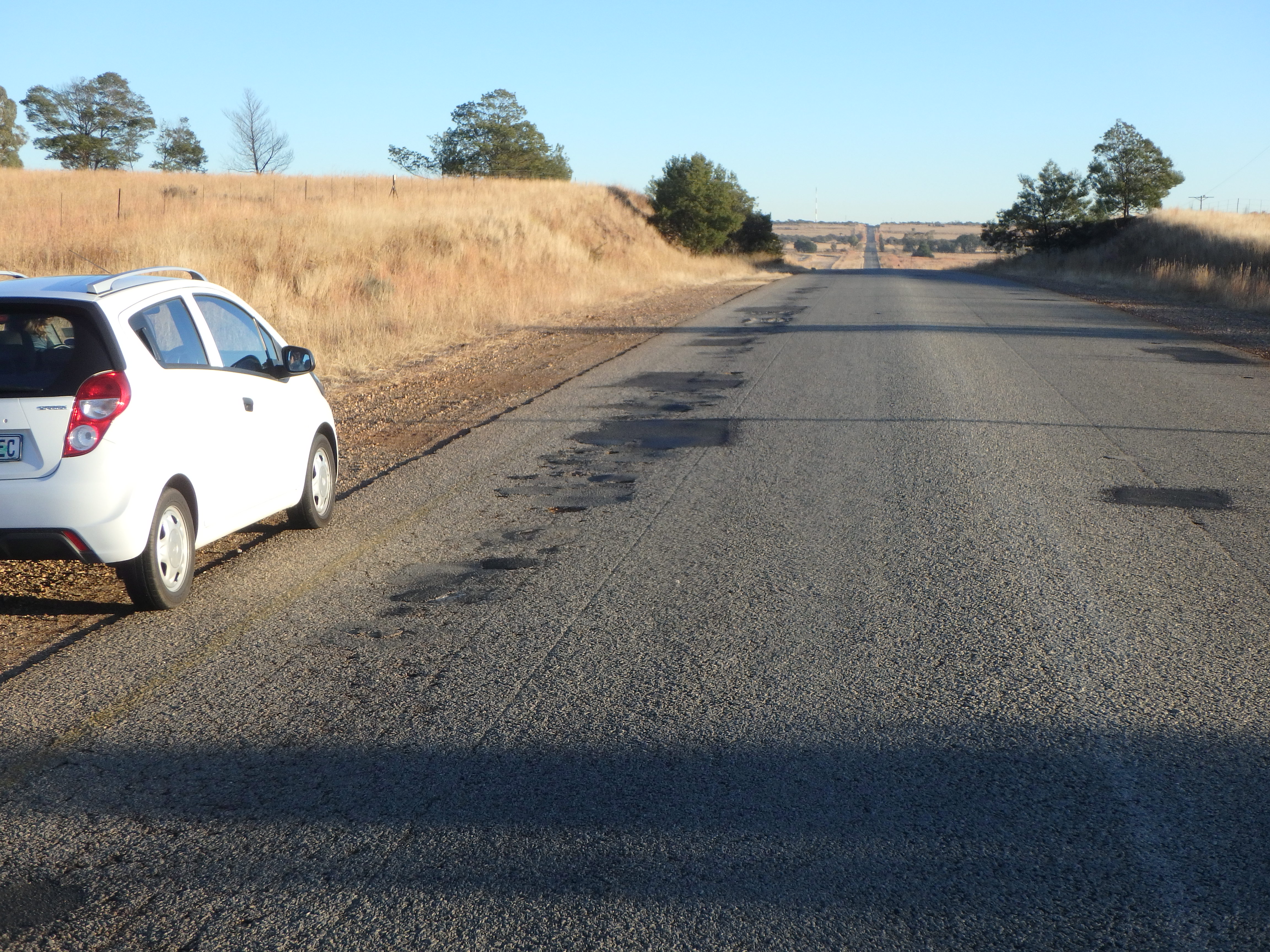
We saw the shantytowns today – the “townships” or settlements. Blacks were required to live there in the apartheid years, and today they still live there, I suppose because that is where their home was before. In terms of housing, from what I saw today, I would have to guess that South Africa in 2015 differs from apartheid South Africa only by percentage points. Vast numbers of people in the country live in ten-foot-wide corrugated metal shacks in shantytowns on the outskirts of the towns. I figured this was true in Johannesburg. It was true in every single town we saw today: the center of the town looks a bit graceless but modern, like the center of a small city in Greece. And as you drive out, the shantytowns begin. Some are tiny brick houses, and there seems to be a kind of hierarchy among the townships: some with brick houses, some with metal shanties (I don’t know if this is the government’s work, to replace corrugated metal with brick, but the result of it is just to write apartheid in letters of masonry on the ground). Most of these areas, twenty years after the election of Mandela, don’t even have a paved walkway (much less bus service) into town, where all the jobs are. At the beginning and end of the day there is a stream of people walking the two or three miles from town to township.
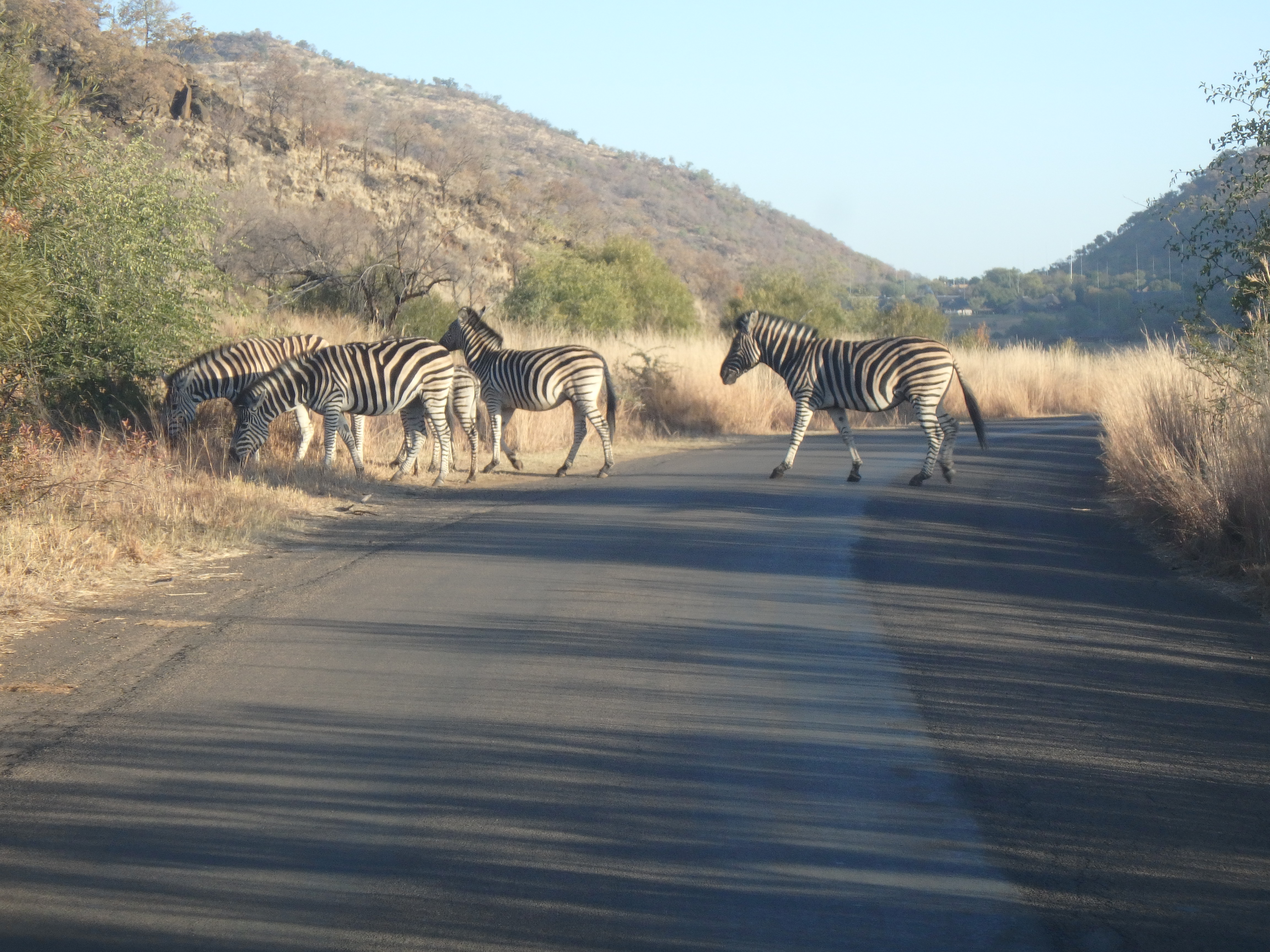
You drive until you see animals, and then you stop and watch them: Pilanesberg National Park. It's really quite lovely.

It was in this context that we saw Pilanesberg National Park. It was amazing – it was delightful. We were warned it would probably be busy – there was no one there. We paid our admission – $17 for two people, including a good booklet identifying the animals – and got to drive around all by ourselves, no guides, no cheesiness, just the two of us and the animals. And they were there – it was impossible to believe there could be so many large animals supported by a land so dry. Wildebeest, wart hogs, zebras, impalas, kudus, elands, two rhinoceroses, cape buffalo, several giraffes, a crocodile, fishing eagles, all kinds of other birds, what looked like a serval, and even an elephant at the end of the day. It was magical. Other animals are in the park but we did not see them – lions, leopards, baboons. But compared to the driving, it felt almost the opposite of what I might have thought: I felt that out there, outside the park, was wilderness, was danger, was fear and unpredictability, while here, with the wild animals, there was peace and tranquillity. The wilderness areas are a respite from the wildness that is man’s inhumanity to man.

Driving back through Rustenburg we stopped at a light. Ahead of us was a large pickup truck, its bed literally piled with men in winter coats and hats and gloves coming home from work, perhaps fifteen of them in the bed of one truck. As the light turned I caught one of the young men in the truck staring at me, with my new car, neat clothes, and pretty wife. In his eyes I saw hatred. I looked away and reached for the gearshift. I didn’t really know how else to react.

As we drove through a particularly deserted area there was a sign right before a stop sign which read: “Hijack Area 500m.”  I presumed this means you don’t have to take the stop sign too literally in that spot.  Catherine had been particularly alert and attentive while in that area, which was good, because when we returned to it after nightfall, she recognized the stop sign from the other side, even though there was neither stop sign nor directional sign going the other way.  Missing that turn would have put us on the wrong side of a mountain, and in the dark night – and it is very dark here – who knows how we would have righted ourselves.

I had a runny nose yesterday, and it’s a fever now.  I drove most of the way home with an intense fever.  I will be glad to sleep tonight.  I bought two aspirin at the National Park store, and just took them – aspirin breaks fevers, for me, but it also makes me tired, and I wanted to refrain from them until bedtime.  Now I plan on sweating out the fever.  Tomorrow we head across the interior deserts to Kimberley.
Autumn in Africa.

21-Jun-15

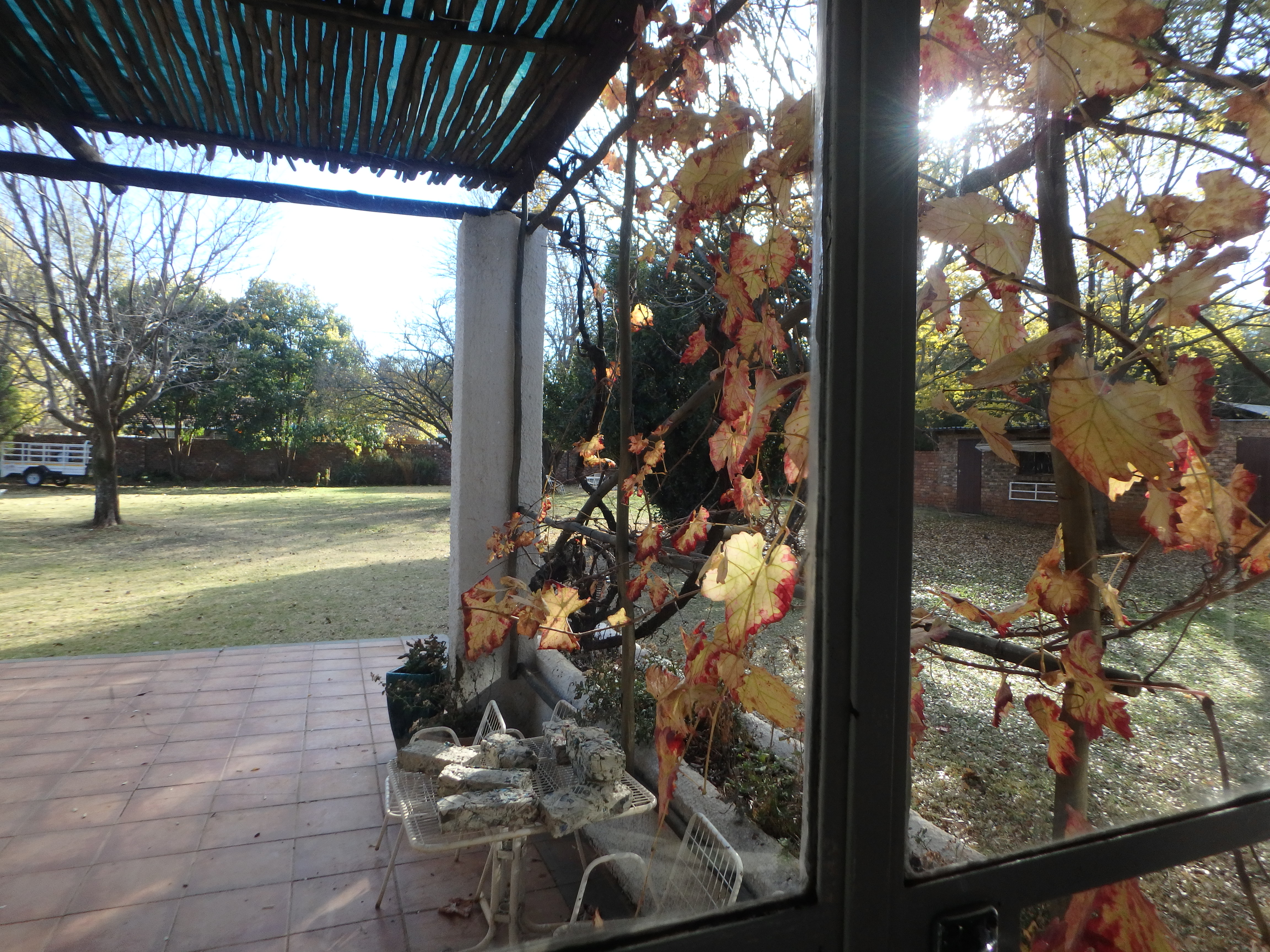
Our view on waking this morning.

June 17th.  Woke up to the sound of what sounded like particularly powerful purring – insistent purring, like someone had recorded a large cat and used it as an alarm on a clock.  It was the birds – birds of Africa.  I presume it was the sound of the doves, which were all over the trees in the backyard.  There was golden slanting morning light on the grapes on the bower in the back-yard, whose leaves were and yellow and crimson – it was the end of autumn here in Africa.  I stepped out into the yard, and the trees had mostly shed their leaves, except for the ones which were still turning colors.  Thirty-eight degrees this morning, the beginning of my first full day in Africa.

South Africa.

21-Jun-15

June 16th. Potchefstroom.

We made it. A little difficult, but we made it.

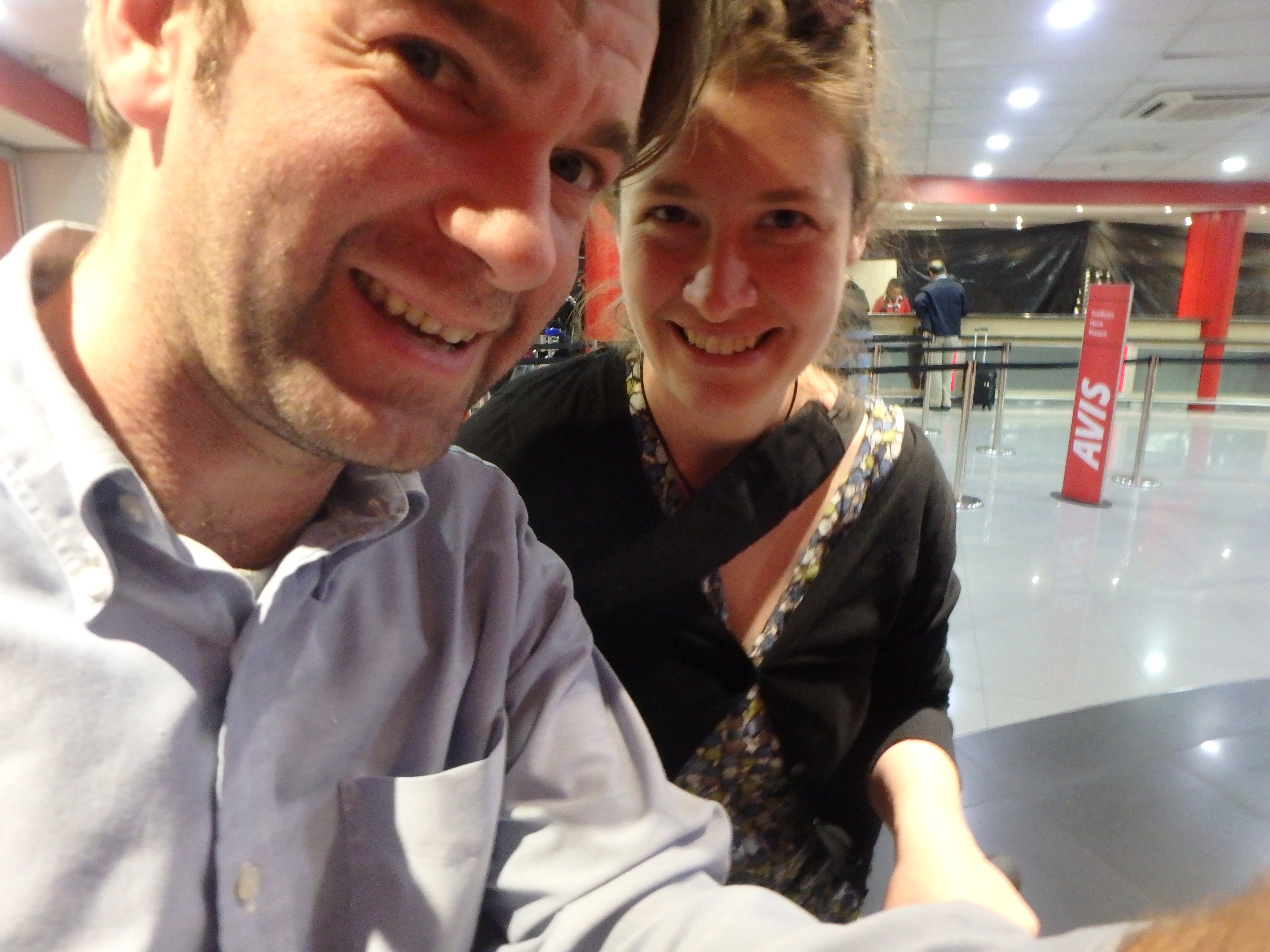
The airport looks pretty much like an airport. But we're in Africa!

Our plane landed perfectly on time. We disembarked to find a lovely, modern, spacious, comfortable, neat airport – it is always pleasant to be reminded that the world’s worst major airports are in Queens. But the line to get through passport control was very long, and very slow-moving. In the end we did not enter the arrivals area until an hour and a half after our scheduled arrival, and our ride, Marianne’s husband, had already left, presuming we were not on the plane. Finding no one to greet us, we found ourselves a bit ill-prepared: I had Marianne’s number, yes, but only on my computer, which had no power, nor could we charge it, because we did not have the adapter, etc. So another hour passed while we changed money, got an adapter, found an outlet, got a cellphone, and called her. Her husband turned around – he had not gotten home yet – and came to get us.

Changing money I had one of those experiences which seemed just a bit different, as one does in a new country. There was a line of three customers all for one teller. There was another teller, who appeared to be working on her computer. After waiting quite a while, I went up to her and asked her if she was busy – because I began to feel that she was not – and she said no, she could help me. It seemed to me unusual that a bank teller should ignore a line of customers. In fact, until I asked, I presumed it was impossible.

Marianne’s husband Dirk picked us up in his BMW, which he drove impressively quickly over excellent superhighways around Johannesburg. The big highways, the desert air – we could have been in Phoenix, really. But then I saw a fire by the side of the road, burning up the dry grass, and not being put out. “It’s the fire season,” Dirk said simply.

We talked for the whole two hour trip, about many things. Only once really did Latin come up: he mentioned that the Afrikaans speakers were the special targets of resentment. I confirmed that the South African national airline did not use any Afrikaans at all, not even a word or two on its logo. We then spoke about the politicization of Afrikaans, how it is very specifically linked with apartheid in a way that English is not (Potchefstroom is “the Afrikaans University,” where courses are taught in Afrikaans, and there has been pressure to end this and teach only in English). I asked if Latin was also considered a mere colonial remnant.

“I don’t think so,” he said. “I don’t think there’s any politics around Latin. If you asked ninety percent of the people in South Africa what Latin is, they wouldn’t know. I think that’s the problem.”

The highway ran right around Soweto and then began to falter. It went to two lanes in each direction; then lane lines vanished; then one lane in each direction, and utterly unlit. Stop-signs appeared out of nowhere in the middle of the highway, with people standing around at the intersections.

“Marianne didn’t want you driving yourself to Potchefstroom,” Dirk explained. “It’s very dangerous, really. The country’s very dangerous. You don’t want to end up in the wrong place, not going around Soweto. There are carjackings, and real violence. It never used to be like this before 1994. I don’t quite know why it’s like this now. I guess people thought that things would change faster. You mentioned before about the rand being weak against the dollar, and for the most part we don’t think much about that. I’ve got my money in London, if my daughters need anything, I can say, ‘here, enjoy something.’ But we pretty much just let the world go its own way, and we go ours. Whatever’s going on elsewhere, things here in Africa don’t change very much.”

Now we’re here. We really haven’t seen much that would be out of place in the U.S. But it feels a bit tattered, somehow – a bit tired. We are staying in the house of a university professor, but there is no central heating, and the lights are mostly fluorescent lights. It’s cold and dim. Not only is there no wi-fi, but none of the neighbors have any either – in a comfortable residential neighborhood, my computer doesn’t pick up any signals at all. In America I would pick up twenty different signals in a neighborhood like this. As we approached Potchefstroom there were more potholes, and more darkness, and a general feeling that something was falling apart and not being repaired. This too may be part of the changelessness.

Mind With Mind.

21-Jun-15

“In Pioneeer countries hospitality is a necessity of life not to the travellers alone but to the settlers.  A visitor is a friend, he brings news, good or bad, which is bread to the hungry minds in lonely places.  A real friend who comes to the house is a heavenly messenger, who brings the panis angelorum.

“When Denys Finch-Hatton came back after one of his long expeditions, he was starved for talk, and found me on the farm starved for talk, so that we sat over the dinner-table into the small hours of the morning, talking of all the things we could think of, and mastering them all, and laughing at them.  White people, who for a long time live alone with Natives, get into the habit of saying what they mean, because they have no reason for dissimulation, and when they meet again their conversation keeps the Native tone.  We then kept up the theory that the wild Masai tribe, in their manyatta under the hills, would see the house all afire, like a star in the night, as the peasants of Umbria saw the house wherein Saint Francis and Saint Clare were entertaining one another upon theology.”   – Isak Dinesen, Out of Africa

Almost There.

21-Jun-15

June 16th. On the plane.

 As we reached cruising speed, the flight attendants walked through the cabin spraying pesticides, to fumigate the cabin.

 My phone is off, and I neglected to purchase a watch, as I thought I might do before departure, so I have little idea of the time, but we are more than three-quarters done with the crossing, I think. As I pace the cabin – I am not very good at all this sitting – I am amazed, at how the whole plane of people shuts their windows – while Africa rolls by beneath – and sleeps or watches television. The complete triumph over the screen is not only over landscape but also over the book: no one on the plane is reading either. I feel I have been very sheltered – that I have been in this other world, where all that matters is God as revealed through nature, people, and books. But everyone else looks so much happier than I feel – all asleep, or glazed in silence. I feel myself chafing at the containment of long flight: I feel like a caged animal. I take no interest in the dishes brought out for my food; it all looks fake to me; I lose my appetite; I wither. All I want is to burst out again.

 Early evening. We have landed. The sun is setting; all I can say is that outside it looks just like an airport. Very flat. A lot of pavement.

In Dakar.

21-Jun-15

June 16th. On the plane.

Dawn in Dakar. We are sitting here on the tarmac, the dawn just a yellow line on the horizon. Insects of various sorts boarding the plane. We are in Africa. At dawn nearly 80 degrees, and tropical humidity breathing into the cabin.

D.C. to Dakar.

20-Jun-15

June 15th. On the Airplane, D.C. to Dakar.

Seated next to a gentleman by the name of Ed Yates, who is a most impressive big-game hunter. He is bringing some acquaintances on a hunting trip – he is familiar with the country, having owned land in South Africa and gone on numerous hunting trips here. Indeed he has been all over the continent hunting, and has the calm demeanor of an expert. He says on this trip he will not kill anything, “except maybe if I see a brown hyena I’ll take one. I’ve pretty much done everything.” He says that all the South African animals may be shot in privately owned game parks, and that many farms are now being converted to such hunting reserves – it has the potential to be, so to speak, a higher-yield cash crop for these farms. And also, I will say, a more natural and appropriate one than maize or beef or sheep.

He was astonished that I was going to Africa to teach Latin, and wanted my information, saying he might write of it in an article he was planning on composing for Safari Magazine. “I have to say,” he said, “Latin seems a little out of place in Africa. A little incongruous.”

He has been all over the world, Zimbabwe to Mongolia, and taken all the animals, from lions to polar bears. He said the most terrified he has ever been was on two of his grizzly bear hunts. “Those animals were so huge, and so powerful, you really just don’t know what’s going to happen. To be honest, I was scared —-less.” (I am editing his words in case he reads this and wants none of his own profanity in print.) I will say, for my own part – this is precisely the animal I myself think I would be most scared of. Usually I want to see animals, but when I have been in grizzly country, I haven’t wanted to even see one, not even at a distance.

Now four hours into the first flight. No wifi on board and no more power in my laptop. Catherine and Ed are asleep. I have been hoping to get good computer time on this trip – we will see what ends up being available.

The plane is huge – 75 rows, 8 seats to a row – at least in the economy class. The passengers are black, white, and Indian, but definitely white by a large majority.

[For more information on Ed Yates, take a look at this article.]

Isak Dinesen – or, Karen von Blixen.

20-Jun-15

June 15th, Dulles Airport.

Starting Out of Africa, which features the untranslated epigraph

EQUITARE, ARCUM TENDERE, VERITATEM DICERE.

I have to admit it’s hard not to love anyone who starts a book with those words. “To ride a horse, to shoot the bow, to speak the truth.”  It’s from Herodotus, describing the Persians – he says that their education consisted of only those three things.  I’ve never seen it in Latin before, and perhaps Dinesen translated them herself.  She seems to have been that type.  The writing of the opening pages is beautiful.

At the Airport.

19-Jun-15

June 15th. Dulles Airport.

Now at the airport. Unable to get the internet working properly. Pondering possible Latin texts for our classes in South Africa – there exist many Latin accounts of the animals – certainly good material on elephants, lions, and giraffes, from Pliny to Linnaeus. There is much Latin writing about North Africa – Carthage was their great rival – but these are perhaps no more relevant to South Africans than Aztec architecture to a New Yorker. There must be some good Latin about gold and diamonds. And perhaps there exists a Latin account of the voyage of Vasco da Gama, who named the Cape?

Marianne says she will be picking us up at the airport, which, since we will be arriving after dark, is relieving. It will be interesting enough having to drive a stick-shift car with my left hand, while driving on the left side of the road. Finding our way out of Johannesburg to Potchefstroom and then to her house, in the dark, might be more of a challenge than we want in our first few hours of Africa.

I will admit, I am nervous.

In the National Gallery.

19-Jun-15

June 15th. Dulles Airport.

We had time today in the morning, before our evening flight, and so we drove into D.C. and visited the National Gallery. I had been there before, but I don’t know the museum well. In general, it aroused in me the same feelings that D.C. does: I am kind of impressed, but I don’t fall in love with the place. But we did have some fun. Catherine was caught up in the Dutch stilllifes (wow, three consecutive l’s in one word) – especially the ones with food in them – and I thought the Rubens of Daniel in the Lions’ Den was particularly appropriate for our African trip.  It’s a lovely, striking painting – though also with a decided comic-book quality to it.

But it was not until we were just about to leave that I saw something that really entranced me: the Van Eyck Annunciation, a small painting, strange, but exquisite, with Gabriel’s amazing psychedelic wings, and his golden Latin words flowing from his mouth, with Mary’s flowing back at him, in reverse: INIMOD ALLICNA ECCE.