Skip to content

In the Parish.

24-May-14

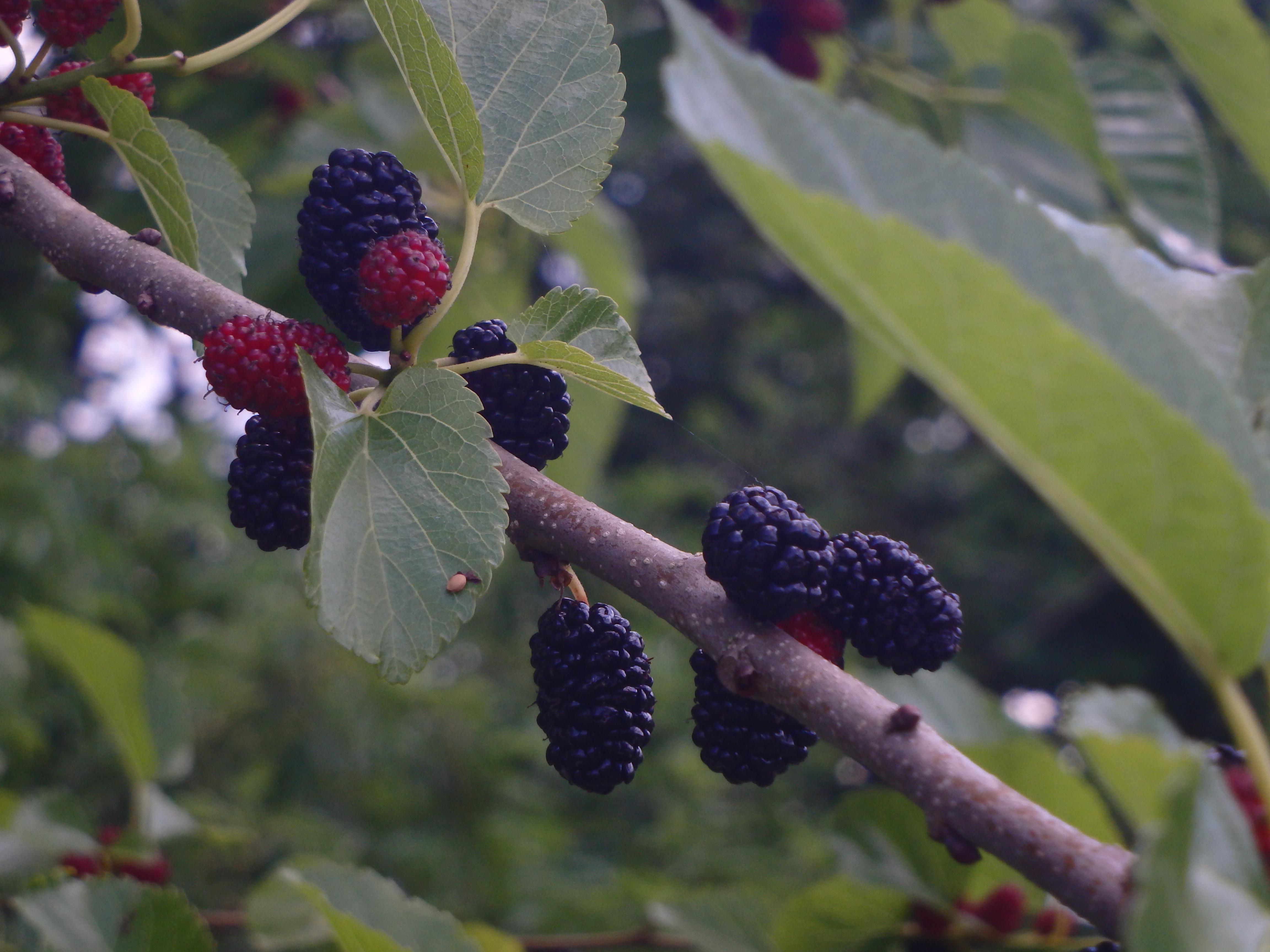
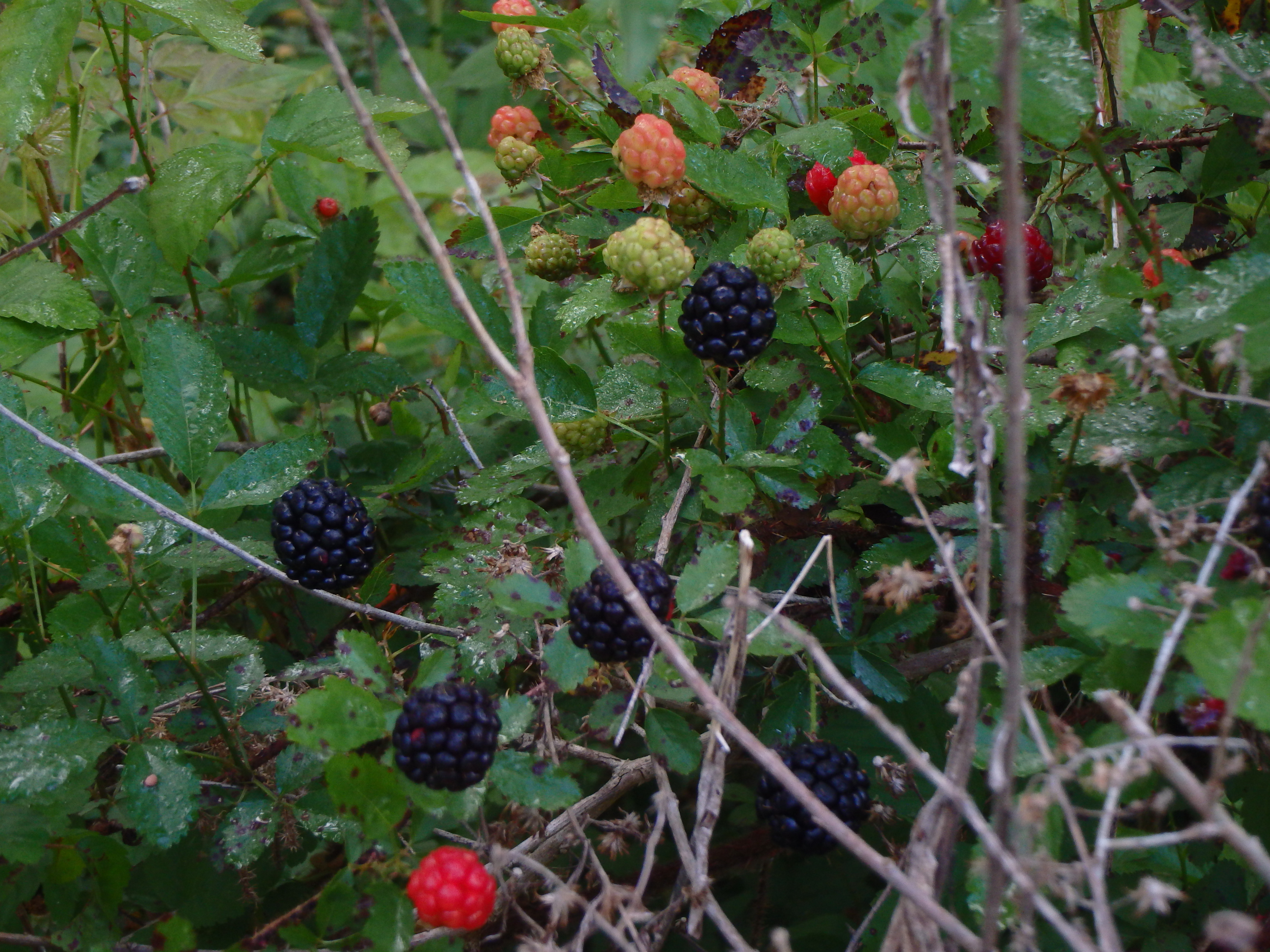
buy disulfiram in australia St. Bernard Parish blackberries. Ripe in April!

buy modafinil egypt I wasn’t eaten that night by an alligator, as it turns out; I woke up entire, and immediately hopped on my bike to do a little morning tour of the park. There were all kinds of wading birds everywhere; they flew off as soon as I was within a hundred feet or so.  I found ripe blackberries and ate a great deal of them, and then found ripe wild strawberries as well. These last were larger than, and equally insipid as, any wild ones I had seen. I have heard it said that this species of strawberry, which invades lawns, is a European introduction, though I do not know that. As delicacies they are worthless, but I imagine that like most wild foods they do have some kind of nutritional value.

When the sun got over the treetops, I spread out my goods, which had taken on some dew in the night, and then read and mulled while they dried. I checked my maps, and by the time I had packed up it was after ten.

Coming into town was a shock, after a night in the swamp with the wild animals. St. Bernard State Park is eighteen miles from the French Quarter, and the gates of the park mark the beginning of the conurbation known as New Orleans. My maps told me I was in Poydras; the people told me I was in Violet; it made no difference, really. I would be surrounded by people and buildings for the next five days, from one end of New Orleans to the other.
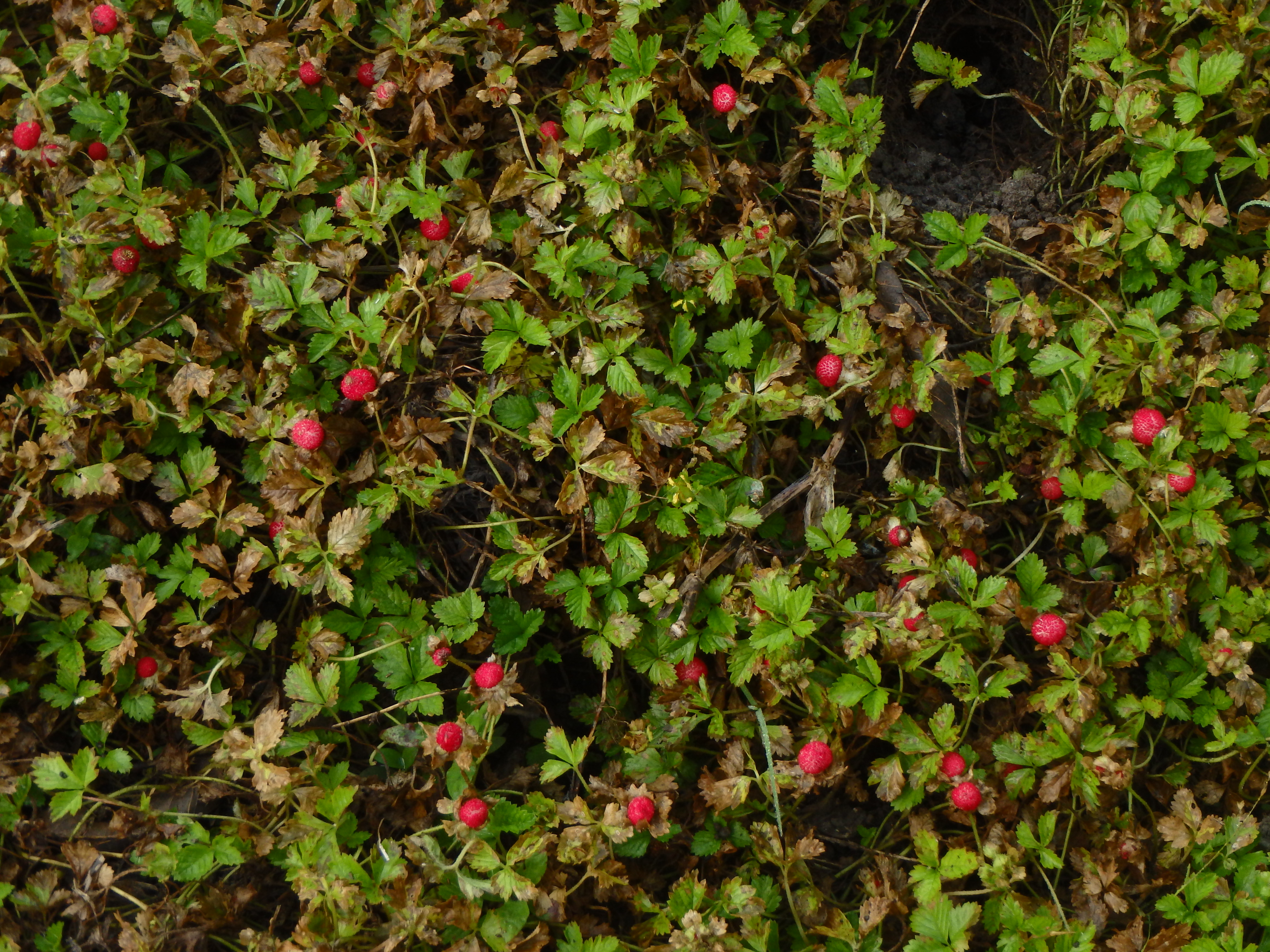
Wild strawberries.

The inhabitants of this East End of New Orleans are known to be loud and brash; those from Chalmette are called “Chalmatians,” those from Violet, by analogy, “Violations.” All told the area is known as “the Parish.” All counties in Louisiana are called parishes; but this one is special, the way Long Island, in a city full of islands, is the island. My first experience confirmed the stereotype. A car in front of me veered suddenly to the right, blocking my path; as there was traffic, I stopped. The driver, a beautiful but somewhat used-up woman – half the women I saw looked like they either had done drugs or dated someone who had – leaned over the six-year-old girl in her passenger seat to speak with someone walking by. “WHY DIDN’T YOU ASK ME I WAS RIGHT THERE!” she yelled at him. “NO I LIVE DOWN THE BLOCK WITH JOHNNY NOW! YEAH! COME OVER ANYTIME YOU NEED SOMETHING! FOR REAL!” Then she veered back into traffic. Young people looked too skinny, too tattooed, too tanned and leathery or too pale; everything seemed off and weird. Black men with weird red and yellow eyes walked each one alone down the road. The shoulder of the road seemed to have been paved with broken glass and garbage.  Nothing in particular was photogenic.

I wanted to check my email to get the phone number of my host for the night – a friend of a friend – and I stopped off at a bakery. They had internet and I got a donut and took a seat. I barely got anything done, of course, because the woman who worked there – a woman in her sixties wearing much makeup – kept coming right over to my table to speak to me.

“Wheah you from honey? New Yawk! I was in New Yawk once. Oh God, like forty yeeuhs ago. I hated it. Too much. Too many people. I mean – I loved the Broadway shows, I want to take my dawtuh-in-law to the Broadway shows. But othuhwise, no.” Then off she went, going out of the shop, into the shop, doing various things. Not long after she came back to my table. “You know the one thing about New Yawk I liked – this one thing kind of saved it for me. On every block, you’ve got those guys selling like icees in a little papuh cup! Every block! I think I lived on those things. Now that was pretty coo, I thought.” I didn’t want to tell her I hadn’t seen anyone selling Italian ices like that in twenty years.

She came back to show me a picture of her as Queen of the Mardi Gras Parade in Violet. “Oh yeah, that was me, honey.” I would not have recognized her, to be honest. She had been, indeed, quite beautiful. “I was a pretty hot bitch! I had some good times. I made that costume, it took me like five weeks and it cost, I mean today it would be thousands of dollars.” It looked like a Vegas showgirl outfit – very large, with a lot of feathers and sequins. “That was 1982. I had been working for yeeuhs around heah and so I was something of a community figyuh, let’s say. I had that outfit in my closet, lost it in the stome. We had fifteen feet of watuh heah. Lost all that stuff – all my furnicha, all my pickchas, my close, all the memories. So sad. So sad what that stome did.”

She went off and spoke with a neighbor who came in. Apparently Jodi had just gotten a restraining order against her boyfriend. “Relationships should be about babies,” she declared to her neighbor. “Am I right? That’s what it’s about. So make sure it’s someone who would be a good fathuh. Because nowadays you just don’t know about people othuhwise. But you can tell if someone will be a good fathuh. That’s instinct.”

She went off to the back room, then back to my table. She put her fingers on the table as she looked down at my seated self. “And you want something to tell people in New Yawk about honey, how bout this. Aftuh the stome Habitat for Humanity – you know, Jimmy Cahtuh, all that bullshit – they came around heah and they offered to build people houses for fawty thousand. So people were like, ‘Okay, great!’ So they paid them to build houses. But they would staht and then run out of money – I mean, you can’t build a house for fawty thousand dollahs honey. I’m not tawkin about a FEMA trailuh, I mean a house. So people said, ‘You said you weh buildin us houses, now you want mo money?’ But if they didn’t pay up the Parish would come around and take theah propuhty away, because it was an eyesore. I tell you, it was all one big scam, Habitat for Humanity, look it up. Nobody tawks about this stuff.” [I can find nothing to confirm any of this.]

Later she was back. “You people from New Yawk always love to heah about alligatuhs. I just had one, it was sad, I had to call the cops, he was in my back yahd all the time. I love them, but not in my back yahd, you know?”

“So the cops come and kill them?”

“Right, if it’s a nuisance. Yeah, we got a lot of stuff around heah. My son, he said even if he wuddn’t bawn and raised heah, he’d still wanna live heah. Because of the coachuh. Heah you can sing and dance down the street. Anyplace else they lock you up.”
Into the Dagobah System.

20-May-14

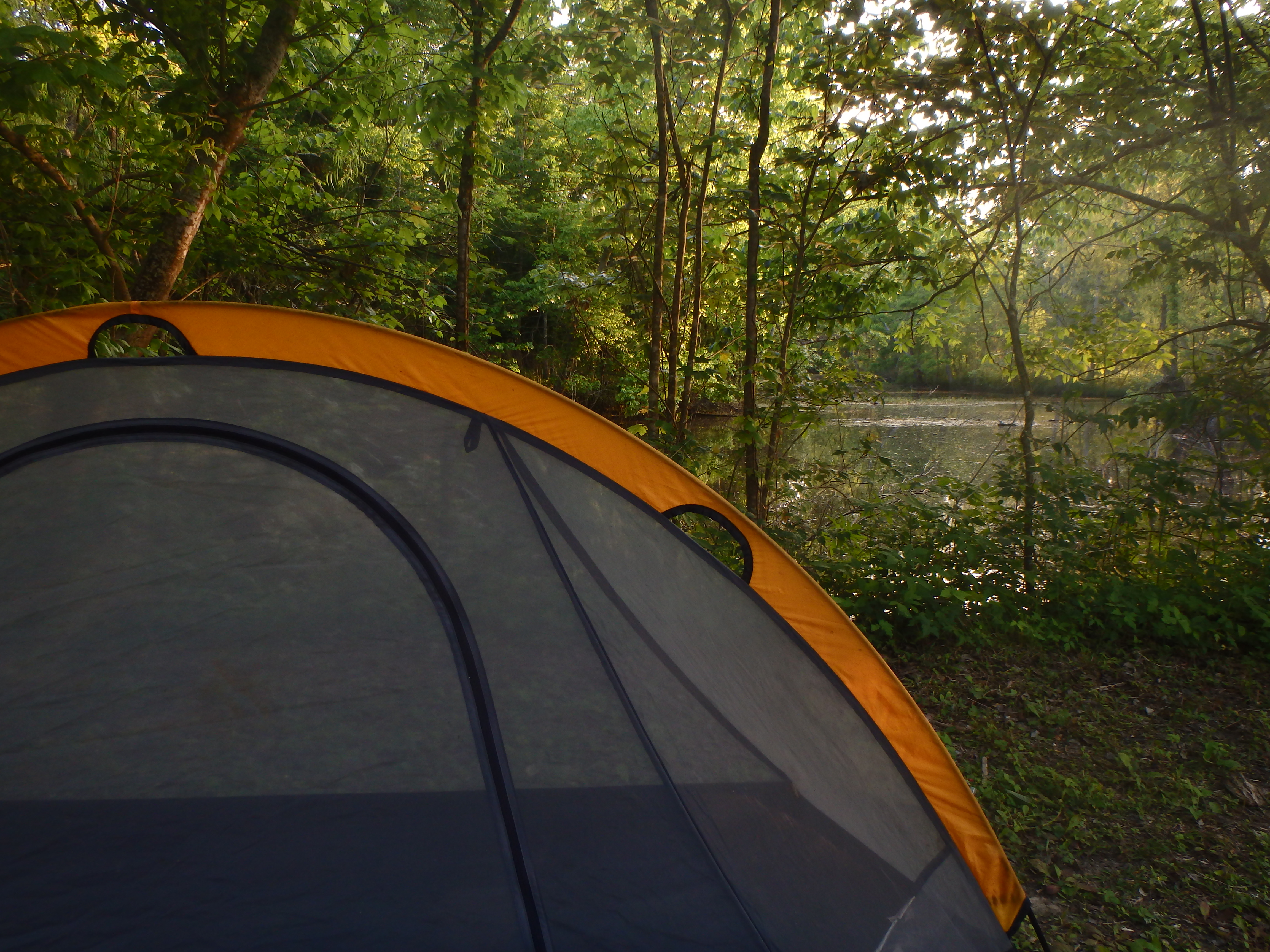
My campsite by the bayou.

I stayed that night at St. Bernard State Park, where I paid twenty dollars for the right to camp legally.  The very nice woman at the gate, who looked kindly on the idea of biking up the river and seemed eager to please, thought long and hard about which campsite to give me.  She had determined that I wanted a quiet spot, and did not need to be too close to the consumerist bonanza of gear that constitutes American car and RV camping, which is typically just a morose mobile barbecue party without the people.  She thought about it and chose a site for me, which when I arrived I saw could not have been worse, not only not far from other campers but on wet ground inappropriate for a tent.  I chose another spot.  In choosing, I decided to put faith in everything I had heard about alligators, that they were peaceable creatures who were not going to harass sleeping cyclists: because if there was ever a site which would tempt an alligator to crawl up out of the water in the middle of the night and grab a sleeping camper by the leg and drag him into the water, this was it.  I was just a few feet from the water’s edge, at the end of a bayou, tucked into a little mown strip between box-elders.  I figured – and this was accurate in the end – that the greater danger was from the poison ivy coming up through the grass everywhere.  I used to be deathly afraid of the stuff; now I just take it as a fact of life outdoors.  You get used to the temptation of itching it, and like most temptations, most of the time you resist, and sometimes you don’t.

But it was all worth it, to spend a night in that swamp.  The region around New Orleans, in terms of its natural life, is one of the great things I have seen (another trip to a natural place nearby is narrated here).  Its distance from the coast removes it from the cooling ocean breezes, so it is truly tropical and humid; and it is removed from the salt of the ocean, which limits the growth of plant life.  And it is not merely swamp, or Gulf, or tropical vegetation: no, here the cypress meets the maple, and the cottonwood meets the palm; species that are found a thousand miles to the north are still present here.  Many of the animals, too, which are found in New York – the possum and the raccoon and the barred owl – are here, but they are joined by alligators and garfish and large birds I couldn’t even name.  I was so surrounded by life I thought Master Yoda might show up, that dream of everyone who seems to have no clear path through life:

I’ve been waiting for a guide to come and take me by the hand

Could these sensations make me feel the pleasures of a normal man?

All through the night I heard that violent rasping of the unfamiliar frogs, and the great booms of the barred owls, their voices bigger and stronger than their northern counterparts, their voices filling the entire swamp.  Some strange bird provided a treble cry, while the bullfrogs took up the bass; and all through the night unknown things plopped into the water.  To my unknowing ears many of these creatures sounded very large.  And then, of course, there were the bugs.  My tent sounded like a beehive all night long as they prowled around – in vain, thanks to those tent-manufacturers – smelling the carbon dioxide of my breath.  When I shone a flashlight outside I could hardly believe how many there were; mostly mosquitoes, but gnats and Junebugs too, as well as some unfamiliar Mayfly-type creatures.  It was hot too; summer was coming.  I woke up several times that night, but in between, I slept soundly; I was tired.  I was happy and tired.

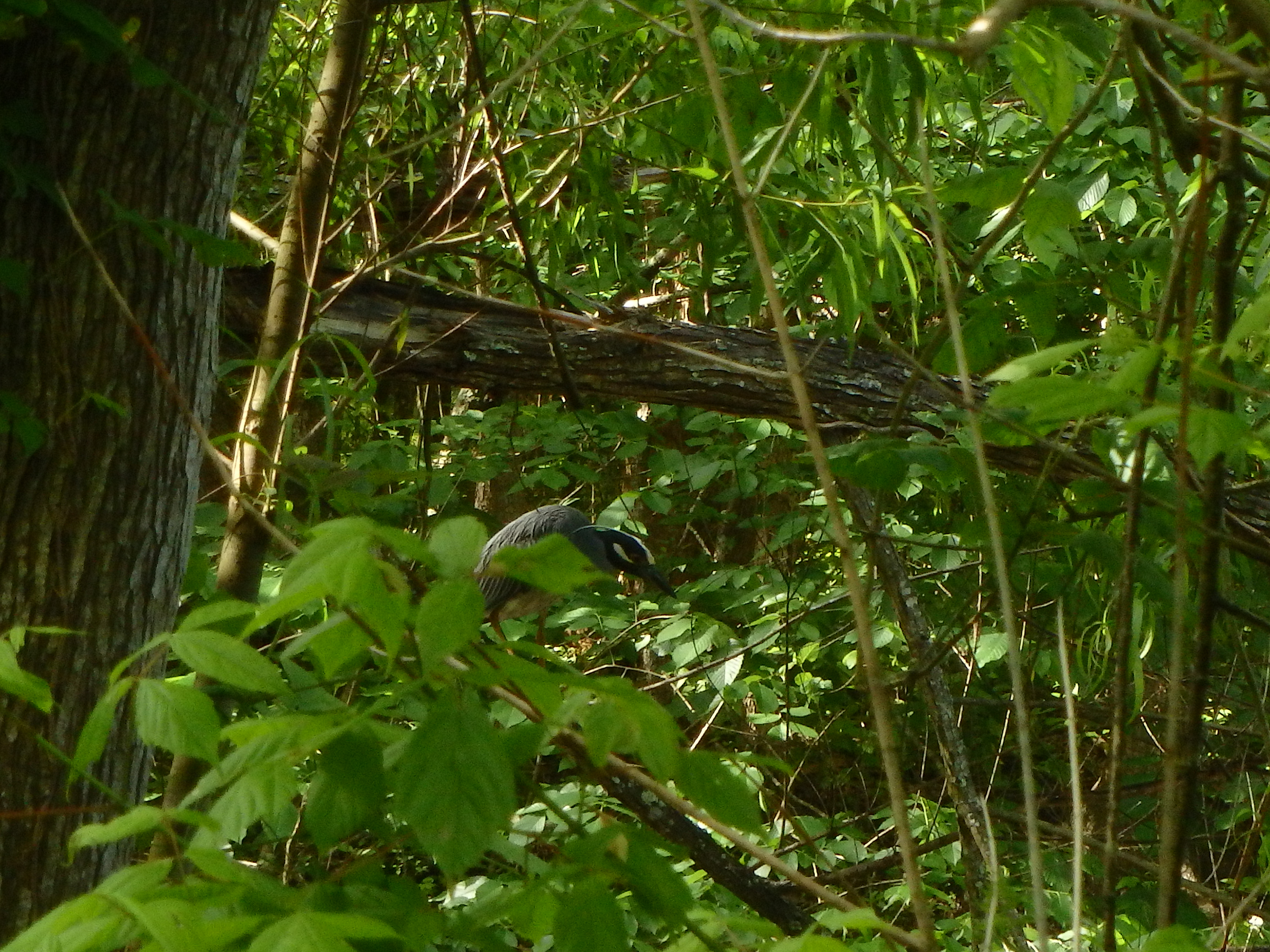
From my tent-site, a golden-crowned night heron.

Fiddler Crab Holes.

20-May-14

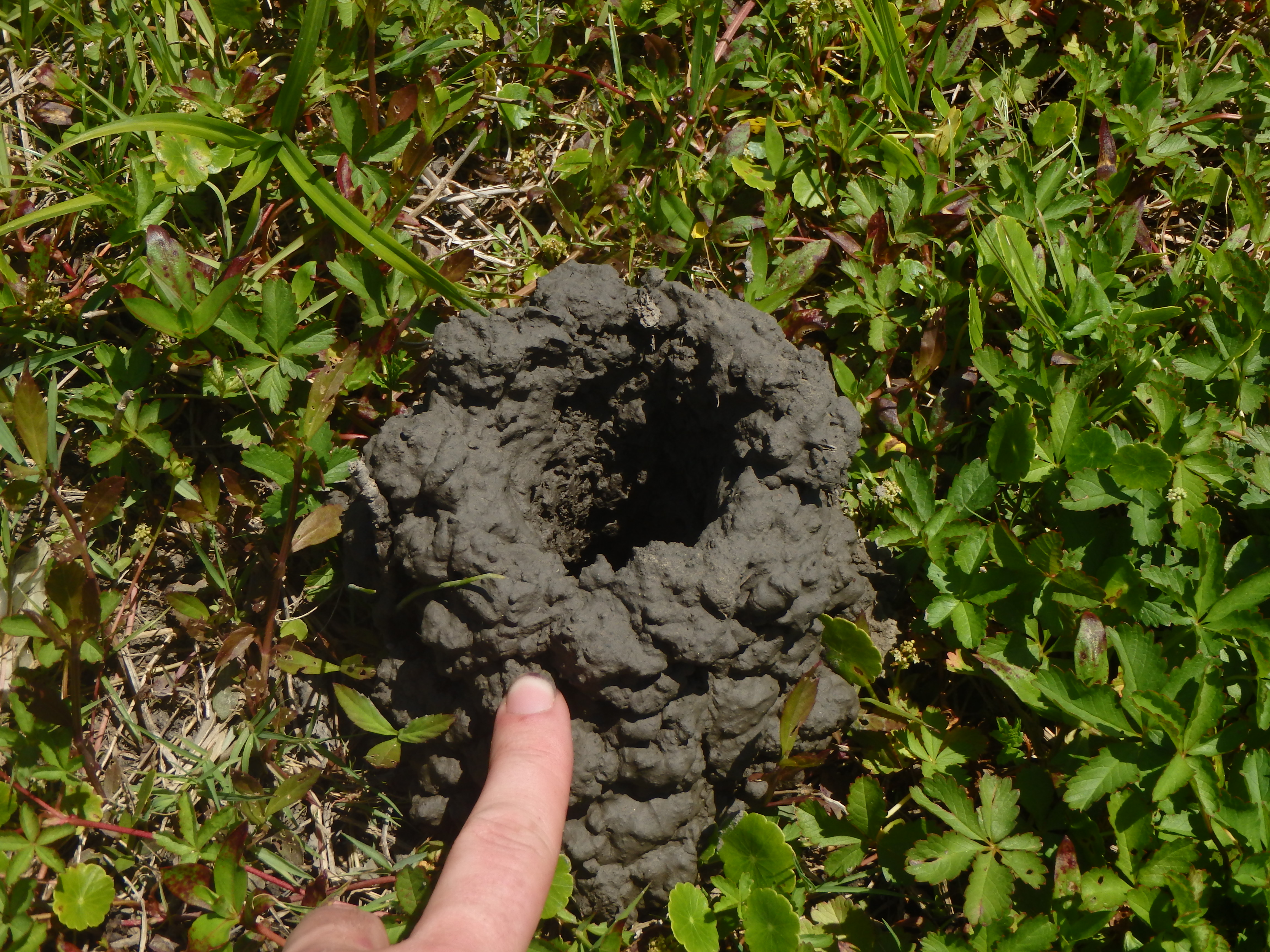
Throughout Louisiana, the roads are at least slightly embanked to deal with flooding, and the river of course is heavily leveed, and the material for the banks and levees typically comes from nearby – generally the ground adjacent to the road or levee.  So you are always travelling next to a ditch.  The drier ditches are lined with little mud-towers four or five inches high.  I am told [erroneously; see below] these are made by fiddler crabs.  Mark Twain mentions them in his Life on the Mississippi: “The drainage ditches were everywhere alive with little crabs – ‘fiddlers.’ One saw them scampering sidewise in every direction whenever they heard a disturbing noise.  Expensive pests, these crabs; for they bore into the levees.”  I never saw any myself; and I think the levees, which are much larger now, are not much endangered by these crabs anymore.

[These are in fact made by crawfish, thank you Don for the correction.]

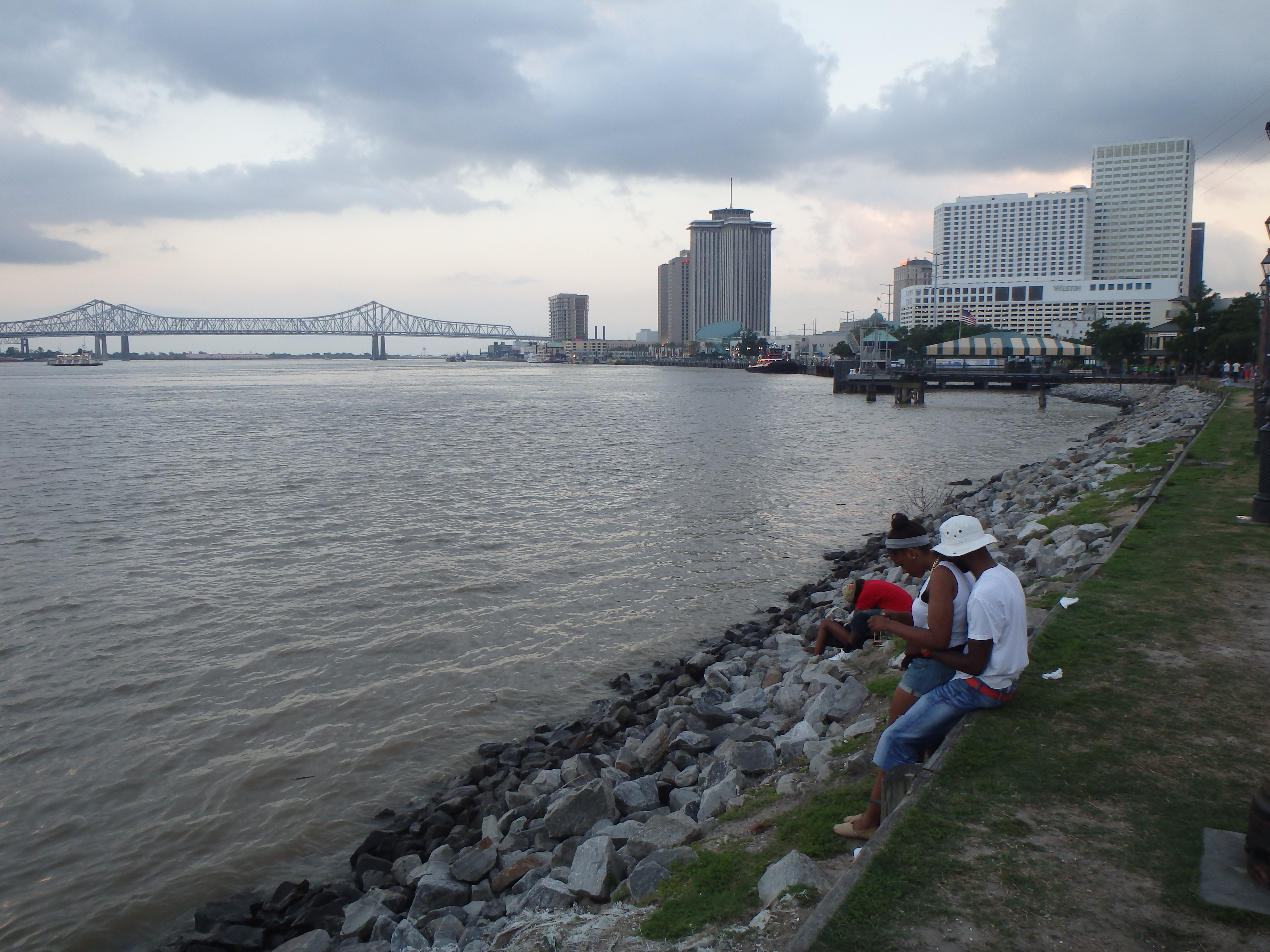
The Mississippi River at New Orleans.

20-May-14

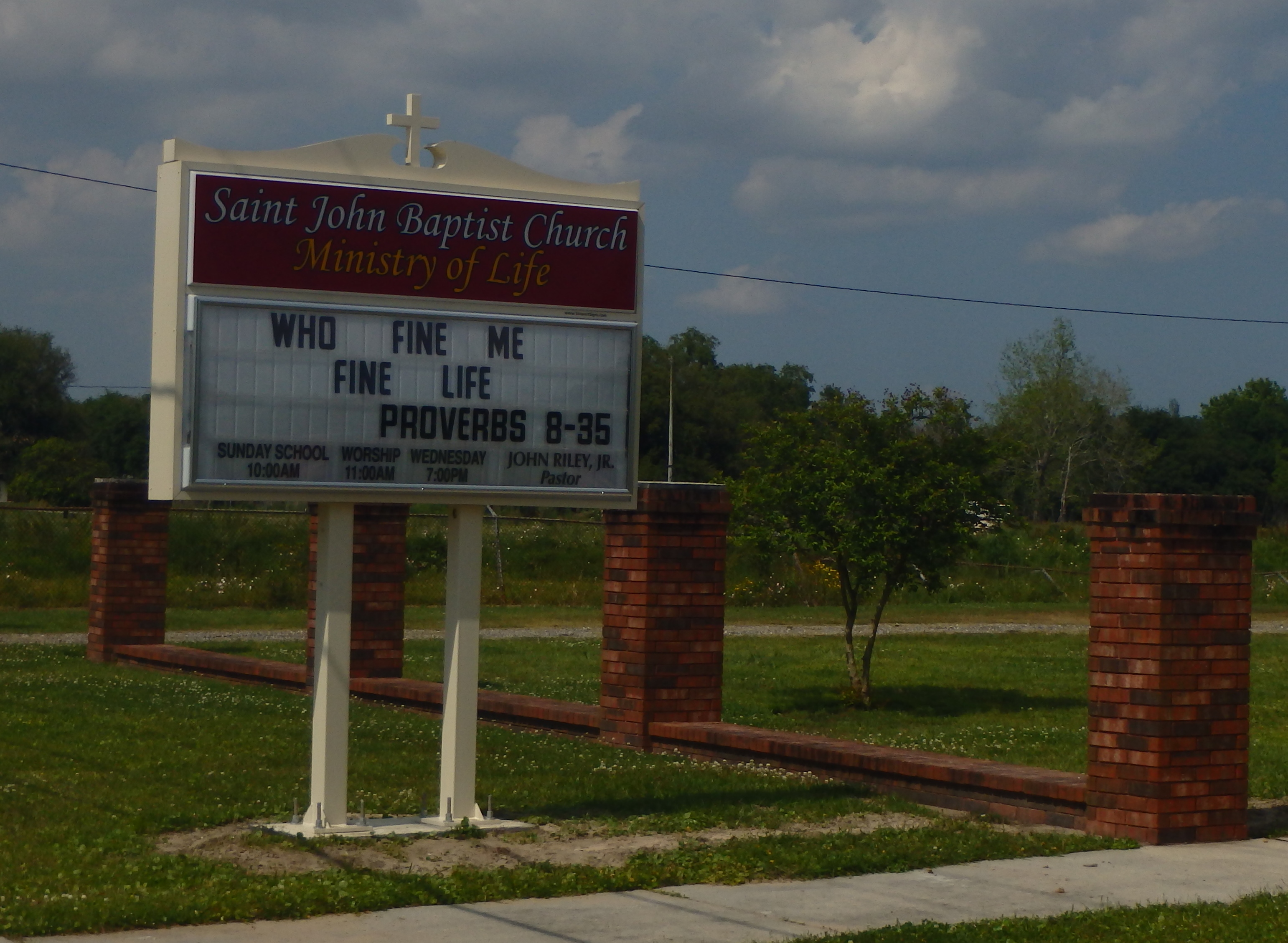
Bible, King Louisiana Version.

20-May-14

This is actually a pretty good transcription of the way people talk in Louisiana, where there is no distinction between “fine” and “find.”  But I’ll note the full transcription should be “Who fahn may, fahn lahf.”

Next Brush With the Law, and, Where West Virginia’s Mountains Go.

19-May-14

The eastbank of the river is not heavily developed in Plaquemines Parish, but periodically along the river you will see chain-link fence behind which sit large industrial complexes; I saw a grain elevator that smelled like Honey Nut Cheerios, pouring grain directly into a tanker ship: no packaging, just grain dumped straight onto seabound steel. I didn’t take pictures of the elevator, because I was cautious: because a few photos had resulted in a run-in with the law earlier in the day.

It happened like this: I came to a large facility which took up both sides of the road: on the right a large yard was filled with big black hills of coal, being pushed around by machines. On the left, on the river, were docked big ocean-going vessels as well as smaller river barges. The levee ran right through this facility, and I was riding on the levee, so I went right through it.

I was curious: no coal is mined in Louisiana. What was it doing here? Was this a coal-fired power plant? I yelled down to a workman walking along the riverfront:

“Hey there! What are you doing with all this coal?”

“Mostly goin’ ovuhseas!”

“Where’s it coming from?”

“It comes down the rivuh in those bahges, then we transfer it to the big ships and out it goes.”

“Gotcha thanks.”

There was our “energy independence,” which as we all know is a fraud: we were tearing apart entire West Virginia mountaintops, but shipping the coal to distant ports. This was a transfer facility, where riverboats meet ocean vessels. Just down the levee I could see precisely what they were talking about: a machine unloading a barge, and coal being dropped into the hold of a massive ship. I took a few pictures, and continued on my way.

Within a minute I was aware of someone driving like a lunatic on the levee behind me. The levee’s top is wide enough for only one automobile, and this pickup truck was taking up the whole levee-top and coming at full speed. I got over to the side and of course it stopped right next to me.

“What the HAIL ah you doin’?” It was a gruff, older white man. He looked like he could have been a dispossessed shrimp fisherman – which indeed, he might have been.

“Uh-oh, am I in trouble?”

“You shuwah as HAIL ah! The po-lice are on their way!”

“For what?”

“This levee heah’s PRIVATE PROPEHTY.”

“I’ve been riding on the levees for miles. There are no signs – the signs just say, ‘No motorized vehicles.’”

“Gimme your camera!”

“Is there any law against taking pictures?”

“Hail YES! You can’t take pictures of any of this, it’s a Nine-eleven thing”

I thought about this one. I actually didn’t doubt that he already had called the cops. This was a perfect cop situation: they’re in a rural place with nothing to do, and here comes an out-of-towner they can play cops and robbers with. It was not, in other words, a good situation for me. That morning I had camped out on someone’s property and been found.  They already had something I could have to go to court for.

“You want me to delete the pictures? I don’t care about the pictures, I just thought it was interesting the way they were moving the coal into the big ships. I don’t care.” So I held up the camera for him to see, and deleted the two pictures I had taken. “See all the others are of plants or people. I’m sorry about this I’m not trying to cause any trouble. I’m just a tourist. I’m biking the whole Mississippi River, all the way up to Minnesota, so I just figured this was part of the trip.”

“Well you gotta watch out theah’s all kinds of crazy stuff you can’t just go around takin pictures! Gimme your driver’s license.” And I did, and he copied my info down. “The cops are gonna be heah soon.”

I took my license back. “Listen I have to make it to St. Bernard State Park tonight, that’s where I’m camping, so I need to go. I’ll be cycling down the road. Everything will check out, so I’m not worried about it. If the cops want to stop me, you know where I’m going.”

This I felt was the best solution: make the cops have to stop me again, if they wanted to. So I biked off, getting onto the road for speed. A few hundred feet down the road, I heard the sirens. They stopped at the coal facility. Then a few minutes later as I rode, a cop car came by me, but, apparently satisfied, the cops kept on driving and I kept on pedaling.

Crawfishing.

19-May-14

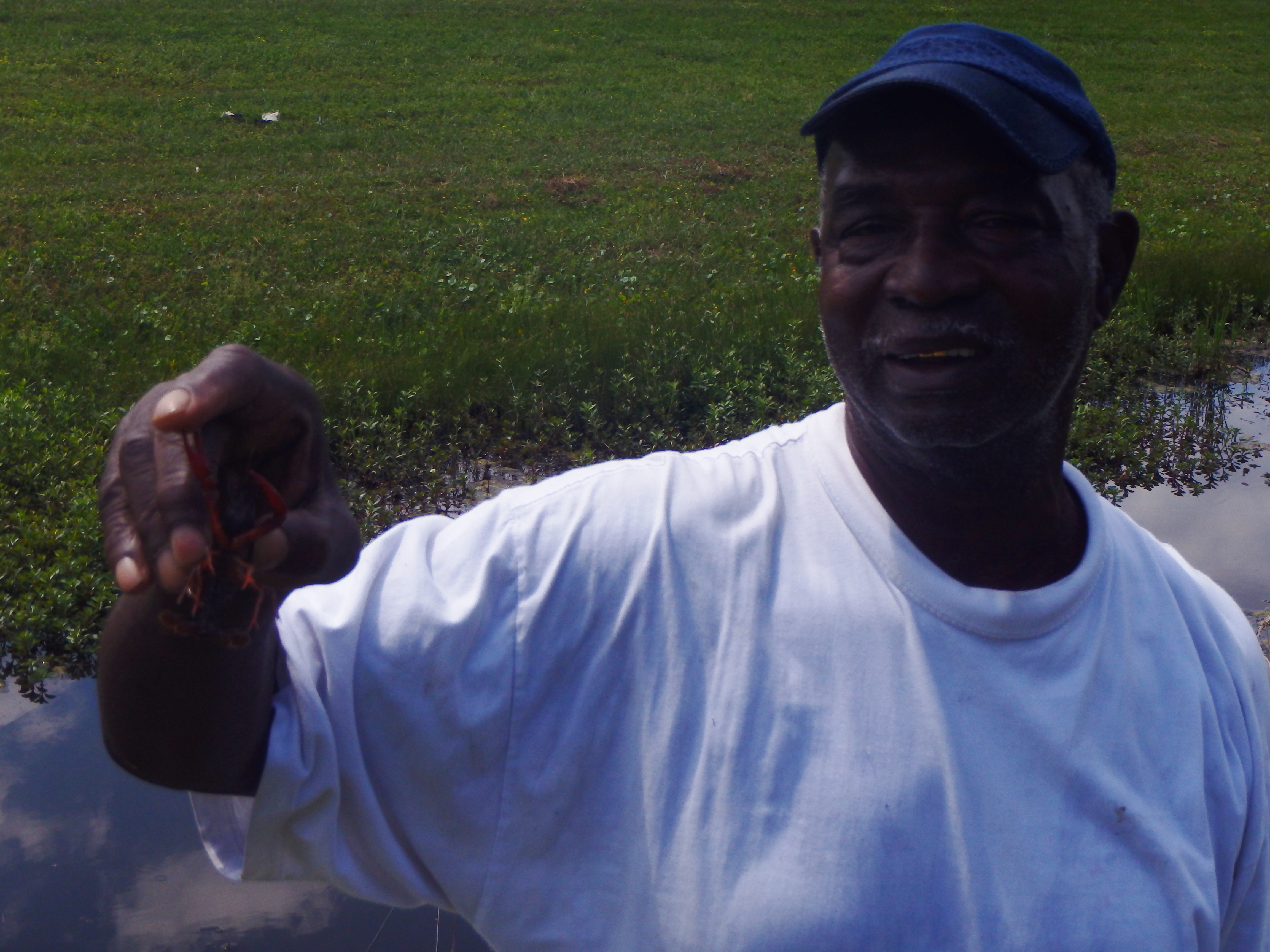
Andrew with a crawfish.

When you’re in a car, you drive by people sometimes and wonder, “What the hell were they doing?” But you’re already long past, and don’t circle back to find out. On a bike, you just press the brake, drop your bike, and find out. I grabbed a sprig of a white-blooming shrub I hadn’t recognized – a privet as it turns out, an invasive which has taken over vast amounts of the South – and brought it over to this black couple, who were sitting, without fishing poles, by a bucket beside a ditch. The ditch was not more than a foot deep.

“Excuse me do you know what this shrub is?” I said, proffering the man the little sprig of white flowers.

He looked at me. “Dat – dat deah is a white flar, dat blooms in de springtime.”

I was not sure if he was mocking me, or if I had come across the most literal-minded person in Louisiana. I’m still not sure. But I could now dispense with the preliminaries. “So… what are you doing?”

“We crawfish fishin’.”

“Crawfish fishin’! Here?”

“Oh yeah dis is a goodplace.” The accent on the first syllable of Southern compounds – like a redlight – is quite a phenomenon.

“Can you show me how it’s done?”

“You nevuh seen nobody crawfish fishin’?”

“Never. Never in my whole life.”

Zana with some crawdads.

“Where you from?”

“New York City.”

“Hooooo-wee! You come all de way heah from Newyowk on dat bahsickle?”

“No a friend drove me down here, I’m biking up the Mississippi River. I started in Venice, I’m going to Minnesota.”

Minnesota?” They both looked at each other. “Why you doin’ dat?”

“Well, this way I get to see everything. A couple of days ago I got a shrimp fishermen to take me out to the Gulf, I saw them fishing for shrimp, now I’m seeing crawfish fishing! We don’t have stuff like this in New York.”

“Oh yeah, it’s different down heah. Oh yeah.”

“So have you caught any?”

“Oh yeah we got some.” He showed me the bucket, at the bottom of which about half a dozen crawfish were crawling about.

“I’m John by the way.”

“Andrew.” He gave his last name too.  He was wearing jeans and a very large white t-shirt.  He was probably in his fifties, with white hairs in his thin moustache and at his temples.  The rest of his head was covered by a now-almost-formless baseball cap.

“Zana,” she said.  She looked at least a decade younger.  Both were wearing white rubber boots – coonass boots.

“So how do you catch them?”

The crawfish and the bait.

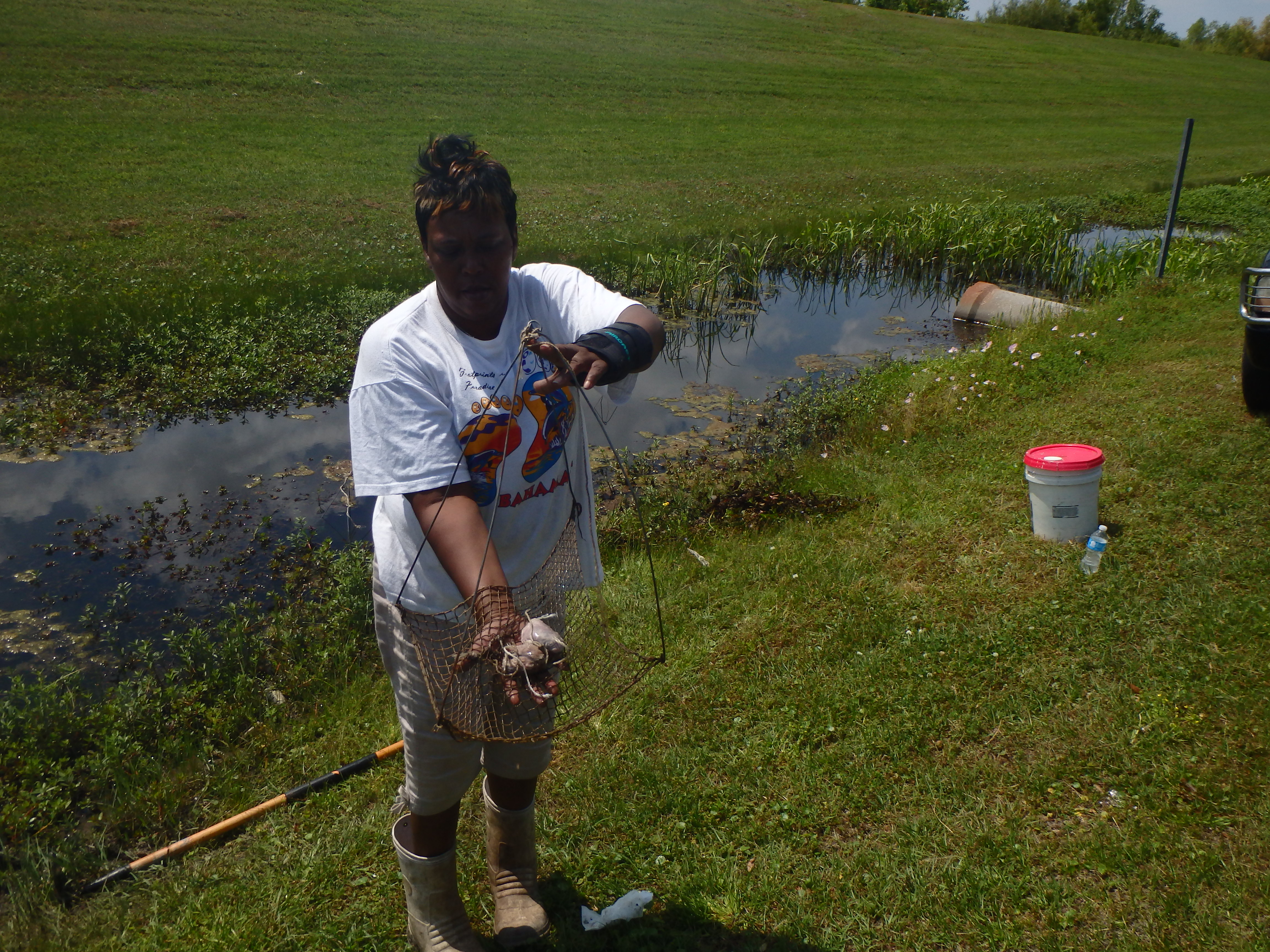
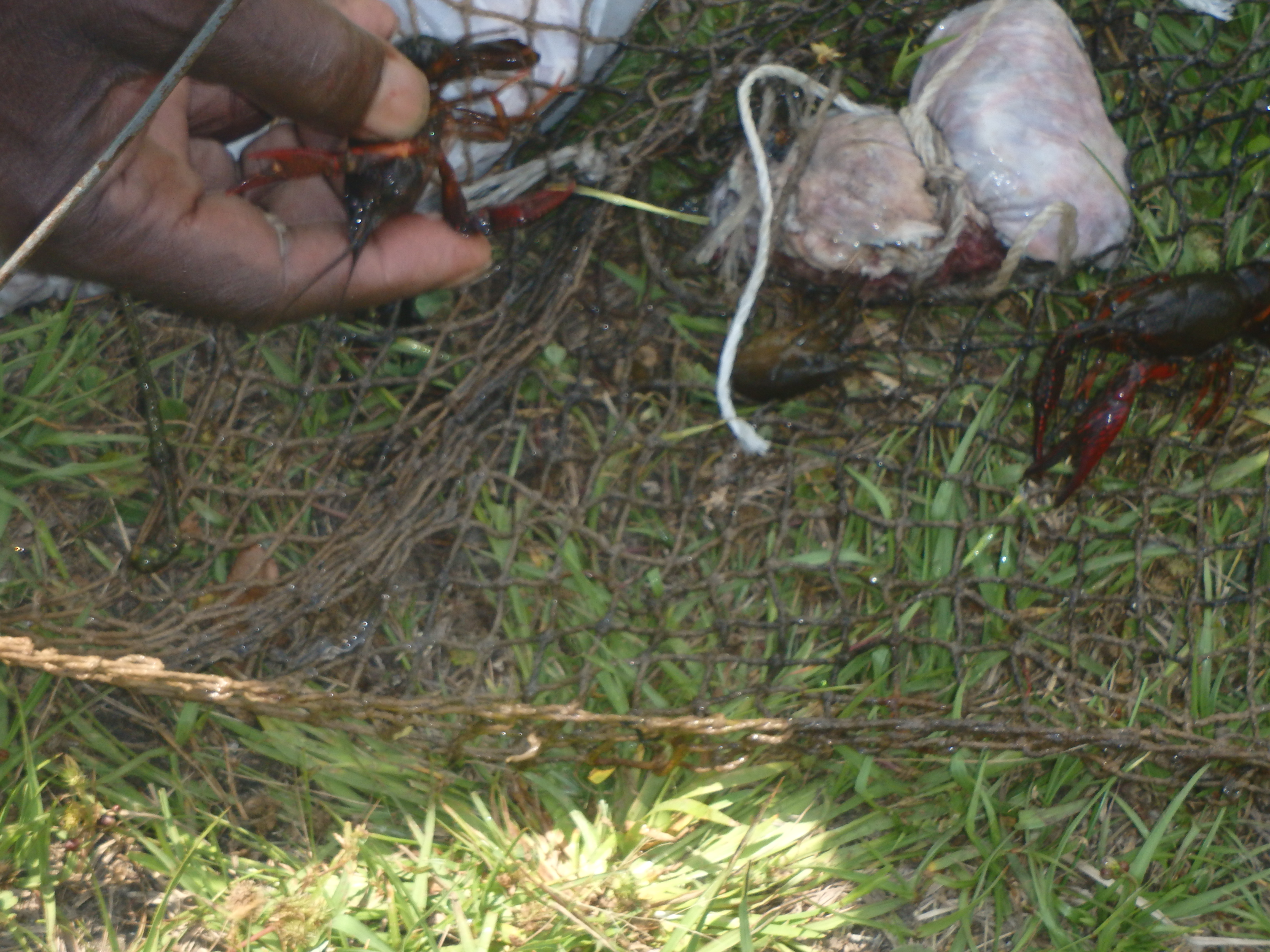
“We’ll show you,” Zana said. She took a garden hoe and reached it into the center of the ditch, where a kind of wire pyramid could be seen coming up out of the water. She put the hoe into the wire pyramid and lifted, pulling out a net which was suspended on the wire, like a pair of scales or a hanging brazier. Three or four more crawfish were crawling on the net around a gooey meat-colored glob. Holding onto the glob, the net was dumped into the bucket, and then returned to the water.

“That thing in the middle is meat?”

“Yup dat’s the bait. And they come right fuh it.”

“Can I try?”

“Shuwah. We got anodduh net right deah.” So I grabbed the garden hoe, pulled the net up with it, and put the crawfish into the bucket without dumping the bait.

“This is great! It’s easy!”

“Oh yeah dey jes come right fuh dat meat.”

“Should I put the net in the same place or should I move it to a new place?”

“Move it ovuh deah.”

So we continued our crawfish fishing. To me it is a miracle that people can be fed so easily: put a little bait in water, and there appears a meal. But it takes some knowledge: until I did this, I had no idea that there were crawfish in the wet ditches next to the road. They asked me about New York and I asked them about various things I had seen along the road. I tried to ask about the mud mounds I had seen around – mounds of mud about four or five inches high, with a hole in the middle, like a little volcano. Andrew tried all kinds of answers – alligator holes, muskrat holes – but I kept saying they were much smaller. I then found some on the other side of the road and showed him.

“Oooooh, dose. Dose ah fiddluhs.” That made sense – fiddler crabs. The holes were everywhere in drier ditches.

“Do you eat those?”

“Fiddluhs – yeah, shuwah you can eat dem. Crawfish is easier to catch dough.”

I stayed for awhile, for another changing of the nets. When I got up to go, we spoke about my trip to Minnesota, and how long it would take. I said two months. He seemed to think that was about right. “And when you get to your destinay” – dropping off the -tion – “I bet you gonna lay on yo back, and jes look at the stahs.”

It was a strange prophecy, I thought, but I hoped it would be true. It was beautiful.

Eastern Plaquemines Parish.

17-May-14

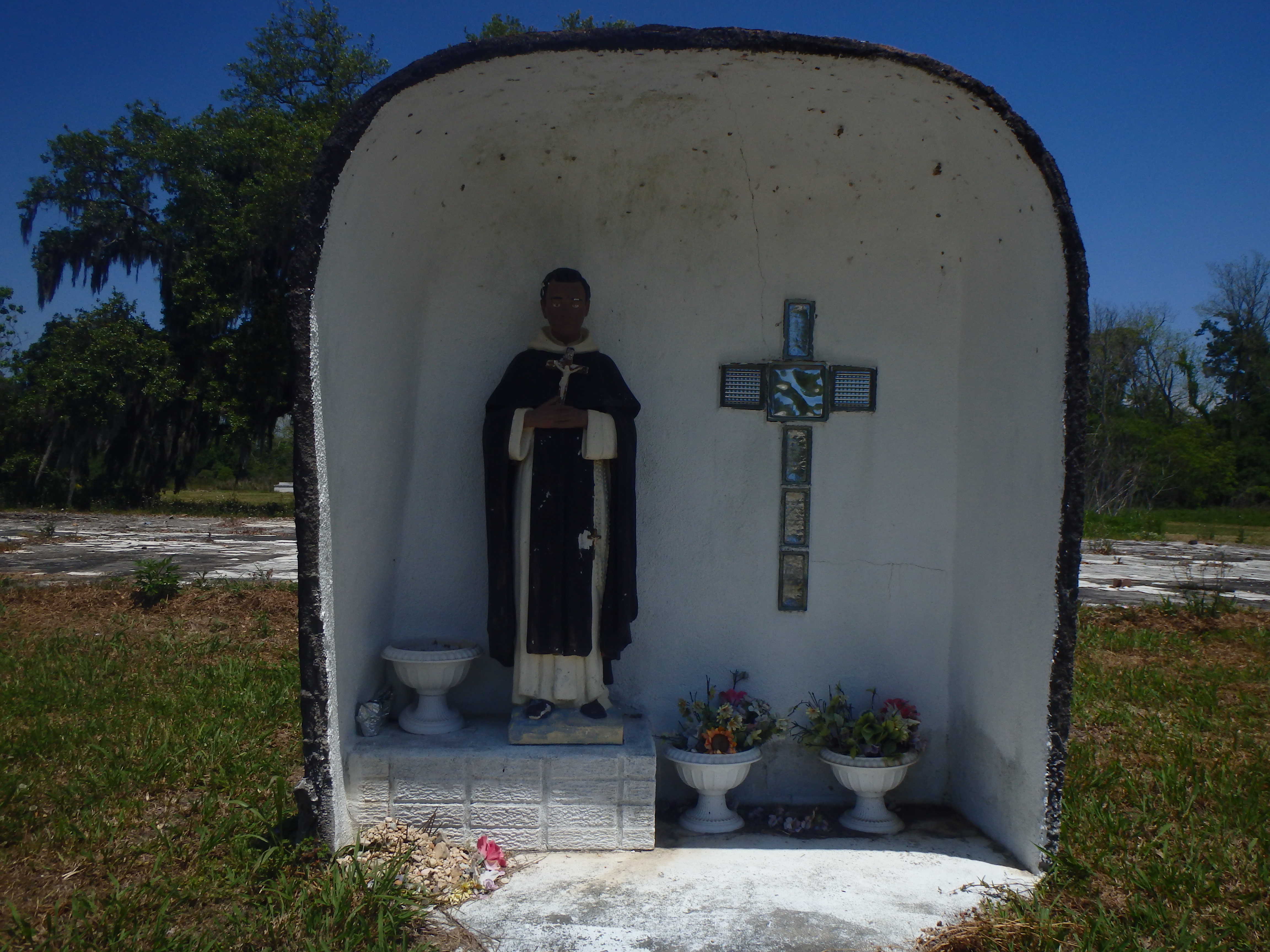
Roadside shrine.

My guidebook had not exaggerated when it said that there were no facilities between Pointe a la Hache and Poydras; for thirty-four miles there is not a single gas station, restaurant, grocery store, or anything else. I have often reflected on how important commerce is for community: we need public houses, and businesses are typically our public houses. This was my first extended run on the bike, and I was satisfied with the results: I finished the 34 miles comfortably in the course of the afternoon, seeing a great deal of what a stranger could see.

Yummy!

It was noticeable that I was moving away from the Gulf: the thickets on the side of the road were becoming true woods, with a rich variety of species. I saw what appeared to be mulberries with ripe fruit, and I stopped when I saw some more, and easily picked a pint of them. I found that the truly ripe ones were insipid, but fruits which were just shy of ripe – with some cells red rather than black – were extremely tasty. Over the next week I would eat a great number of mulberries, which I think are an underrated food source. A single mulberry tree can produce vast amounts of fruit in its season – I am told, enough to feed a pig for the two weeks of ripeness – and the tree is easy to take care of and never needs spraying. I remember last year a woman came in to the nursery to buy a mulberry. She said that she didn’t eat the berries herself, but her property always had the most remarkable birds during the summer, and then her mulberry was taken down by Hurricane Sandy. She swore her property was not the same during the summer without the mulberry – it had gone silent, the birds were gone. Customers like her were the reason Catskill Native Nursery exists – people who have realized that gardening is not just exterior decorating, but is the use of our intelligence to nourish life. This time, of course, it was nature’s intelligence, nourishing as it so often does my life.

Overgrazed, uncared-for pasture, coming up buttercups. Looks pretty, but looks can be deceiving.

Punctuating these woods were open fields where cattle were being pastured. I was surprised to see cattle farms in this area; the swamps did not appear naturally suited to the savanna ecosystem on which pasturage is based. Nor was I impressed with the results: the fields were coming up almost entirely in thistle and (especially) buttercups. Buttercups are in the Ranunculaceae family, which are almost all poisonous, and so are shunned by the cattle; but they had been allowed to take over the fields, so that it barely seemed any grass was growing there anymore. In older days weeds would have been hand-picked from such fields, or other animals would have been introduced that would eat the weeds – goats, for instance, have notoriously indelicate stomachs. And under natural conditions, buttercups will never dominate a field like this: this is the result of overgrazing, which has given poisonous plants a competitive advantage over nonpoisonous ones. Needless to say, pretty as the buttercups are, it is not pleasant, for someone who can see what is happening, to see pent animals grazing in a field of poisonous plants. There is something ominous and foreboding about it. It looks like no one is caring for the land. Every cattle pasture I saw south of New Orleans looked like this.

A stretch of road near the northern end of Plaquemines Parish ran by marsh again, as the sea approached closer.  As I biked past several times large animals plopped into the water; I had to look closely and go slowly to see that they were muskrat jumping into the water.  I was told I might see alligators along this stretch, but I did not.

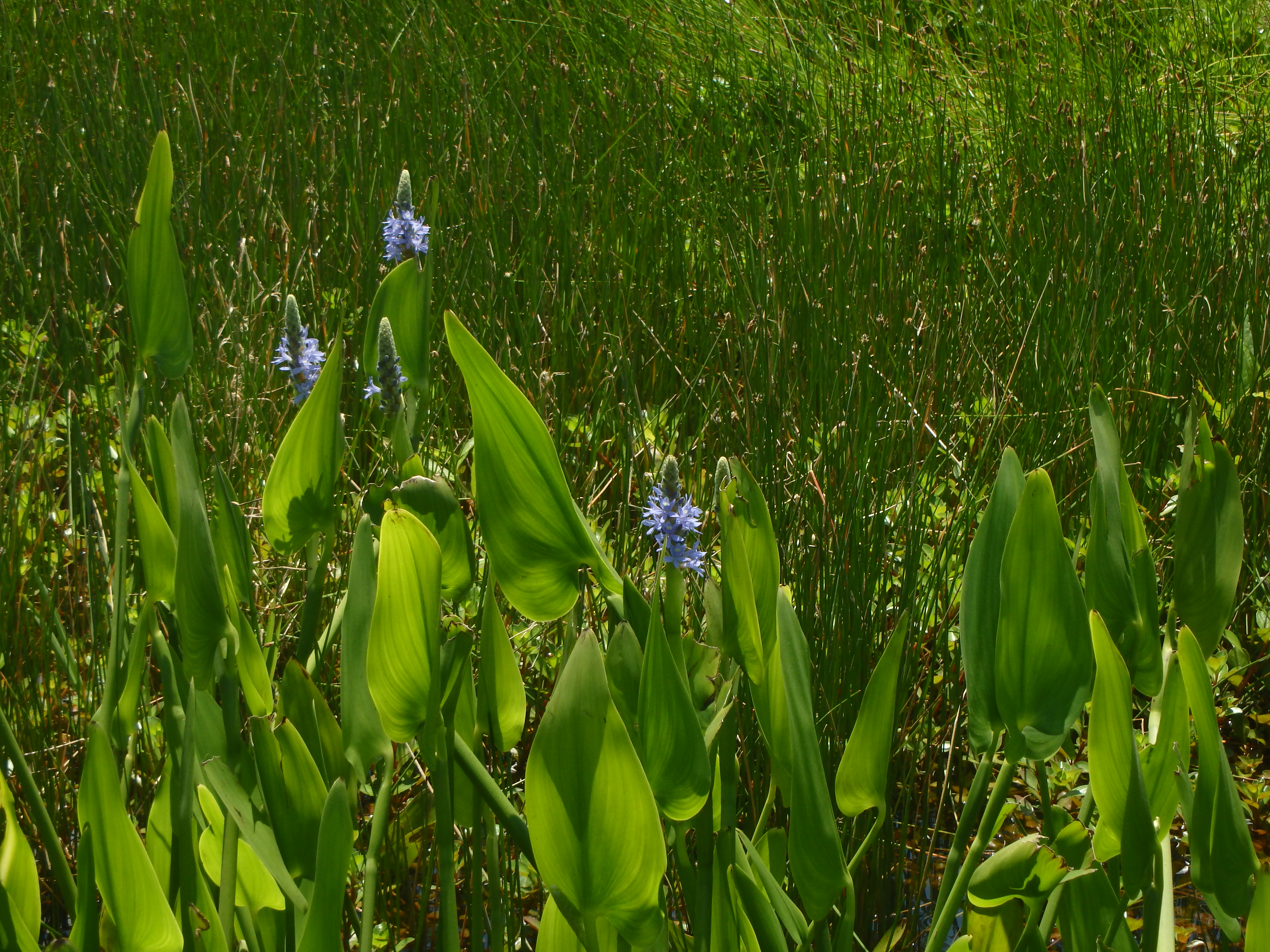
Pontederia cordata, pickerelweed.

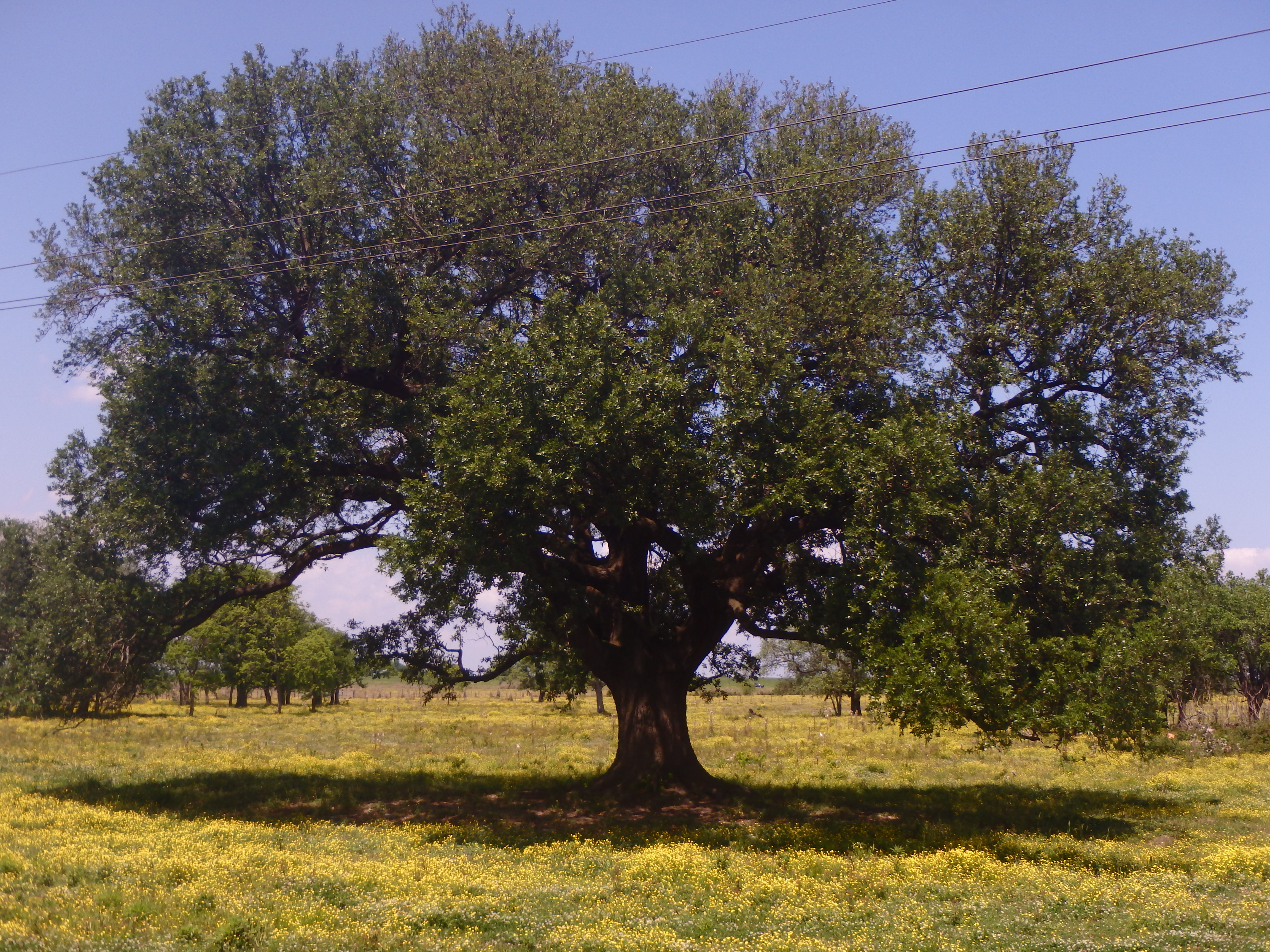
I had ample time for good botanizing on a stretch of road so deserted: besides superb, giant live oaks, I saw several choice species: Iris fulva, an unusual orange iris; Iris giganticaerulea, the giant blue iris; Hymenocallis liriosme, the spectacular spider lily; the first Tillandsia (Spanish moss) I had seen, and Pontederia cordata, pickerelweed, a beautiful blue-flowered swamp plant. I had fewer conversations with people than I had with plants: one with a veteran who did not appear to be compos mentis, and kept repeating over and over again that he had been “all over, Ko-rea, Washington, Seattle… lots of places, like Ko-rea, Washington, Seattle…” He had waved to me to stop because he thought I was “one of those guys… in the hunting cabins.” And a conversation with a black couple that I saw sitting by a ditch by the side of the road with a bucket. I simply had to stop to speak with them. What the hell were they doing sitting by a ditch on the side of the road with a bucket?

Pointe a la Hache.

17-May-14

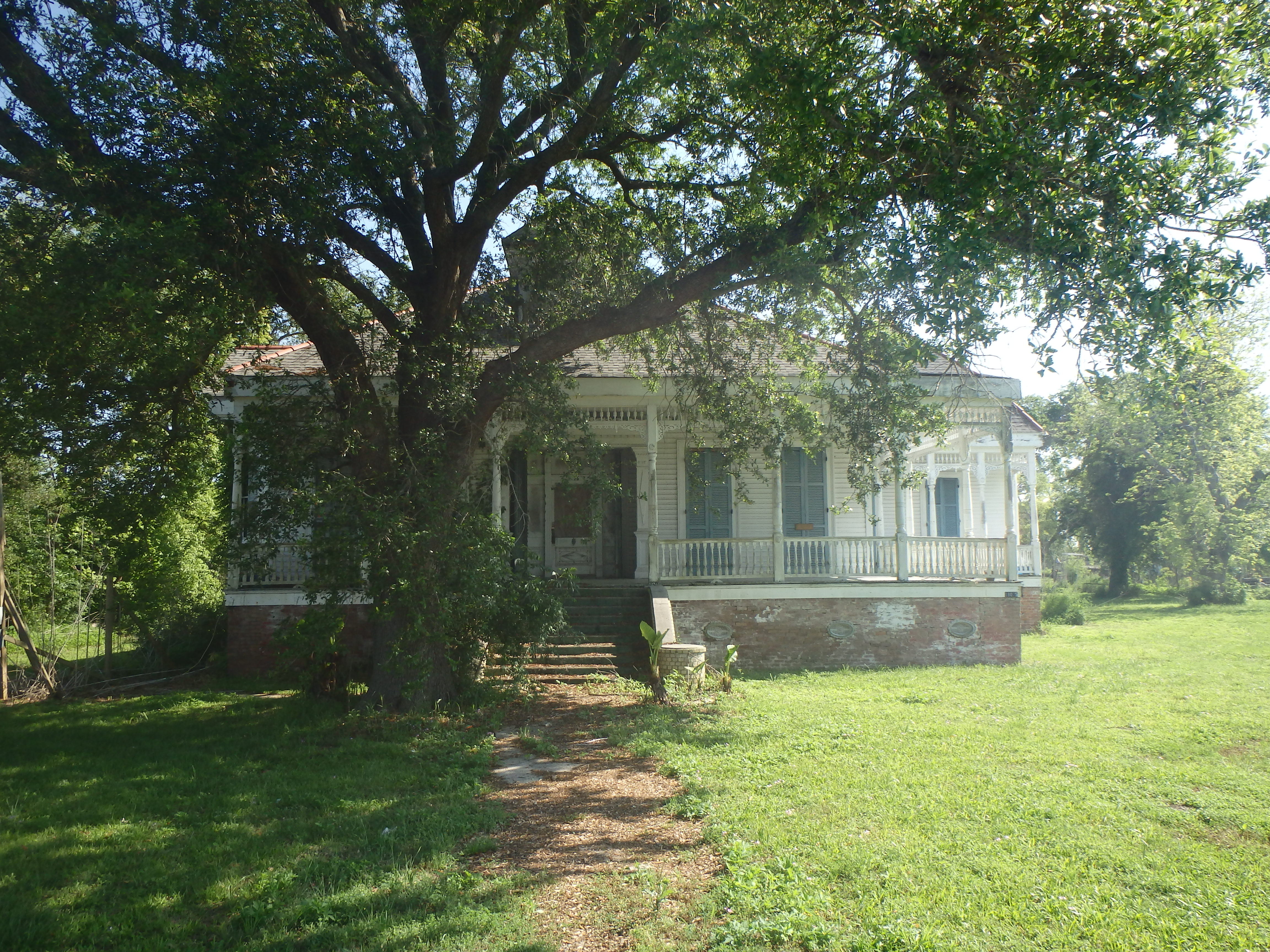
I landed on the eastbank and immediately the place was different. It was quiet here – no highway, and indeed, no people. There was a structure, right across from the ferry landing, which was actually old – somehow or other an old wooden house had survived the hurricanes. It was abandoned, mind you, but it was still there. It was the finest piece of architecture I had seen so far.

Across the street from it was a brick shell of a building which had been the courthouse. It had been operating recently – it had modern additions tacked onto it, and war memorials along its front of fresh granite, and the kind of signs that indicate a twenty-first century government building:

NOTICE

ALL PACKAGES, BRIEFCASES, AND CONTAINERS
SUBJECT TO SEARCH PRIOR TO ENTERING BUILDING.

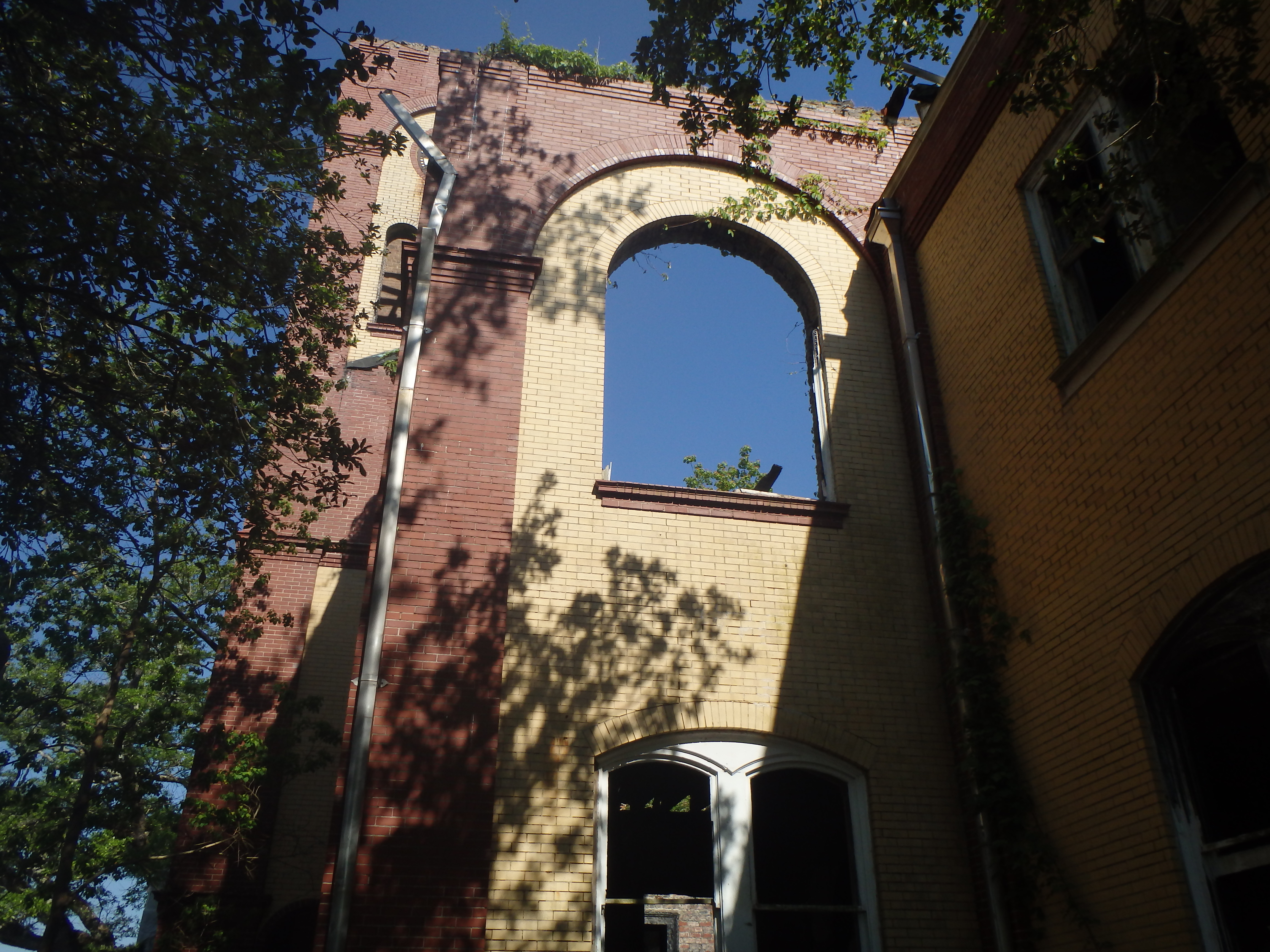
Old Plaquemines Parish Courthouse.

But it was just a shell, forty-foot-tall brick walls standing roofless under the blue sky. Charred timbers filled the enceinte of its walls. I was left to speculate if it had been flooded by the hurricane, and an electrical fire commenced, or was flooded and then set on fire by someone later, or something else. It was a striking enough ruin, with red brick arches through which the blue sky shone. It had become a kind of massive hive for large bees, resembling bumblebees. I don’t know if they were swarming particularly on this April day or if they are present in such numbers that they are always flying about, but it appeared that this entire hundred foot-long structure was their hive. They quite effectively deterred me from trying to explore within.

There was no one around. I ate my lunch under the tree in front of the courthouse ruin, and then walked around to the back, where I saw a post office in a trailer in the parking lot. Figuring whoever was working at the post office would know some things about Pointe a la Hache – and would also have time, given the complete desolation here – I walked over. As I came to the wooden ramp leading up to the door of the trailer, a woman in a post office uniform emerged with a can of wasp killer. She shook the can and looked up above the door.

“My God,” she said. “They just did that! That just happened! I can’t believe that!” She then took aim at a bee and shot some kind of foamy stuff at it. It buzzed around her, apparently unafraid, and she shot again and then swatted at it. It flew off. In her swatting she caught sight of me.

“It just put another hole in the wood!” she said. “Right now! In the last hour!” She pointed to a clearly visible dime-sized hole in the wood.

“What are they?”

“Wood bees,” she said. “They chew into the wood, they’re everywhere.”

“The old courthouse there seems to be their hive,” I said.

“Yeah… well they come from that tree over there,” she said, pointing to a bald cypress standing in what appeared to be the swamp, which began at the edge of the parking lot. She had a southern accent, but it was very slight. I could just barely pick up a slight lingering over her vowels. She had dark hair streaked with gray, and she looked fit and active and intelligent.

“How long has that courthouse been abandoned?”

“Oh… it burned down just before the storm. Then there was the storm, and… I don’t know. They say they’re going to fix it again, put the courthouse back on this side of the river.  I don’t know what will happen. You can see a lot of things got destroyed.” Indeed, we were standing in a weed-filled parking lot behind a ruined building, which was across the street from an abandoned house. The only thing functioning was the small trailer where she worked alone, waging a bardless war against a swamp full of wood bees.

“How much water was here?”

“Oh I don’t know. Probably over the levee. I was in Buras we had twenty-three feet there.” She paused. “It’s come back a little but… but not really. It’s mostly just trailers and mobile homes… when I was growing up we had a lot, we had hotels, all kinds of restaurants, we had stuff to do… we had three movie thee-ay-ters” – that word jumped out from her generally standard English – “we had one in Venice, one in Buras, one in Empire… now the kids today they don’t have anything to do… there’s the Whah” [the Y] “that’s got a swimmin’ poo but that’s about it.”

I spent about ten minutes later in the day while biking saying to myself over and over, “Swimmin’ poo,” and it did not get old to me.

“They say it’s gonna come back… I don’t know. You know my uncle he wrote an article I was looking at it… he wrote it in 1965, see we had Betsy in ’65 that was fifty years ago, before Katrina. He wrote the article just begging them to rebuild the coastline. Now they say they’re gonna do that but they shoulda done this fifty years ago. The bayous are all different we used to have mangroves and trees… all that’s gone. The whole land here has changed, you can tell.”

She said she was a few years from retirement, and then she’d “see.” It seemed she might have other places in mind to go. She seemed thoughtful and considerate, the kind of person who would spend her retirement going to wildlife refuges and looking at birds, thinking whatever quiet beautiful thoughtful thoughts those people think.

We parted warmly and I walked back over to my bike, determined to head north.  But after a few hundred feet I came to a store. My guidebook had informed me that this would be the last place I could get food or water today – the next store of any sort was on the other side of the campground I would be staying at, which was at the outskirts of New Orleans. So I decided to stop and hydrate. As I walked in I looked at the signs posted in the entryway, and one in particular charmed me:

It’s Summer Time If
You Are Looking to
Cool Off Call????
D-Money Waterslide
Contact: Desmond
(Tunafish) Simeon

Needless to say, I am always made happier by remembering that somewhere out there there is a person called Desmond “Tunafish” Simeon; even more so by knowing that I am near him, and can touch a piece of paper that ran through his printer.

Inside I admired the cashier, a thirtyish black woman who said things like, “You nee a bag chile?” She and a customer kept laughing and joking so much I just had to say, “I’m not from around here I’m from New York, and I just wanted to say what a pleasure it is listening to you two laugh and joke and talk. People around here HAVE FUN, and I think it’s beautiful.”

They broke into wide smiles. “WHAT? It’s not like that in New York??”

“No, in New York everybody works all the time.”

“Yeah,” he said: “it’s like they tense!”

She said, “You know, I’ve been to New York! One time. Yeah. You’re so right! Everyone there was like robots. Fast robots, but robots.”

He agreed. “You know I lived for a year in Huxtable Georgia you know every day I saw this woman she just waved at me, never came by to say hello or nothin. Never talked. Just waved – what the hell is that? Man, I’m not like that. I got to know you. I got to know you. We different here.”

I thanked them and took a seat with my drink. I downloaded the photos from my camera onto my computer, and discovered there was internet access there as well. So I got online and started sending emails, when I looked up and saw a muscular black man sitting down at my table with me. “Hey how y’all doin,” he said. “Where you from? I’m Zachary.” And after shaking my hand he started eating his lunch right there across from me. I couldn’t believe this. You didn’t need to be terribly extrovert to meet people in Louisiana: all you had to do was sit someplace and conversations would happen. He worked maintaining the levees, mostly mowing the grass; the levees are mowed in order to prevent trees from growing on them; trees, while binding the levees together while alive, rip out chunks of the levees when they fall, and ultimately weaken them. We discussed the animals found around here. He inquired very particularly about the deer in New York, and he sounded jealous when I told him how many we had.

“You got coyotes theh?”  It seemed to be a point of special curiosity for him, as if he had been waiting for the opportunity to ask someone from New York about coyotes.

“Lots. I hear them all the time at my cabin.”

With Zachary.

“They a new problem here… we never had ‘em before.”

“Well, they’re not a problem. Something’s got to eat the rabbits, right? You said there are lots of rabbits here.”

“Well that’s the problem I want to eat the rabbits, so I don’t want no coyotes! We catch the rabbits all the time.”

“You catch stuff, huh?  Is there any fur business around here anymore? I hear that used to be a major industry around here.”

“Yeah, that used to be… no mo. They used to catch muskrat.  Now they got that nutra-rat.”

“Yeah I’ve heard about them, don’t the coyotes eat those?”

“Oh no, the coyotes run from them, they get fifty pounds! Imagine a fifty-pound rat? That’s a nutrarat.”

The nutria, an introduced species, has caused problems by eating local vegetation so thoroughly that it compromises the physical structure of the swamp.  There was a government program encouraging hunters to kill them.

“The nutrarats, you get fi dollahs a tail if you bring ‘em in.”

I got one of the other diners to take a picture of me and Zachary. I felt hydrated and ready to strike north.

First Cross.

15-May-14

The ferryman.

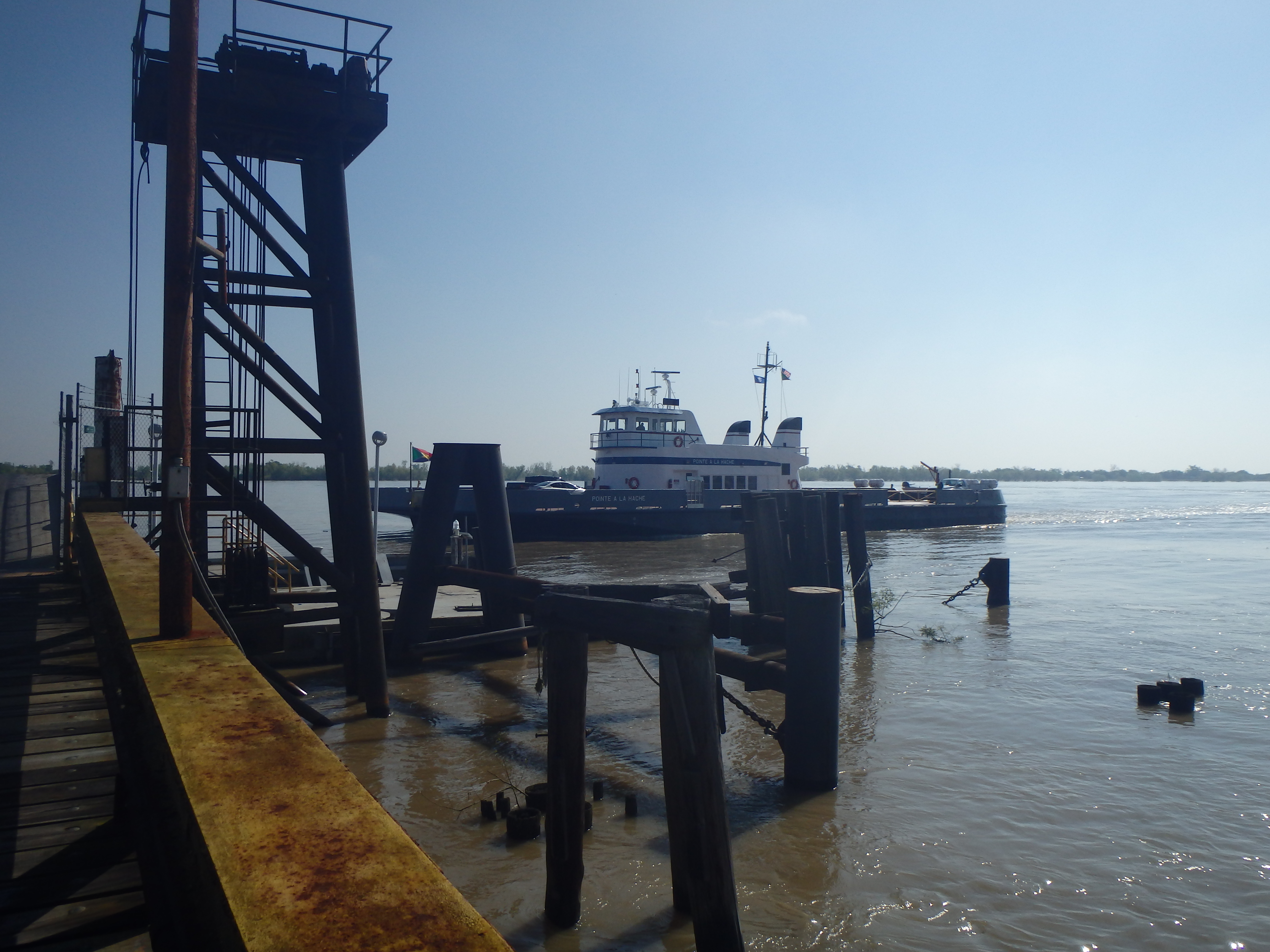
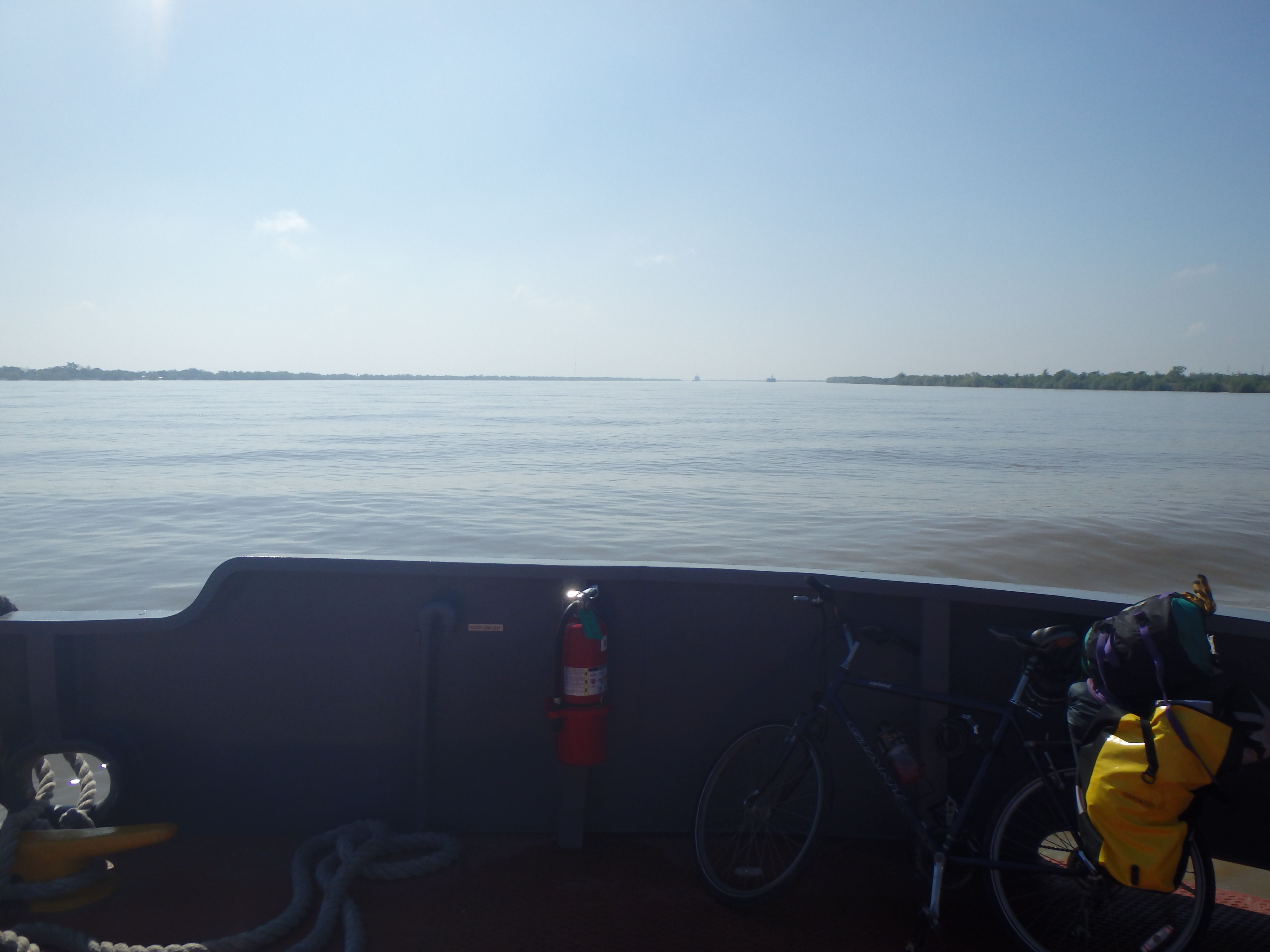
I was in one hell of a good mood about riding the ferry. Both the other riders were in their cars, however, and there were no workmen on the deck; so I had my excitement all to myself. I sent a few text messages because I couldn’t help myself: this was my first Mississippi crossing on the trip. And I was beginning to make some kind of progress: I had started in one place, biked somewhere else, camped overnight, and now was continuing to progress. I had made it to something I had only read about before: a Mississippi River ferry. I was at a place called West Pointe a la Hache.  It was all fabulous.  I felt that my back was starting to feel a bit better as well: it had not felt good when I first woke up, but the warmth and exercise were loosening it a bit.

When a workman came out to lash the boat to the eastbank dock, I couldn’t help talking to him. “This is a big river!” I said.

“Yup.”

“I’m biking all the way to Minnesota! Gonna do the whole river!”

“The ho rivuh? You crazy? That’s a long way.”

“That’s what I’m doing.”

“Where you start?”

The River at Pointe a la Hache.

“Venice.”

He thought about it. “How much time you givin’ it?”

“Six weeks.”

He thought some more. “Six weeks, yeah, that’s bout right.” He looked at me, as if evaluating me.

I liked what he said next. “I think you gonna make it.”