Skip to content

More from the Peg-legged Transmissionist.

01-May-14

Alapayevsk I forgot this one: when I gave Troy the maple syrup, he said:

Novaya Balakhna “Sez hee-ir ‘Cape refrigerated.’  Gotta do that, huh?”

“Only after you’ve opened it.  It’s fine now.  But if you open it, yes, put it in the fridge.”

“Whaz that?”

“You know, it’s sugar, so something will eat it… mould, bacteria, something.”

“Thayre’s some papil in Kentucky that mould and bacteria’s the only culture they’ve got.”

In the Smokies.

01-May-14

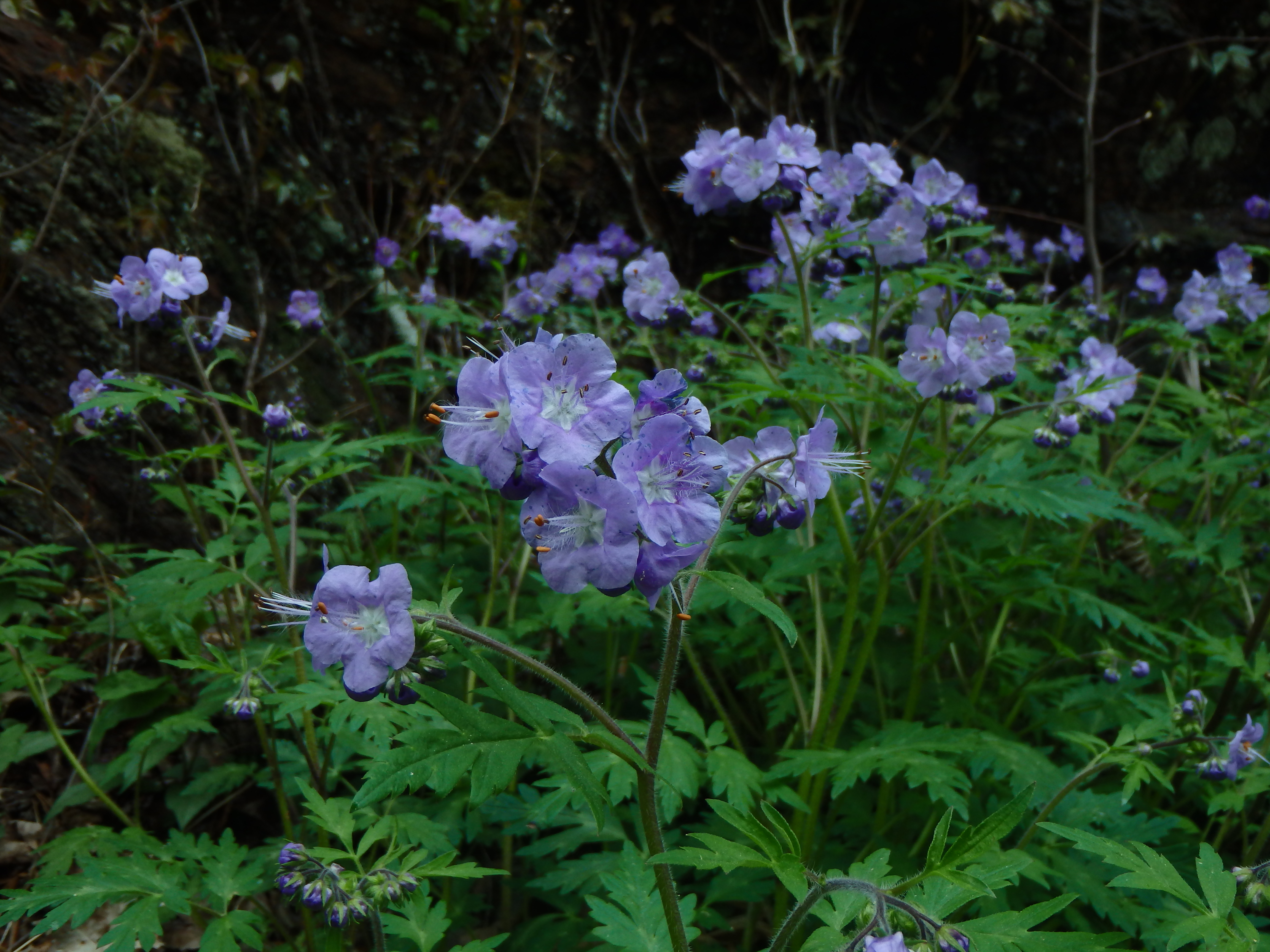
Phacelia binnatifida.

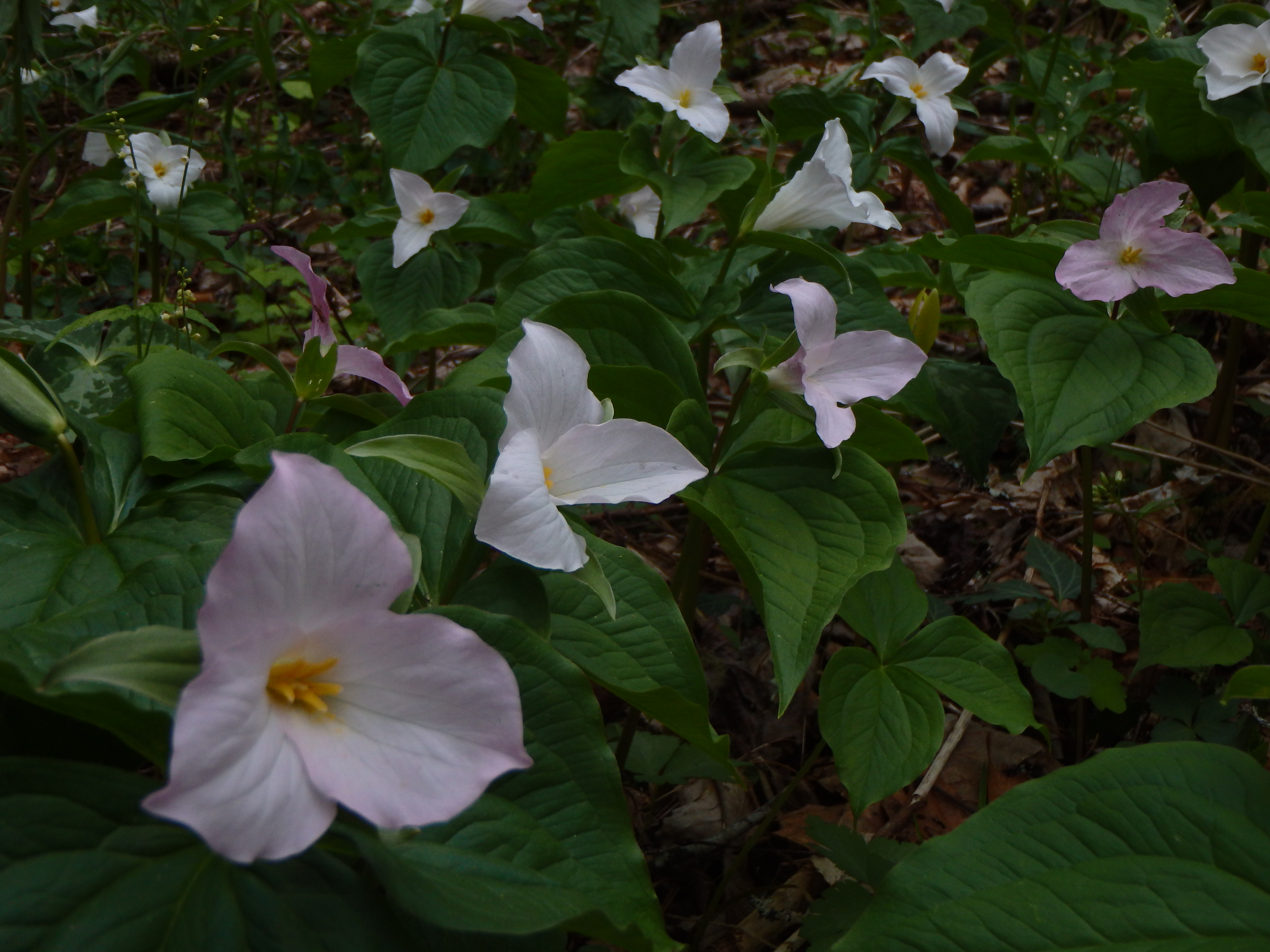
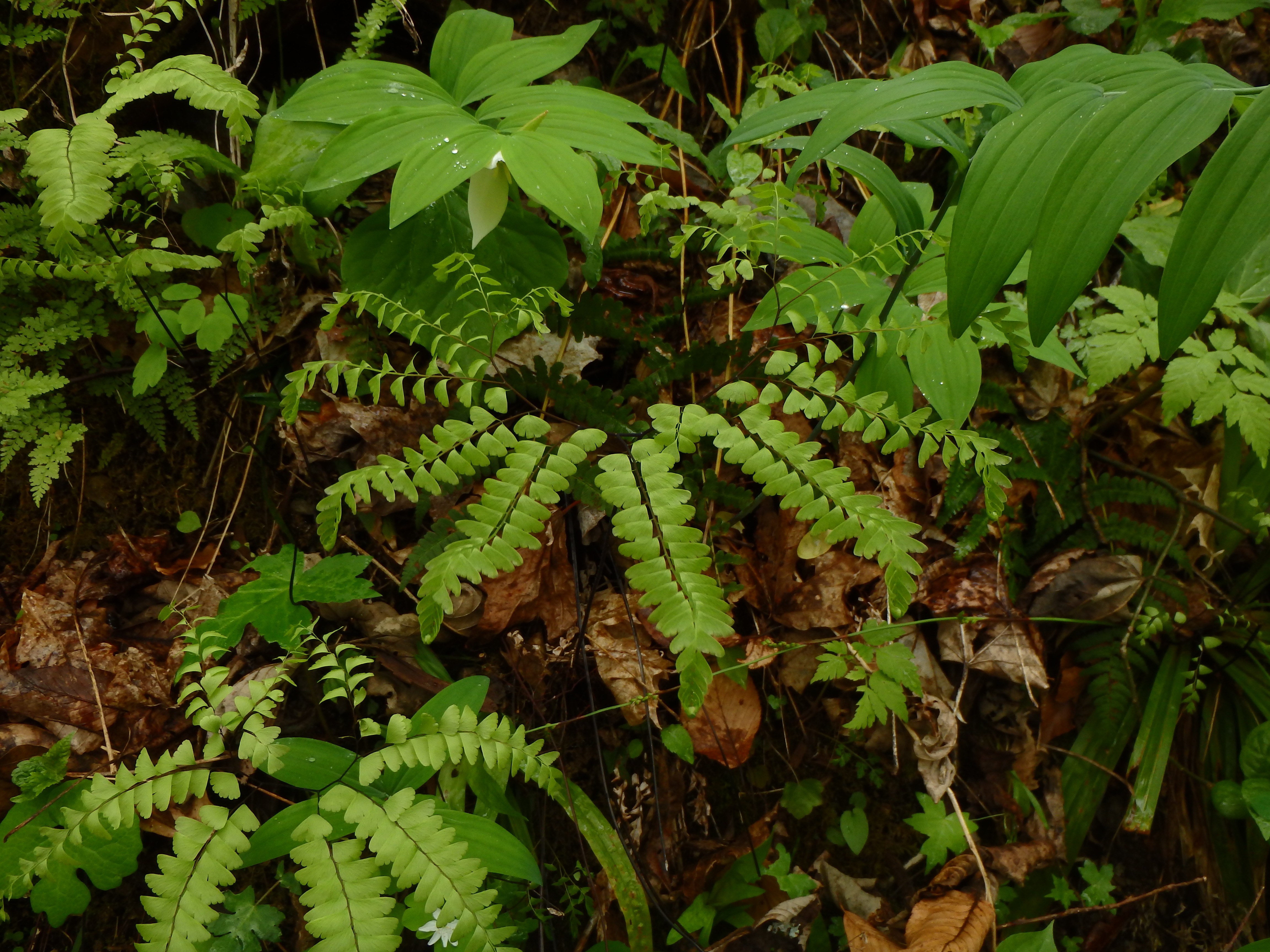
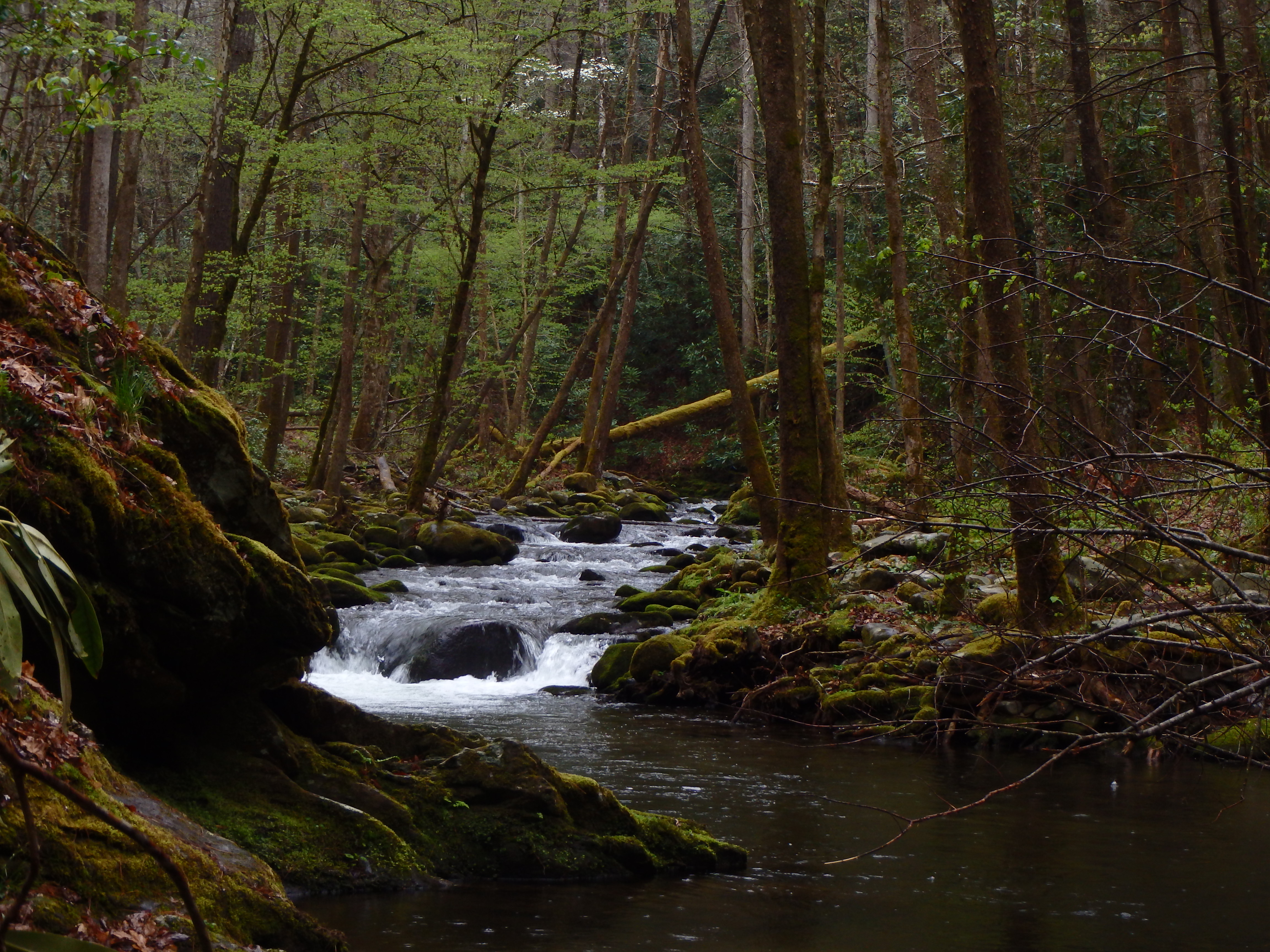
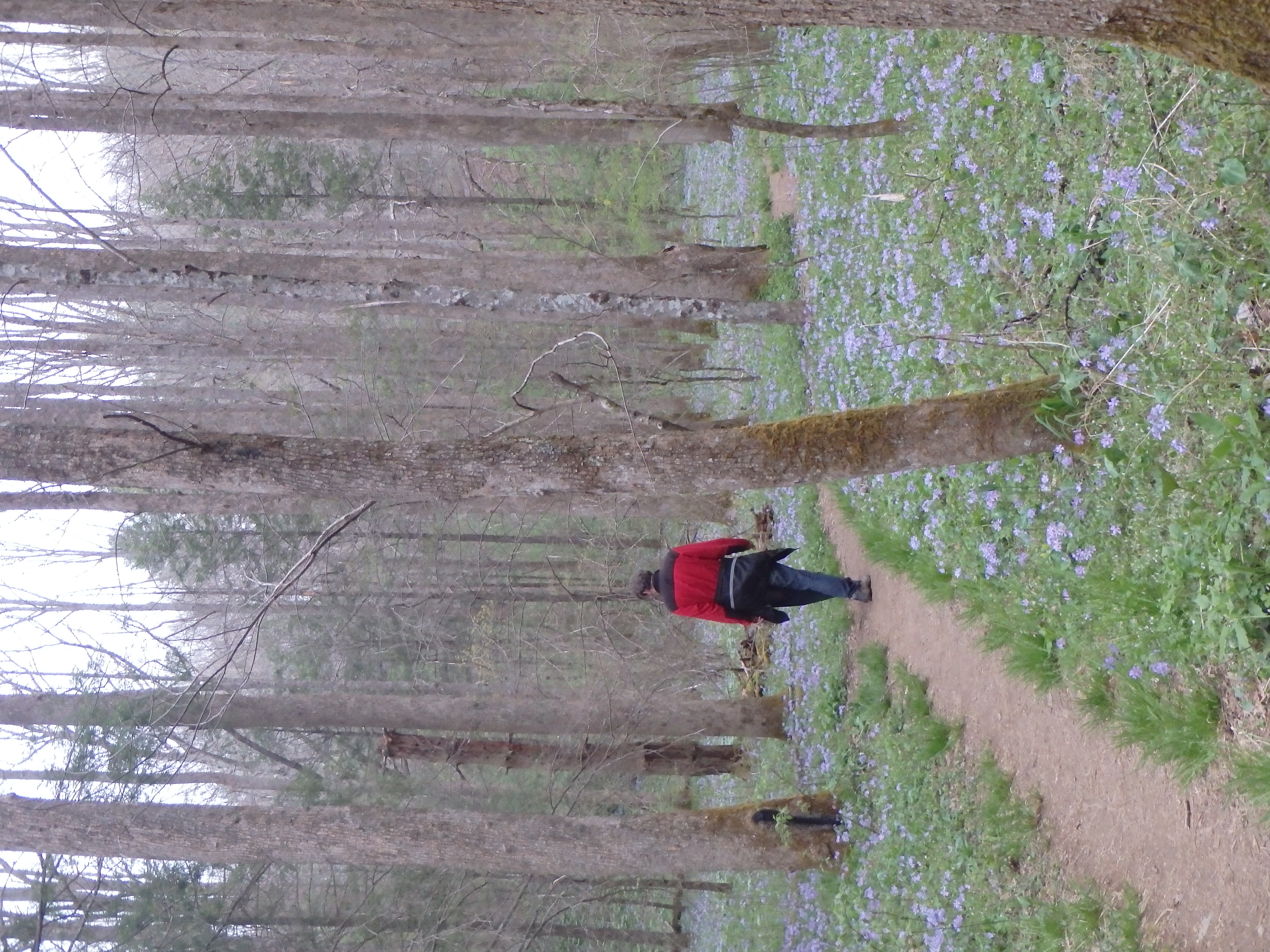
We camped out in the Smokies one night, and went on two hikes, one down to the White Oak Sinks, and another the next morning along the Chestnut Top trail.  Both are in the same area of the park, and at approximately the same elevation, but there really was no time for a thorough exploration, nor was there need to drive to distant parts of the park: all that was really necessary was to be out of the car.  I knew most of the plants I saw, but I knew them only from books or the nursery trade: most I had never seen growing wild.  My favorite were the trilliums: Trillium luteum and flexipes were everywhere, and I saw Trillium grandiflorum for the first time in the wild.  The floor of the White Oak sinks was covered in woodland phlox (Phlox divaricata), and all through the park the purple phacelia (Phacelia bipinnatifida) – which until corrected I thought was a Geranium of some sort – was quite spectacular.  Mr. Langdon, the park biologist I spoke with, informed me that he had measured densities of this plant approaching 2,000 flowers per 4 meters squared.  When I return, though, the plant I will ask for the highest concentration of is the flowering dogwood, Cornus florida.  I saw only scattered individuals, but if there’s some part of the park where they grow close together I would love to see it.  They are so lovely.

Life everywhere.

The place was the woodland garden all the woodland gardeners of the world want, and a landscape designer could learn endlessly about plant combinations and plant habitat there.  It’s not clear how many things I observed in the park are actually reproducible elsewhere: the park has abundant moisture, undisturbed old-growth forests,  and, what we do not have elsewhere, a well-knit, functioning ecosystem, with wolves to hunt the deer.  The result is a place where the mind of the mountain still dwells – a most difficult thing to put back together again, once it has gone.  But nature had put life everywhere, in every little corner, and so much of it was so different from the other life – there weren’t just ten species through the park, everything was mixed up everywhere.

As we walked along we met a number of people – mostly nice old ladies – who were looking at the flowers intently.  I identified some wood-betony for one group, and when I heard another group debating whether or not “it” was very close and they should keep going, or far away and they should turn back, I stopped and asked them what they were looking for.

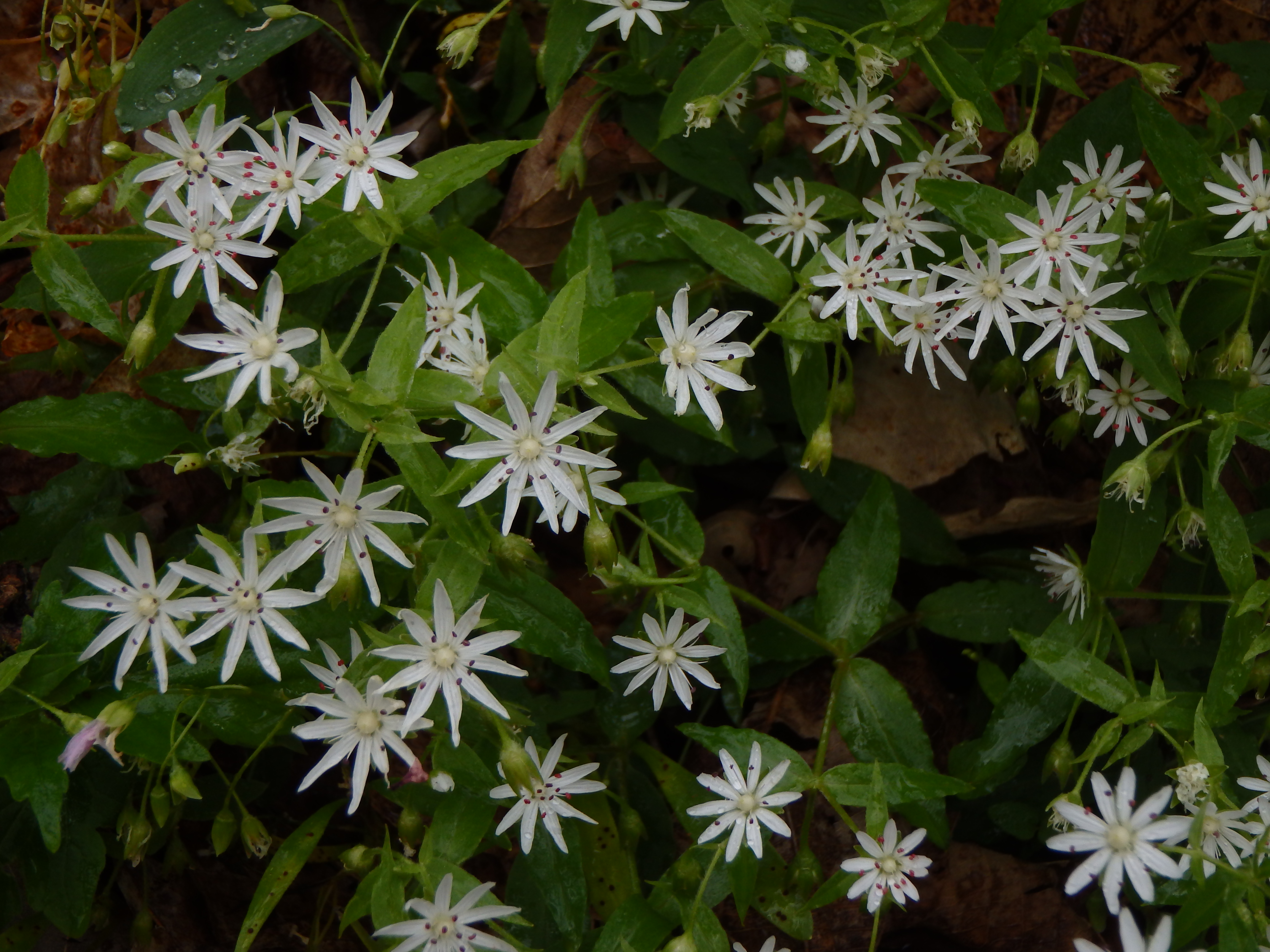
Stellaria pubera, the star chickweed. I love this plant.

“The trayling arbutus?” she drawled.

“It’s just around that bend,” I said.  “You’re right there.”

“Oh Ah’m sorry Ah didn’t think you were here for the Pilgrimage!”

As we walked down the trail Catherine said, “I guess you should have a beard and tan shorts and binoculars around your neck and be twenty years older, that way people would recognize that you know something about plants.”

I had begun speaking like Troy full-time by now.  It drove Catherine crazy, but she did laugh.  “What the hayl they musta thawet ah was a moron!  You wear a National Guard flayce, they all thank you probably a moron.”


John Muir.

30-Apr-14

Crossing the Cumberlands:

Awoke drenched with mountain-mist, which made a grand show, as it moved away before the hot sun.  Passed Montgomery, a shabby village at the head of the east slope of the Cumberland Mountains.  Obtained breakfast in a clean house and began the descent of the mountains.  Obtained fine views of a wide, open country, and distant flanking ridges and spurs.  Crossed a wide cool stream, a branch of the Clinch River.  There is nothing more eloquent in Nature than a mountain stream, and this is the first I ever saw.  Its banks are luxuriantly peopled with rare and lovely flowers and overarching trees, making one of Nature’s coolest and most hospitable places.  Every tree, every flower, every ripple and eddy of this lovely stream seemed solemnly to feel the presence of the great Creator.  Lingered in this sanctuary a long time thanking the Lord with all my heart for his goodness in allowing me to enter and enjoy it.  Discovered two ferns, Dicksonia and a small matted polypod on trees, common farther South [probably Resurrection Fern, Pleopeltis polypodioides].  Also a species of magnolia with very large leaves and scarlet conical fruit [probably Magnolia tripetala].  Near this stream I spent some joyous time in a grand rock-dwelling full of mosses, birds, and flowers.  Most heavenly place I ever entered.  The long narrow valleys of the mountainside, all well watered and nobly adorned with oaks, magnolias, laurels, azaleas, asters, ferns, Hypnum mosses, Madotheca, etc.

From his A Thousand-Mile Walk to the Gulf.

The Vision of the Secret of the Mind of God.

30-Apr-14

Being Pro-Life In Tennessee.

30-Apr-14

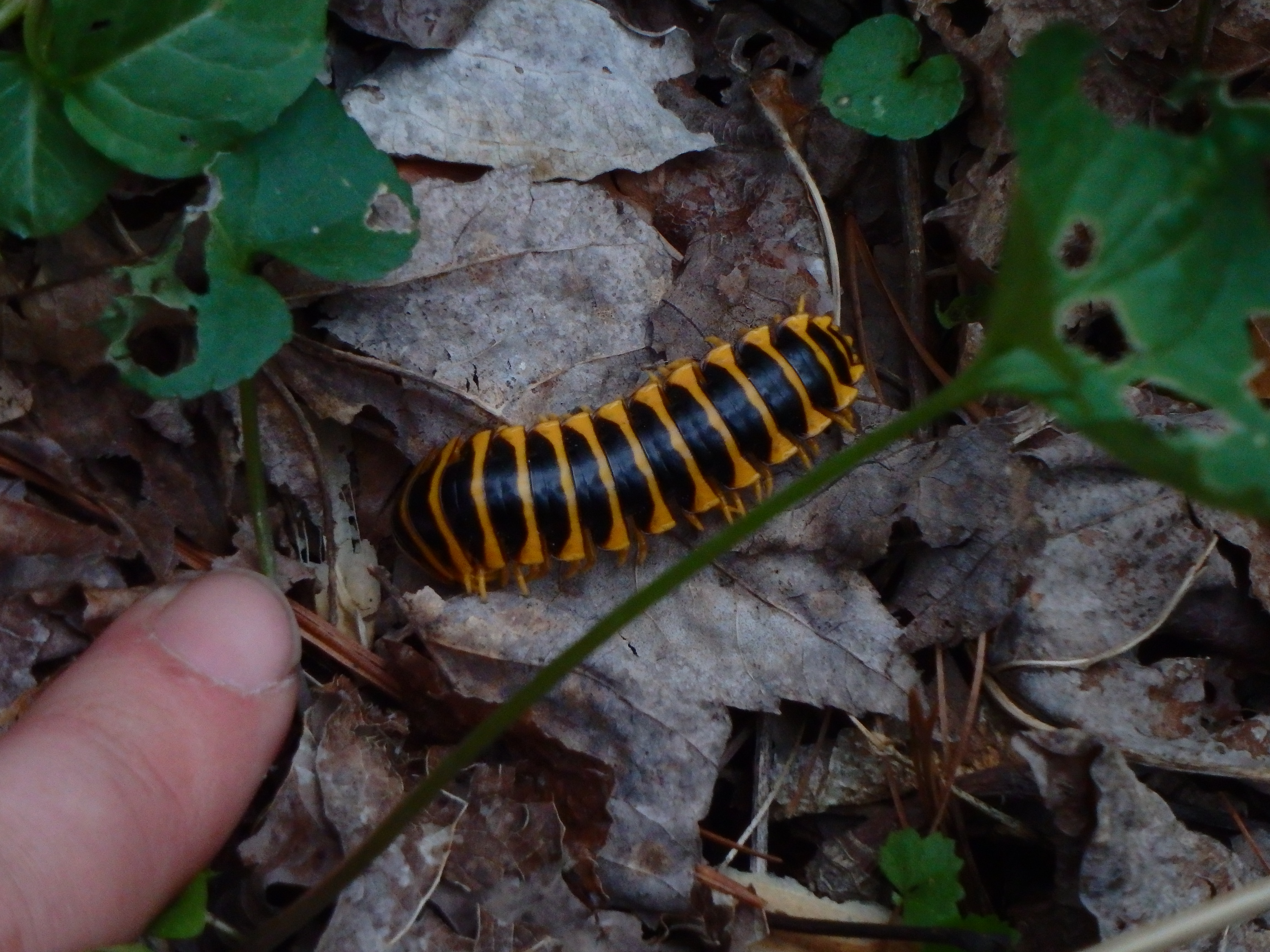
I'm not even sure what this guy is, but he's lovable too.

When I was a child of maybe ten or eleven, I remember hearing a bunch of teenagers talking about a recent camping trip they had been on. There was a stream by their campsite, and they walked up the stream, catching every frog they could, and then smashing them. “We musta gotten fifty frogs!” they laughed. “It was crazy.”

I can still remember my child’s indignation upon hearing this – the kind of indignation which is holy. It is certain and sure, having all the moral authority of innocence: that protests against the fatuous carelessness of adults, that refuses to give up its sensitivity to what is beautiful and true, that will not trade what it knows for all the horrid conformity that reconciles us to man’s endlessly brutish relations with life. I knew that what those boys had done was desecration. And I knew this despite the fact that I was no saint. I used to pour salt on slugs in the backyard, and go out of my way to stomp ants as I walked on the pavement. But in this instance I knew something terrible had been done. Perhaps it was because it had happened in the Catskills – a place I had seen only a few times but knew that I loved – or, in the terms of childhood, knew was sacred.

Years have only convinced me even more of that childhood intuition. Now, indeed, I try to expand it with principle: I know I am at my best when I catch the moths who fly into my cabin and let them out, even if I do not always feel like going to the effort. I know that we must shape our lives always to nourish and respect and cherish the lives around us. Once I saw a friend working to coax a fly in my cabin toward a hole in my windowscreen, and I saw in an instant how lovely she was. That sense of the sanctity of life is our highest opinion: we do not always live it, but when we do we can feel how the belief elevates us. And we may call in facts to make the case for such a belief: when you think about the fact that you can go not just a million, not just a billion, not just a trillion, but twenty-five trillion miles into space – the distance to Alpha Centauri, the nearest star – and not come upon anything living at all, not so much as a mosquito or a duckweed – and likely you can go not trillions but quadrillions of miles into the lifelessness that surrounds us without coming upon anything alive – is that not scarcity enough to make life precious? Does not that backdrop make every living thing on earth with us valuable? Indeed, apart from life there is no value at all. Is this not completely obvious?

Monarch butterfly, from my garden on Wildcat Mountain.

It is obvious, but it is the obvious things we cannot convince others of. I was speaking of the plight of the monarch butterfly to someone I met on this trip, and he said, “What do you care if ninety-eight percent of these butterflies die off in two years? Why care if they all die off? Man, I’m all about Darwin. If they die off, that’s because they’re being replaced by something better, that’s all.” What can you say to talk like this? Fire is not hot until you are close to it. And when you are in it, that’s all you can think about. Have one of these butterflies land on your hand; you will know it is sacred. You will know it is of far more worth than the majority of the things the majority of people go to work for, the majority of the days of their lives.

And what better thing can I say about our visit to the Smoky Mountains, but to say, that it made me a child again. That place makes me burn with reverence: I go there and everything is so alive, so harmonious, so balanced and beautiful. The first time I ever went there I drove past a large field, and a big mama black bear and her two cubs were grazing at the edge of a field – grazing, like cows, from a distance it looked like they were just eating the grass. I can’t quite explain how it made me feel, to just stop the car there and watch them from the other side of the field. It was holy. Or, in adult terms, I loved it.

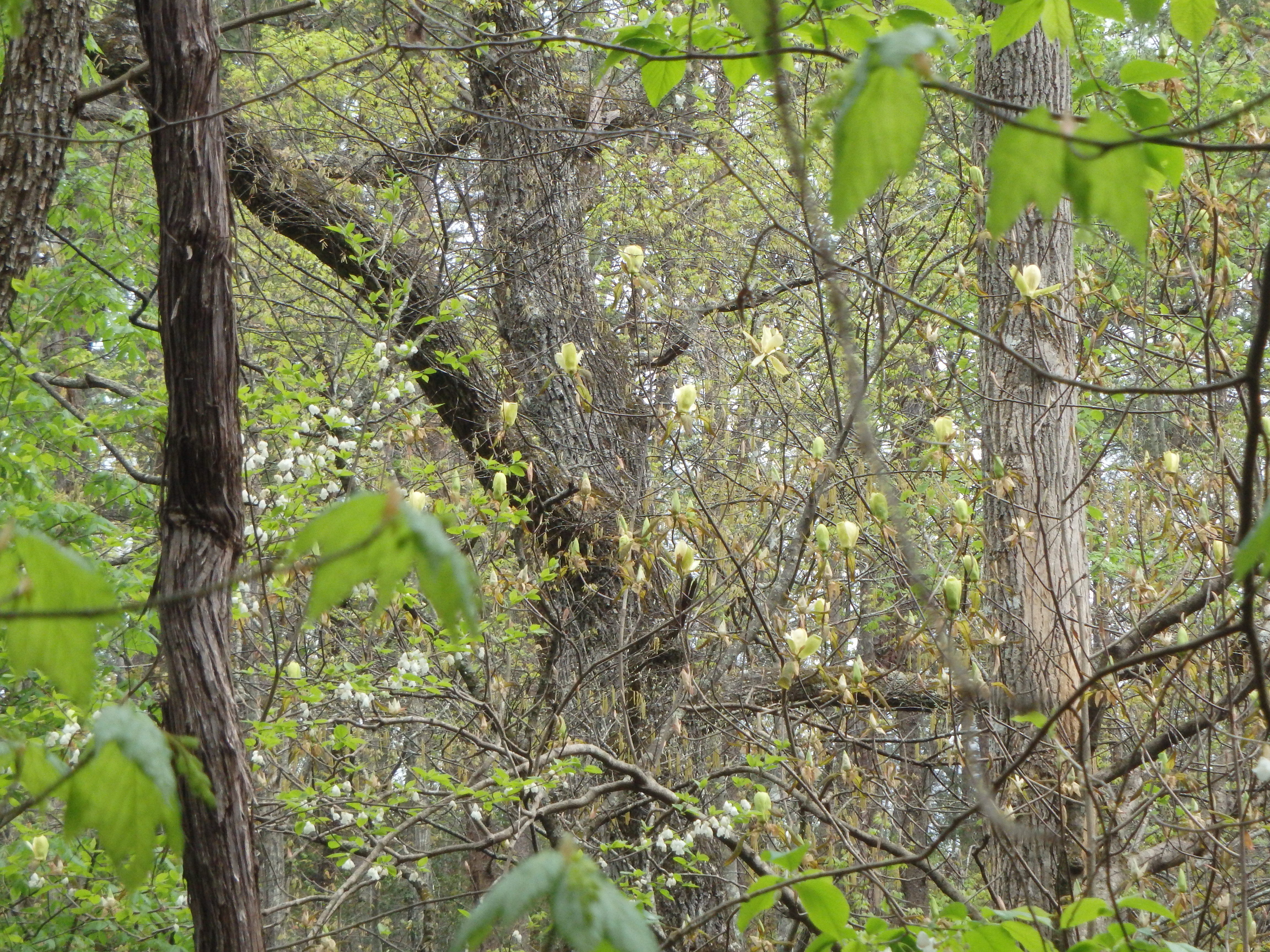
The beloved Magnolia fraseri, just beginning to bloom.

So I returned to the Smokies, and was lit on fire again. And I could love the way God asks us to love: not just with all my heart and all my soul, but with all my mind and all my body as well. As we walked along at the top of a ravine, I stopped: across on the other side of a ravine was a magnolia – a MAGNOLIA! Growing on a wild mountaintop! Growing as they have for a hundred million years! I was pretty sure it was Magnolia fraseri, which I had never seen in the wild before, and so I just had to – had to – plunge down the ravine, cross the little brook, and come up the other side to look more closely at this plant. To do so I had to plunge into a tangled thicket of mountain laurel and rhododendron; climb over massive fallen trees that choked the ravine; and put my feet into any number of doubtful places, praying all the while that no copperheads were planning to sink their teeth into the first ankle they had seen in years down there. I sweated and I strained and otherwise showed my love with my body. Like a physical creature – as a physical creature – I had to touch, to see, to feel – that had to be part of my love. And as for my mind, well, I had filled my head with all these plants for years, and now, there in the Smokies, all that training I had given myself was put to use. It was tested and pushed, in fact, as I encountered many many plants I could not identify even to genus.

Why the Smokies should be so different from all the other mountain ranges of the world is not immediately clear. But they are different: they are the most biodiverse temperate area in the world. I have already mentioned the All Taxa Biodiversity Inventory, which is attempting to create an inventory of all the species of living things in the park. There are more species of plants found in the park than are found native to the entire European continent, from Sicily to Sweden.

One of the best theories for this biodiversity is that the Southeastern United States was near the center of the supercontinent Pangaea, and all sorts of different plants and animals met in that area. It is certainly the case that a great number of very old forms of life – such as magnolias and their close allies the tulip trees – are found here. Many monospecific genera – meaning genera which remain today only in single species – are here. To use my friend’s language, it is like a place where “Darwinism” (in the limited, dumb, human sense) does not exist: where it is not competition and extinguishment, but preservation and benign neglect, where living things can wander into the mountains and get lost, living changelessly on while the world around them alters.

There are so many beautiful things here: Adiantum pedatum, Trillium flexipes, Maianthemum racemosum, Carex plantaginea, Stylophorum diphyllum... and more too, all in harmony.

Mountain ranges typically are strongholds of biodiversity, as elevation can isolate different populations onto “climate islands,” and speciation occurs more easily in such isolated populations. The Smokies are also one of the oldest mountain ranges in the world, its uplift having occurred in Ordovician days – four hundred fifty million years ago. That is to say that the rock on top of Mt. Mitchell has been six thousand feet in the air for half a billion years (much rock has been eroded from on top of that rock, but it itself has been in its place for that length of time). Before there were dinosaurs, there were the Smoky Mountains.

The area was also never glaciated, which makes it extremely different from the northern parts of North America. From about New York City north there were no plants at all a mere fifteen thousand years ago. Everything we have has been the result of the rush north since the last Ice Age. In the Smokies, however, plant life has gone on uninterrupted in all that time.

All this would be academic if it were not possible to sense the truth of all this when there – but this is entirely possible. Indeed it is obvious. In the Rocky Mountains and in the deserts there are some amazing floral displays because the blooming season is so short: everything has to bloom at once, for the snow-season, or the dry season, is coming within a month or two. The Smokies have floral displays to beat them all, not because of the brevity of the season, but because of the abundance of life. In April the spring ephemerals bloom; in May the trees and shrubs bloom; in June the composites begin in earnest; and it all goes on right until frost. The fact that the place receives so much and such consistent rainfall – 75 inches spread evenly throughout the year – only helps. It is the damp garden of the clouds.

We ended up spending less than twenty hours in the park, but it was still one of my peak experiences. We first drove to the campground and set up our tents in the light rain; we then headed immediately for White Oak Sinks, bringing along a flashlight in case we were caught out in the darkness. But of course it took us awhile to get there, because time and again I had to pull to the side of the road and hop out to inspect some amazing treasure by the side of the road: and this despite the fact that I could not get out of the truck without pain, and I often hobbled to the flowers with back bent, unable to straighten up for at least a minute or two after rising from a sitting position. I still got out to look at these beauties. It really was quite remarkable: along most roadcuts, invasive species come right in and advance along the line of human disturbance. But in the park the ecosystem is so well-knit and robust the human disturbance seems to be only generative: columbines bloomed in the rockcuts, and dense patches of yellow trillium and purple phacelia creeped up right to the roadside. Up the creeks we could see the slender-branched dogwoods blooming silently in the woods. It was all so precious – I felt that if I had had to go twenty-five trillion miles for this experience, I would have considered myself lucky to have gotten there just to see it, just to know it was there.

At the time I had just finished John Muir’s Thousand-Mile Walk to the Gulf, a remarkable book. It does not have developed themes nor is it complete or even clear at times. But it is the transcript of a man who was lit ablaze by the sense that life was holy. Having been infected with some kind of disease of the eye, for which several weeks in darkness was prescribed as treatment, Muir emerged with a fear that the sight of beauty – the nourishment of a certain kind of soul – might be lost to him forever. And so, considering how his light was ill-spent on most of the occupations of men, he set out,

making haste with all my heart to store my mind with the Lord’s beauty, and thus be ready for any fate, light or dark…. I bade adieu to mechanical inventions, determined to devote the rest of my life to the study of the inventions of God.

Along the way he sees many plants which were probably not new to science, but they were new to him, and that was all he needed. You can feel the joyousness springing off his pages:

The sun was gilding the hilltops when I was awakened by the alarm notes of birds whose dwelling in a hazel thicket I had disturbed. They flitted excitedly close to my head, as if scolding or asking angry questions, while several beautiful plants, strangers to me, were looking me full in the face. The first botanical discovery in bed! This was one of the most delightful camp grounds, though groped for in the dark, and I lingered about it enjoying its trees and soft lights and music.

With the Phlox divaricata.

At one point he says that he “met a strange oak with willow-looking leaves.” It is wonderful to read such a thing: I may say that I first really began to be interested in botany, when visiting Chapel Hill of North Carolina. I found there a tree which from its shape I took to be an oak, but as I drew closer I saw it had willow-like, unlobed leaves. “Well, I guess it’s not an oak,” I said. But then I saw acorns on its branches; it was an oak, but unlike any I had seen before. It was a willow-oak, Quercus phellos. This slight change from the flora of New York to North Carolina filled me with interest, and I wanted to know more. That tree had been a discovery to me, and early in his career it was a discovery to the northerner Muir as well. Seeing that – and recognizing his passion on the page – filled me with joy, that there were other existences like mine, that not all were sunken too deep into the apathy to ever get them out: there were brothers out there. Sunt lacrimae rerum, says another one of those kindred spirits, et mentem mortalia tangunt.

Knocking on Heaven’s Door.

29-Apr-14

We woke up in Sevierville and walked over to a pancake breakfast place. It was indicative of this area of Tennessee: the entire approach to Great Smoky Mountains National Park is lined with tourist-themed businesses, motels and restaurants and putt-putt golf places, in a profusion that I could hardly believe. Many people complain of the crowdedness of the National Parks, and if that is true anywhere, it is true here: more than nine million people visit the park each year, more than double the amount who visit any other national park. The area was crowded on a weekday morning in April: I can only imagine what it gets like during the summer. Much of the development, which was entirely car-driven (remember, we had tried to eat downtown the previous night, and found not a single option open at 8 p.m.), was big chain restaurants and hotels: you know the familiar signs by the roadside, Holiday Inn and Motel 6 and Wendy’s and Chili’s and all the rest (literally, all the rest). But a lot of places were local: this pancake house was not a chain, and it was made to look like a log cabin. Inside there was also a knick-knack shop, selling those souvenir license plates for people with names like “Jayden” and “Dylan” and “Dillon” and “Madison,” as well as teddy bears and keychains and wall hangings that said things like “Bringing your husband shopping is like going hunting with the game warden.”

Dollywood is nearby, along this same stretch, which is the same phenomenon of a locally owned tourist development.

I admire local business, and I also kind of like how useless and dumb tourist shops are, but that will not change the fact that the worst thing about visiting the Smokies is having to run this gauntlet of stop-and-go tourist-drivel sprawl. An hour of driving in such conditions exhausts me; and we would end up spending all day in it. It is worth detouring to avoid this approach.

Back from breakfast, I spoke with the owner of our hotel, who said that yes her husband was a good mechanic, but he was working on a project on a deadline. His brother, though, ran a repair shop and was very good. “He’s a good man,” she said. “He’s honest. And I’m not just sayin’ that.”

And I believed her. She called to see if they could look at the truck immediately, and they said yes. I thanked her and off we went.

The place was Rick’s Repair Shop, like everything else just down the six-lane highway. The man at the counter had a blond mullet which looked like it had suffered no substantial modification – with the exception of a few gray hairs – since 1981 when his dream girl had told him that she thought Daryl Hall was really hot. (See the Hall and Oates “Method of Modern Love” video to see what I’m talking about, and just for fun sing “M-U-L-L-E-T-O-F-L-O-V-E.”) He said they were expecting us, but they would need to take out the transmission just to take a look, so this was going to take time. In fact, it would take just about all day.

They said maybe they could speak with the transmission place in Lexington, and payment could be arranged. I said I’d call myself.
When I reintroduced myself to Troy, he said, “Ah knew you’d be callin’ us this mornin. Ah jes knew it. When I got back home las’ nigh, I said to mahself, ‘Ah nayver shoulda let him lave with that vee-hickle. That thing shoulda been bled a lot mawur.”

“Well, all I know is that it ain’t fixed. I’m in Sevierville.”

“Ah got a guy in Pigeon Forge, maybe you can talk to him.”

“I’m already at a place here. I’ll have them talk to you when I know the cost.”
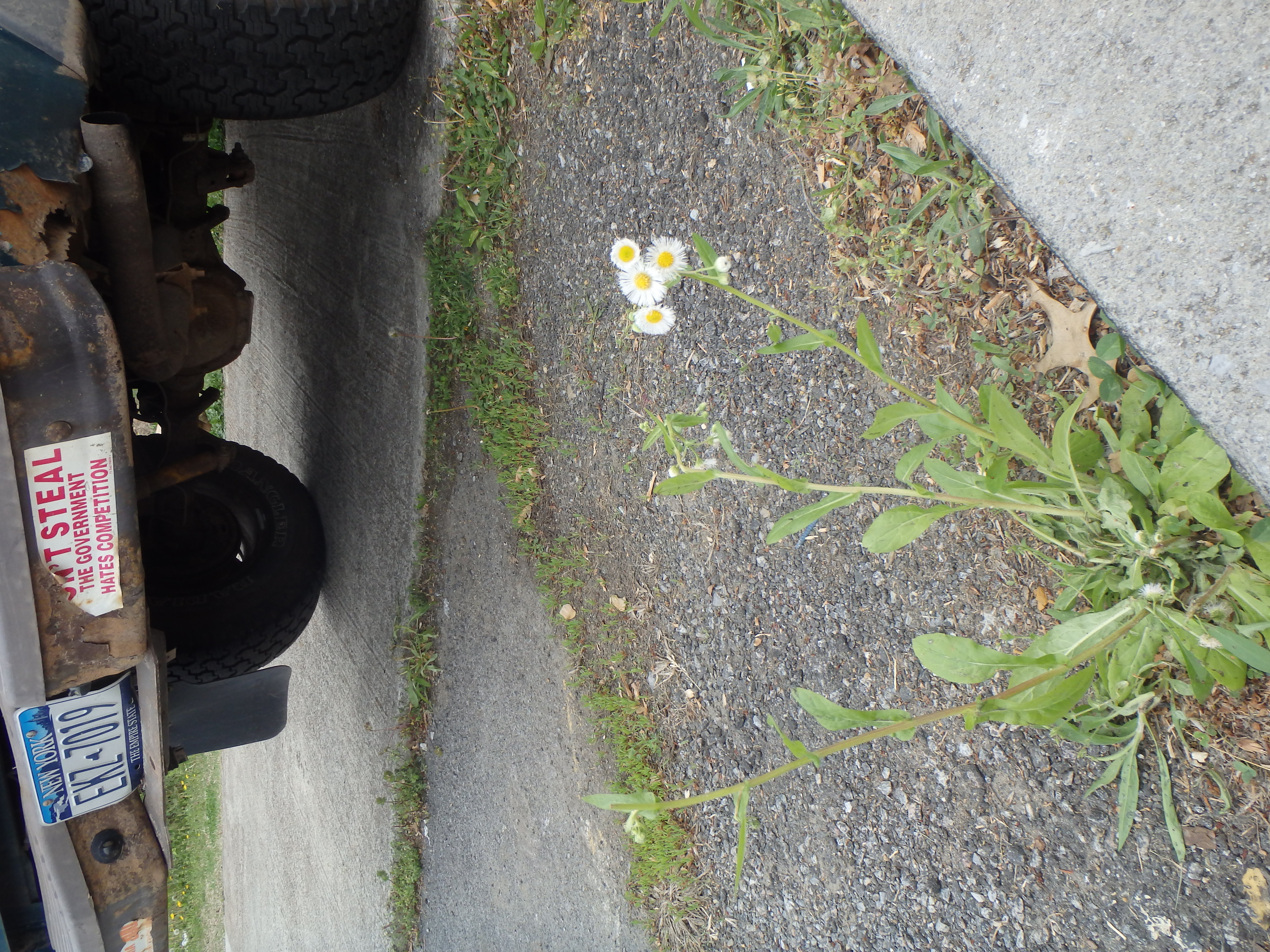
This was the botanizing I did. There was an erigeron blooming in the parking lot. This photo, by the way, does not want to be rotated for some reason.

Meanwhile, we were still trying to get into the mountains. We discussed our options. I knew that just above us, in those mountains, was one of the paradises of the world, a wonderland of God’s beauties, and delay had made desire turn to madness. We decided to rent a car. Catherine got online and found some amazing $12 a day deal for a car. I will never understand the internet, and how just a few clicks online – if they are the right clicks, of course – can cut costs on a project by seventy or eighty percent. I thought $50 a day for a car would have been a good price.

The car company said they would come pick us up. So we waited and chatted with the people. A woman told us how amazing this place was – “You came to the right place. They’re very honest.” An older man told us that he had been instrumental in establishing the first “Church of the Nazarene” in town.

“Do you know that church?”

“No. What’s different about the Church of the Nazarene as opposed to other churches?”

I was looking for doctrine, but he said, “Well, in 1907 Joseph So-and-so started a church, and he got Phineas So-and-so to collaborate with him, and they started in Texas, and then they spread to such-and-such a place, etc.” And perhaps this was actually the relevant information. I always looked for the ideas, but maybe it was mostly about the people.

“We always have some back-and-forths, you know, certain things, with the Baptists. Now you know the Baptists are named after John the Baptist.”

“Yes.”

“Well: I always say: ‘Your church is named after John the Baptist. Ours is named after his first cousin.’” And he gave me a sly look to see if I understood, which of course I did.

“I think you got the right cousin.”

Conversation stalled there, and he said, “But these guys here, they’re very good. Very fair. Once my car had…”

And as this tale was being told, of all the good work they had done, who walked in but Keith Langdon, national park biologist who has done extensive work on the All Taxa Biodiversity Inventory, which has been attempting to discover and catalog every living species in Great Smoky Mountain National Park. In fourteen years of work, they have doubled the number of species known to be in the park, from from 9,511 to 17,527.

Now I did not know this gentleman by name, but I knew he was a naturalist as soon as he walked in: tall, with a baseball cap, a gray beard, tan cargo shorts and a tan button-down shirt that made him look ready for safari, and he had an old hiker’s physique: there was a tummy but the legs and glutes thin, strong, and well-used.

“Here for the wildflower pilgrimage?”

He looked at me as if he were surprised that someone could have been able to tell such a thing about him.  Whereupon a conversation started and he gave me all kinds of useful information about the best places to see flowers in bloom right now. He rattled off species I had only the vaguest idea of – did I want to go see Phacelias or not? I wasn’t sure. He strongly recommended hiking down to White Oak Sinks. “And you may not see it, but there’s a Claytonia there with threadlike leaves, it’s very unusual.”

He was just there to drop his car off for an oil change. He lived in the area. “You came to the right place, I’ll tell you that. These guys… real honest.”

When he left I marveled at the coincidence. He was probably the single person in the whole area I most would have wanted to meet. And he had walked into a service station I never in a million years would have wanted to be stuck in. About an hour later he returned to pick up his car again. “You still here?” Our car-rental pick-up had been delayed. I asked him if he could take us himself, when – of course, my phone rang. They were here to pick us up. Keith took my email and said he’d send me some more hike ideas.

“Good luck,” he said. “Remember, White Oak Sinks.”

So we loaded up all our stuff into the rental car. We were considering leaving the truck here; we would rent the car, drive to Louisiana, then Catherine would drive back, drop off the rental car, pick up the truck, and head back to Kentucky. But it was Good Friday now; Sunday, when she would be returning, was Easter; everything would be closed; they didn’t allow cars to be dropped off. It all just seemed impossibly difficult. Really, we needed that truck.

The gentleman who picked us up from the car rental place was very nice, well-attired in pressed pants and an expensive shirt. Traffic was bad getting from place to place in town, so it took awhile to get to the rental agency, and then we spent another fifteen minutes or so at the counter as our data was punched into a computer – it amazes me how long all that takes – and at long last we had a car. It was on empty, of course, so before heading out of town we filled up the gas tank.

Just as we pulled out we got a call: the truck was fixed and ready to go.

So we doubled back to the mechanic’s, and were told that the problem was human error: the engine had been shaved down a bit to get the new clutch in, but there was some kind of pressure on it, which left a gap and hence the gears couldn’t quite mesh. I didn’t really understand that part, but I understood the next: “No charge.” I tried to pay, but when refused I thanked them profusely and left a tip for the person who had done the work.

There was only one problem. “Where’s the key?” I asked.

“It’s not on the clipboard?”

“No.”

“Hmm. Must have fallen off.”
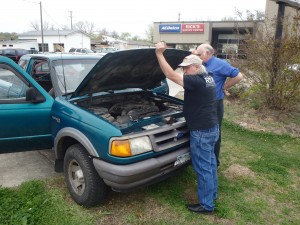
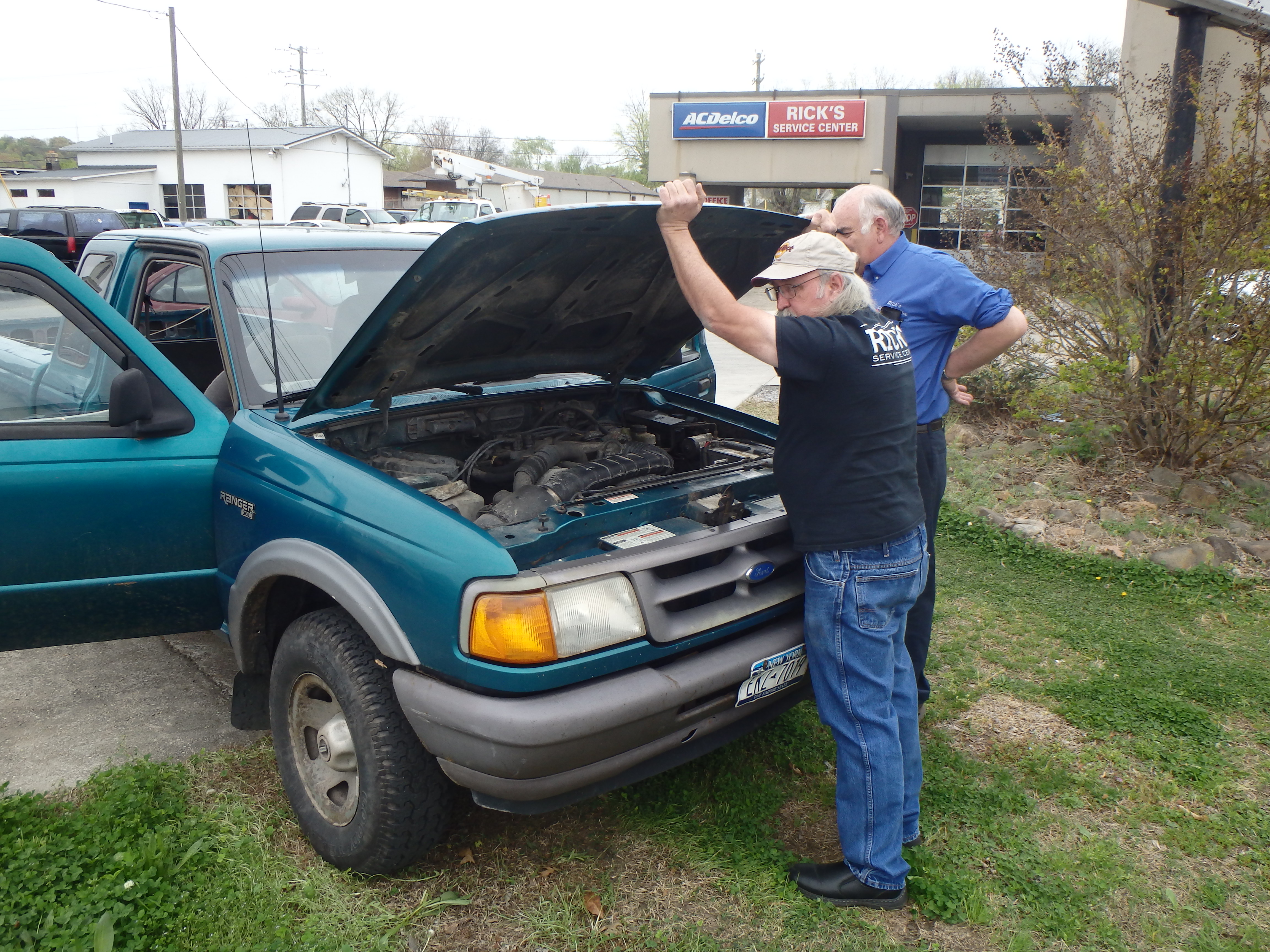
Looking for the key under the hood.

He came back a few minutes later, a bit flustered. No key. The key had vanished. We went out to the truck. It wasn’t there. We opened up the trunk to see if it was under the hood. Nothing. We checked on top of the dashboard. Nope. I cleaned out the floor of the truck – no go. The whole place got into the search. Normally I don’t even need a key, but they had put the ignition onto “lock” and from there the key was absolutely necessary.

I couldn’t believe it. I laughed, but it was a desperate kind of laughter. I just couldn’t get any of this right. I just could not get into the mountains, no matter what I did.

After watching them all scurry around staring at the ground and looking under things, I put my hand into my pocket and pulled out the key. Both I and the mechanic had apparently forgotten that he had given it to me. I felt like an idiot. The whole place had been turned upside down in the past half-hour: the whole business had been embarrassed by what appeared to be their own incompetence, when in fact the incompetence had all been mine. When I sheepishly told everyone – and to be honest, I think I would have rather just crawled under the earth than tell them – they just laughed. “Well, we can’t fahnd the key if it’s in your pocket!”

Catherine asked if I knew the way to the rental car place. I said of course and off we went. Whereupon I got completely lost, leading us on a wild goose chase through the stoplights of exurbia. We finally got back to the rental agency, where we had to go through the standing at the computer all over again as all the computerwork got filled out. By the time that was done and we had retransferred all our stuff, we were starved, and so we ate a very late lunch in another non-chain restaurant in the middle of a parking lot by the highway. It was late afternoon – a drizzly late afternoon, foggy and gray just as the name of the mountain range would suggest – before we finally got to the Smokies. It had taken three and a half days. But once I got there, all the misery would vanish from my thoughts.  In fact, it was the beginning of an amazing series of peak experiences, from the Smokies down to the Gulf.
Redbuds.

29-Apr-14

Driving along the highway from Kentucky into Tennessee, I was astonished by the redbud trees, which were in peak bloom at the time.  I had never seen them in such numbers before, and in this area they grow up as weed trees right along the highway and in other edge habitat.  Their deep purple colors are completely unique among all flowering trees, and coupled with the bright greens of new foliage and the more typical white blossoms of other trees and shrubs, they made a spectacular spring show.

More Disasters.

28-Apr-14

This trip just got either a lot shorter or a lot hungrier.

I had prepared for this moment for days, by going to the ATM machine bit by bit: my account does not let me draw more than five hundred dollars out on any day, and I don’t have a credit card, so for large expenditures like this I have to pay cash and draw the account out over a few days.  I counted out the money and arrived with it in hand.

When I got there I met the young gentleman I had first spoke with.  “Hey, you ever get to the Red River Gorge while you were here?”

“No.  Didn’t really have wheels.”  Okay not entirely true but I was not above an appropriately timed guilt trip.  “But I want to go – you know, several other people mentioned it while I was here.  That’s a good sign.”

Troy came out.  “Ah thank we’re ready to get you back on the rowud Jawun,” he said.  “Where’d you say you were bikin’ to?”

“The whole Mississippi River.”

“Mayin.  How lawung’s that gunna tayik?”

“I’m giving it two months.”

“Wail, good luck.”

“I brought you a gift,” I said.  “Here’s some maple syrup.  I bottled it myself – tapped the trees and ran lines too.”

He seemed genuinely pleased.  “Mah oh mah.  That’s a grayit gift.”

“If you want to do it Kentucky style, you heat some up in a saucepan, and put some bourbon in it.  Boil off the alcohol – otherwise it will have a sharp taste from the alcohol – and put it on vanilla ice cream.  Bourbon maple syrup on ice cream is pretty much the best thing ever.”

“Mayin!  Sounds good.  So what’d you do while you was hayir?”

“Saw Ashland today, that was nice.  Saw the university, went to Port Royal too to check out the Wendell Berry stuff.  Really the only thing I didn’t get to do was go to Keeneland for the horse racing.”

“Nex tahm, nex tahm.  That will be nahn-fifty-seven and fifty two sants.”  I started counting out the money and he said, “Jes gimme nahn-forty.”  I think the maple syrup had just paid for itself.  He walked me out to my truck too, both of us gimping a bit.

“Wail Jawun nex tahm you’re hayir way’ll go to Cane-land together.”

“I think that’d be fun.  Seems like horses are a big thing around here.”

“Hayl with the horses, way’ll go look at the gur-urls!”

I threw my bike into the bed of the truck and hopped in.  The clutch was a little resistant at first.  But I pulled out and headed to Catherine’s.  But the gear shifts were not good.  “Damn,” I said.  “Damn damn DAMN.”

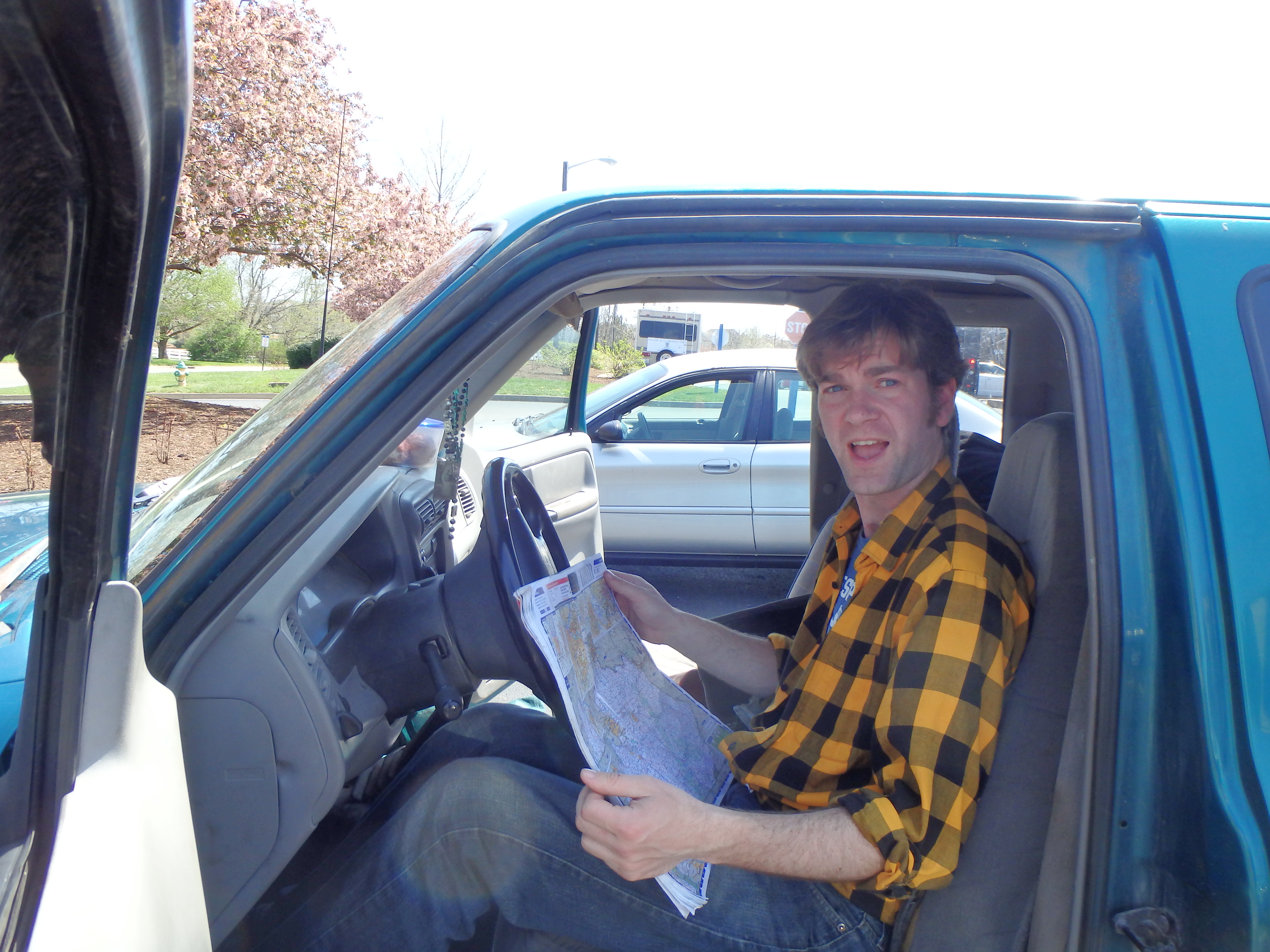
Optimism or obstinacy, we're going.

I thought it might recover miraculously with a bit more use.  I got back to Catherine’s and I grumbled, but still packed up all my stuff and threw it in.  We got in the truck and started it, but the gears ground terribly as I tried to get into reverse.  It then balked at getting into first.  We drove to the first light and then I turned it right back around and went back to the transmission place.

I think the maple syrup had been very useful here.  When I showed up, Troy was clearly angry.  “What sames to be the problem?”  I told him it was not fixed.  He went off in what I would describe as a businessful mood.  He wanted this thing done.

We, on the other hand, sat in the office and made ourselves a standing reproach to their workmanship.  I paged through the Hot Rod magazines, looking for pictures of girls, but apparently these were serious hot rod magazines, for men who only cared about machines.  Some of the ads in the back were interesting, though.

“Would you believe this there are not one not two but three ads back here for penis enlargement.  I guess it really is true that men who drive cars like this are making up for their small penises.”

Catherine busted out Boggle, which amazingly enough she had in her purse.  We played Latin boggle: you shake a container of letter-sided dice into a 4×4 square, and try to spell as many Latin words with the upturned letters as possible.  I have no idea what the mechanics thought of this one.  Pretty girls generally want you to do something more exciting with them than play Latin Boggle, I imagine.  But she had taken it out, so it was her fault.  I beat her four times in a row.

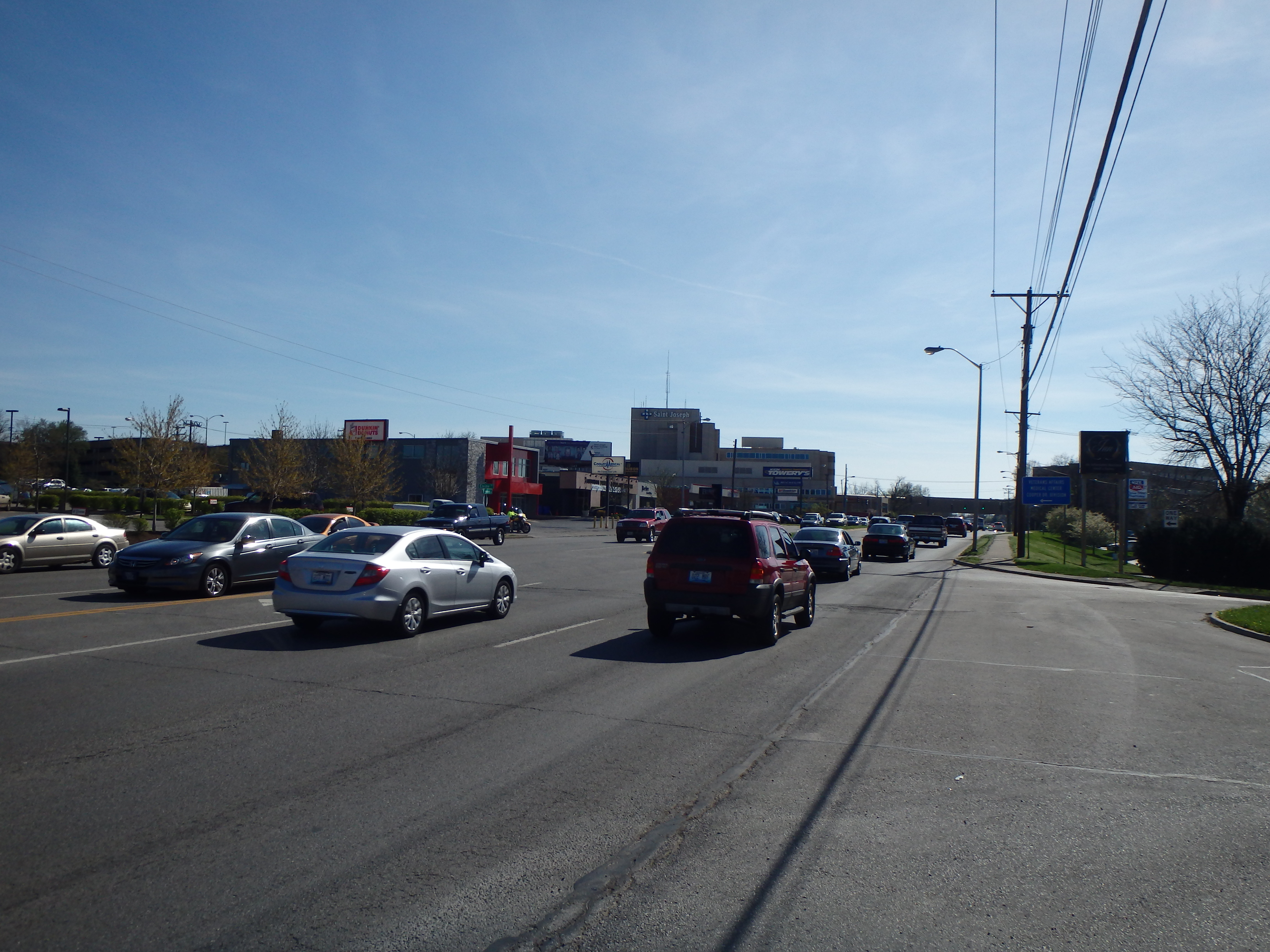
Walking the beautiful outskirts of Lexington.

We went for a brief walk along the trafficky, ugly road, then came back and just sat there.  We talked with each other.  We talked with Troy.  We talked with other people who came in and waited.  It got to be pretty close to five o’clock.  It was clear to everyone that I wanted out.  I was going mad.  And Troy made the decision to release the vehicle again.  Apparently they hadn’t been doing much with it anyway: they were “lettin’ it blade.”  He instructed me that maybe when we got to our destination, we could remove the cap on the transmission fluid container, and it could continue to bleed overnight.  I agreed to do so.  And we blasted out of there.

It was clear that it really wasn’t any better, but I had run out of patience.  I just needed to go.  I wasn’t sure what would happen here.  I could throw it into gear, sometimes by using all my might.  But I doubted Catherine would be able to when it came time to hand the vehicle over.  It was behaving exactly as it had been when I made the determination I couldn’t go to the mountains with it.  I really wasn’t sure what was going to happen.  It certainly didn’t seem smart to drive it right into the Smoky Mountains if we couldn’t rely on it.  But impatience and desire will overmaster judgement in the end.  I slammed it into gear when I needed to, and eventually we made it to the highway, and once I got it into fifth gear and didn’t need the clutch we zipped along just fine.  Three hours later we were off the highway and coming into Sevierville (pronounced “severe”).  Here it became clear that we weren’t going to be setting up our tents in the park – still an hour away – that night.  It was probably time to look for a room.  So we drove into downtown Sevierville and pulled up in front of a restaurant.

It looked nice, too, but we were informed it was closing now, basically – eight p.m.  When I asked if there was any other place nearby to eat – I didn’t want to put the car into gear again without accomplishing the purpose on account which I had taken it out of gear, the waiter said, “In Sevierville?  Ha sorry no I don’t think so.  You see what type of a place it is.  I mean, what kind of place has restaurants closing at eight o’clock?”

Which I thought was a good question.  So we hit the streets and walked.  Downtown everything was empty and dark and closed.  Springsteen had it wrong: the darkness was at the center of town.  At the edges, though, it was all neon and light.  We walked down the nearest block of exurbia.  A Waffle House sign was in the distance.  Catherine had never been to a Waffle House.  “I’ve always wanted to go,” she said.

“Well, I think tonight you get your wish.”

I take suburbia to be the term to describe when people live on the outskirts of town and use their cars to get into the centers.  This was something different – the center was completely dead.  Even if you lived in the center you would have to go someplace else to find supplies or gas or food.  It was exurbia, and it had quite blighted Sevierville.  Lexington had a bad case of it, but Sevierville – otherwise a very pretty town with a backdrop of gorgeous mountains – was quite on death’s door, and this the malignant tumor.  What was peripheral had grown uncontrollably, and threatened to choke off the life at the heart.

At the Waffle House I asked around for a cheap place to spend the night.  I got several answers, but somehow I liked the person who said “the Mountain Aire Inn” best.  We walked back to the car in the American night, smelling the living air coming up from the river as we crossed it, drove to the Mountain Aire Inn, and stopped for the night.  I asked about a car mechanic in town.  The woman at the counter said the owner’s husband was a good mechanic, maybe he’d look at the truck.  And the husband’s brother ran a repair shop.  “He’s very honest, too.”  I would find that out the next day.


In the Footsteps of Clay.

28-Apr-14

The next dawn came and I was still stuck in Lexington. I had arrived on Monday, and now it was Thursday.  I asked if there was a problem.

“Salways trouble with these Foward Rangers. It takes forayver to blade ‘em out. Say, whayn you chenge a clutch you gotta blade ‘em, to get the bubbles out, and it’s just takin’ forever to blade.”

Now I had no idea what he was talking about, but he had mentioned this “bleeding,” before, and I wasn’t going to ask about it now. I just wanted it done. He said lunchtime.

So we had another morning in Lexington. I knew that Catherine had passed by, but never visited, the Henry Clay estate, known as Ashland. Visits from friends are the time when we get things like this done. So we headed over to Ashland and made it for the ten o’clock tour.

Henry Clay was introduced by the guide as “the greatest president America never had.” He had run for president five times, twice receiving his party’s nomination, and never been elected. Lincoln apparently admired him, and called him his “beau ideal of a statesman.” It was a pattern: apparently most of his fellow-politicians thought highly of him. He was elected Speaker of the House on the first day of his first term in the House, which has not happened since.

He was probably unusually well placed for a politician: in the midst of westward expansion, Kentucky was neither settled tidewater nor pioneer territory: it was in the middle. It was the northernmost of the Southern states, but also the southernmost of the states which did not secede. It had steam traffic and commerce along the Ohio river, but also much inland countryside.

Henry Clay's dairy. Underground spaces used intelligently can replace refrigeration.

Clay seems to have had this middling quality in himself – had so much of it that he was extraordinary, in fact, and that was the general impression I got. He opposed slavery, but did hold title to sixty or so human beings himself (like Washington he freed them in his will). He opposed a national bank, but after having paid an electoral price for this position, he then supported one. He supported tariffs, but was involved in important legislation to gradually reduce them to placate the South Carolinians. He was a major – one might say primary – figure in the compromises of 1820 and 1850, which helped prevent a civil war between the states. It came anyway, of course: it just came later.

I don’t particularly think “he delayed the Civil War” is any greater an accomplishment than “he delayed the Revolutionary War” would be. But it is always possible that Clay’s delay is what allowed the North to win: with each year military technology at that time grew (in the North) more and more powerful. This technology – artillery, machine guns, superior ships, railroads – may have been necessary for the North to actually subjugate the South, which I believe was a desirable outcome.

It is hard to read more than a few paragraphs of Lincoln’s eulogy on Clay: it feels very distinctly like hot air. There are expostulations and grandiose statements, and not too many simple facts. In the end, whatever impression the person of Clay made on Lincoln, his legacy does not make much of an impression today. Stories I heard on the tour made him sound frivolous: gambling tens of thousands of dollars over cards, paying vast sums of money for fine racehorses, being a known womanizer. But such qualities might have made him dashing as opposed to frivolous, I suppose; at the very least they could have made him more vital. I do not deny that the prevention of war is a great virtue – and it has been claimed that Clay’s peacemaking virtue was so great, no civil war could occur while he lived. And his gambling and drinking and womanizing probably indicate a sociable and pleasant nature – and the ability to enjoy life is a virtue too. He built a fine house, and was a fine farmer: he was an expert on the production of hemp, his main cash crop. He commanded the respect and friendship of his peers.

But when compared with the political thought of his contemporaries the Abolitionists, Clay seems pallid and merely social. The vast majority of men are thralls of fashion, and lumps of clay in the mold of conformity: after decades, when the mold is removed and the clay stands on its own, the ridiculousness of the shape stands out. Clay was political and social; those were his horizons. In this respect, he stands against the best part of the American tradition. The ultimate teaching of the idea of limited government is that there are many questions – the greatest, in fact – which are outside the adjudication of any body of men. Such cases may appear before the courts, but they judge the courts in the end, the courts do not judge them. The South has since claimed that it was fighting for “States’ Rights,” and to some extent this is true: they fought for the State’s right, with a few speeches and a vote by parliamentary procedure, to strip any man they wished of his humanity. And the North fought for the principle of limited government: that in the end, no government had any right even to bring such a question before it; that governments were good sometimes for the questions they did not allow to be raised.  I let Thoreau speak:

Again it happens that the Boston Court-House is full of armed men, holding prisoner and trying a MAN, to find out if he is not really a SLAVE. Does any one think that justice or God awaits Mr. Loring’s decision? For him to sit there deciding still, when this question is already decided from eternity to eternity, and the unlettered slave himself and the multitude around have long since heard and assented to the decision, is simply to make himself ridiculous. We may be tempted to ask from whom he received his commission, and who he is that received it; what novel statutes he obeys, and what precedents are to him of authority. Such an arbiter’s very existence is an impertinence. We do not ask him to make up his mind, but to make up his pack….

Massachusetts’ crime, the most conspicuous and fatal crime of all, was permitting him to be the umpire in such a case. It was really the trial of Massachusetts. Every moment that she hesitated to set this man free — every moment that she now hesitates to atone for her crime, she is convicted. The Commissioner on her case is God; not Edward G. God, but simply God….

The judge may decide this way or that; it is a kind of accident, at best. It is evident that he is not a competent authority in so important a case. It is no time, then, to be judging according to his precedents, but to establish a precedent for the future….

Only they are guiltless who commit the crime of contempt of such a court.

When Thoreau swings, it is hard not to feel that he lands his punches on the body of Clay:

They who have been bred in the school of politics fail now and always to face the facts. Their measures are half measures and makeshifts merely. They put off the day of settlement indefinitely, and meanwhile the debt accumulates….

These men act as if they believed that they could safely slide down a hill a little way — or a good way — and would surely come to a place, by and by, where they could begin to slide up again. This is expediency, or choosing that course which offers the slightest obstacles to the feet, that is, a downhill one. But there is no such thing as accomplishing a righteous reform by the use of “expediency.” There is no such thing as sliding up hill. In morals the only sliders are backsliders.

Clay’s house was nice, though it was completely rebuilt after his death. The rebuilding effort, finished in 1857, was superb. Beams were large, furniture large, and everything looking to solidity and endurance, rather than cheapness and style. It also felt, as the entire latter half of the nineteenth century does in its architecture, rather masculine: there was a billiards room, and a study, and a library, and all of them looked like places where men drank whiskey and smoked cigars among dark panels and gothic detailing. But Thoreau’s words also can be applied to the house:

I dwelt before, perhaps, in the illusion that my life passed somewhere only between heaven and hell, but now I cannot persuade myself that I do not dwell wholly within hell. The site of that political organization called Massachusetts is to me morally covered with volcanic scoriae and cinders, such as Milton describes in the infernal regions. If there is any hell more unprincipled than our rulers, and we, the ruled, I feel curious to see it. Life itself being worth less, all things with it, which minister to it, are worth less. Suppose you have a small library, with pictures to adorn the walls — a garden laid out around — and contemplate scientific and literary pursuits.&c., and discover all at once that your villa, with all its contents is located in hell, and that the justice of the peace has a cloven foot and a forked tail — do not these things suddenly lose their value in your eyes?

I'm sure Thoreau would have thought the Claytonia the best part of the house.

The answer, of course, is no, not entirely. The grounds were not part of the tour, but we spent some time walking around. The plantation once consisted of some 600 acres, but it was near town and it had almost all been subdivided into nice homes and sold off. There were no formal gardens of any note, though the lawns were entirely covered in Claytonia, spring beauty. Claytonia is a common spring ephemeral, but this profusion of it exceeded anything I had ever seen before, and it made one of the finest lawns I had ever seen. This was probably an indication that the lawn had been a lawn for more than one, and probably at least two, hundred years. The spring beauty had gotten in when the lawn was surrounded by wild land; and had not been subjected to the modern regimen of broadleaf herbicides. But the lawn had been kept short in all that time, because Claytonia cannot compete against taller plants; and it had expanded to take over literally acres of lawn. It was beautiful.

Catherine had an appointment, and so we zipped back home after our brief spin through the grounds. I went over to the transmission place – I was doing the annoying New Yorker thing again, but the parable tells us that importunity, and harassing, works even on the Gods – just to show my face. The truck was not ready. I ate lunch and stewed. I didn’t know if I was going to get this truck back, or if it was going to run ever again.

Perhaps it was having just heard all the gambling stories about Henry Clay; perhaps it was the fact that Lexington has streets named after celebrated racehorses; perhaps it was the story of Jack Kerouac going to the races at Gretna, having a vision about a horse, not betting on it, and watching it win and pay fifty to one (a story which sums up much of the problem of Kerouac); maybe it was just that I had been to the races the last time I had been in Lexington, with my high school debate team. But we were still stuck in Lexington, and we had done most of what there was to do there; so I decided that we should head for the racetrack. Maybe we’d make back some of the money we had lost on the truck.

And then I got a call. The truck was ready. Catherine packed her things, and I biked on down to the transmission place to get the truck. We were finally going to go.

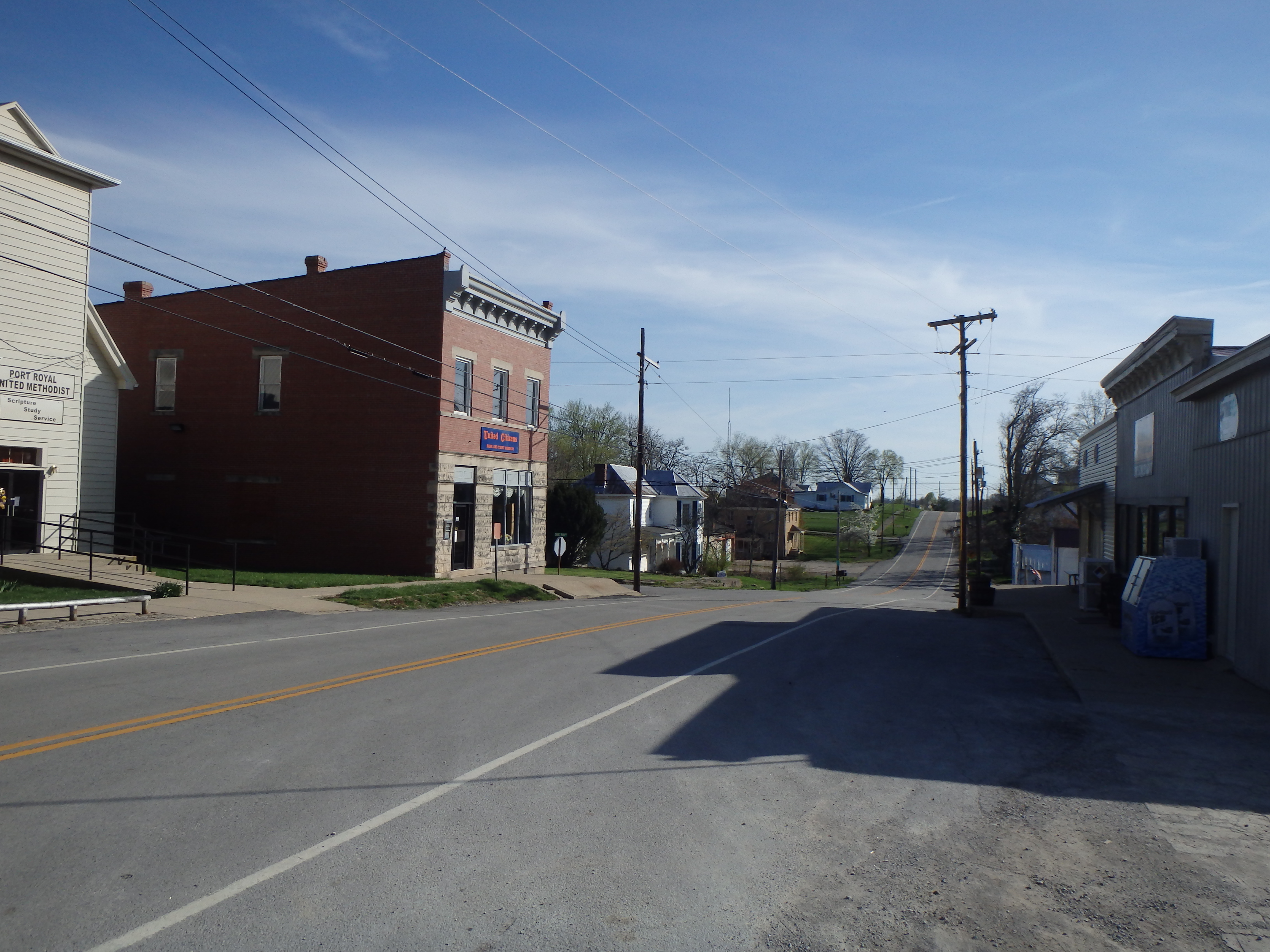
Port Royal, Kentucky.

26-Apr-14

I love the enchantment that love sheds over the world. It is the best companion for an adventure: the unknown is no match for it, the same way you do not fear to hear the worst things about a person you truly love: you love them so much anyway, knowledge can only add to the passion, the way a great flame is only made hotter by the wind. With this in our hearts we headed for Port Royal; and it was an expressed love, that is to say contagious; Berry, having caught it himself, had given it to us; and it was his great love for his home that we found ourselves immersed in and reincarnating.

We passed the Smith Berry winery, which as I understand is owned by Berry’s daughter.  It was itself an example of the retooling of farm life to the modern market: wine requires more skilled labor than growing staples (or tobacco, which they were doing before), and hence can command a better wage and provide a better living for farmers.  Alcohol is one of the more pleasant ways to encourage local business.  The Berrys had a strong presence in the area: the lawyer’s office across from the courthouse was theirs too: John Berry’s.

Soon enough we came into the tiny tiny town of Port Royal, which of course was neither royal nor a port.  The place was so unimpressive I was deeply impressed.  It would have been easy to discount Berry’s principles if he had been writing about some place that had a thriving local economy; easy to think of him as a facile thinker if his glorification of small-town life had been based on some impossibly pretty vacation town.  Port Royal offered no advantages to his principles, besides the fact that there were no other principles available.  In our entire twenty-mile drive we had not seen a single corporate outpost: no gas stations, no big supermarkets, no little markets, no Domino’s or McDonald’s or Subway.  Almost no businesses at all, really: Rick’s Farm Center Restaurant (open til 5 p.m.; it was also the general store); a sign proclaiming the UNITED CITIZENS BANK AND TRUST COMPANY in the one brick building; a Methodist Church, and a post office.  There was an empty storefront, that looked like it could have been Jayber Crow’s barber shop.  But that was it.  It was around 6 p.m., and there was no one around.  We walked up the sidewalk, and then down it.  An overweight father and son drove up to the post office and went in (people with post office boxes had keys to get into the lobby).  I mentioned to him that we loved Wendell Berry and were wandering around and he seemed unimpressed.

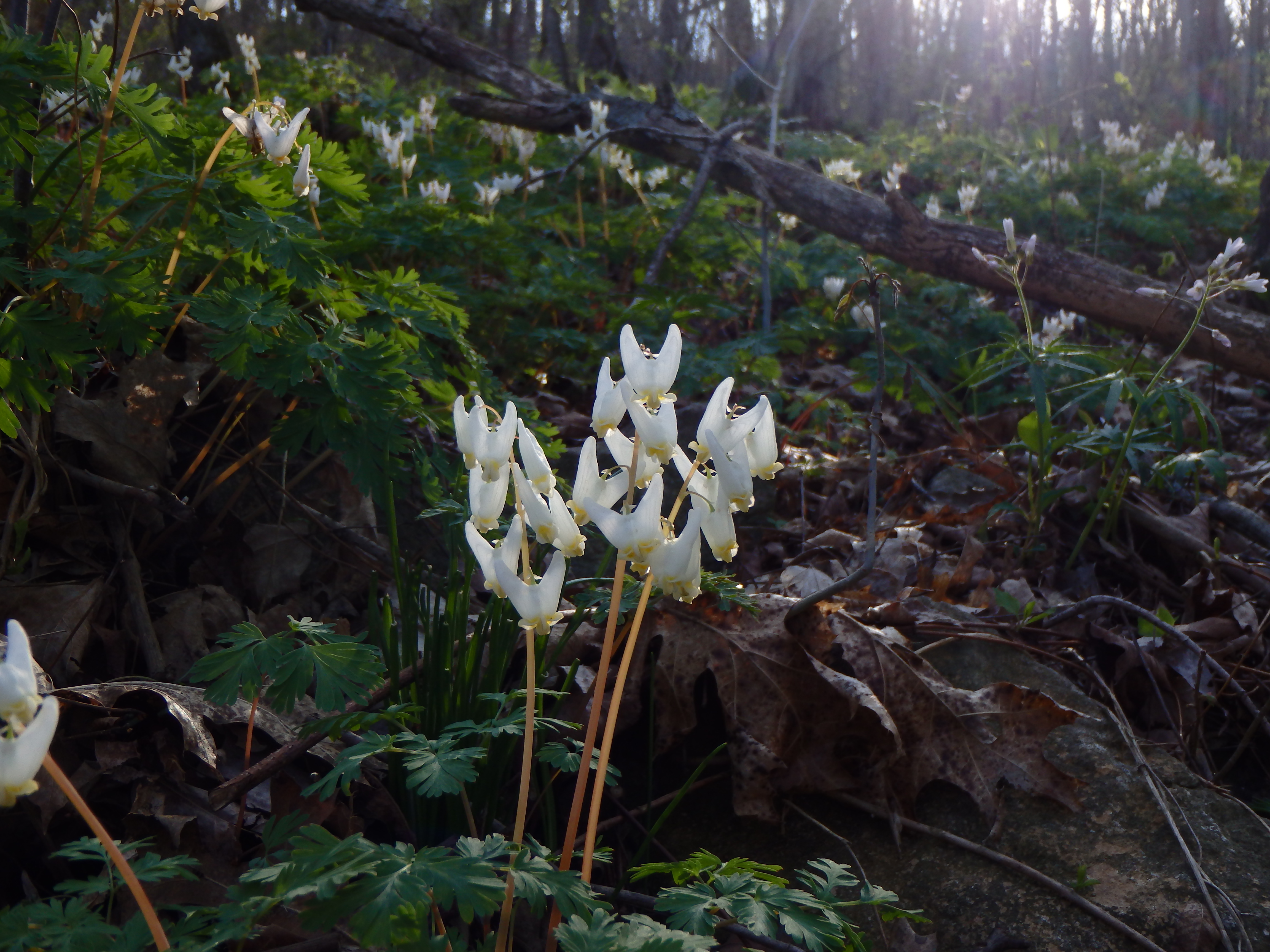
Dicentra cucullaria, Dutchman's breeches.

We took a side road, looking around for a white clapboard farmhouse that might have been Berry’s.  We were looking for sheep too, we knew he had sheep.  We came down a slope toward the Kentucky River – which was a fair distance away, and even in its valley we found no port – and came into what must have been a long-untouched forest, as this one spot, in the area, had a beautiful display of native wildflowers, Dicentra and Mertensia and Dentaria.  It was beautiful.

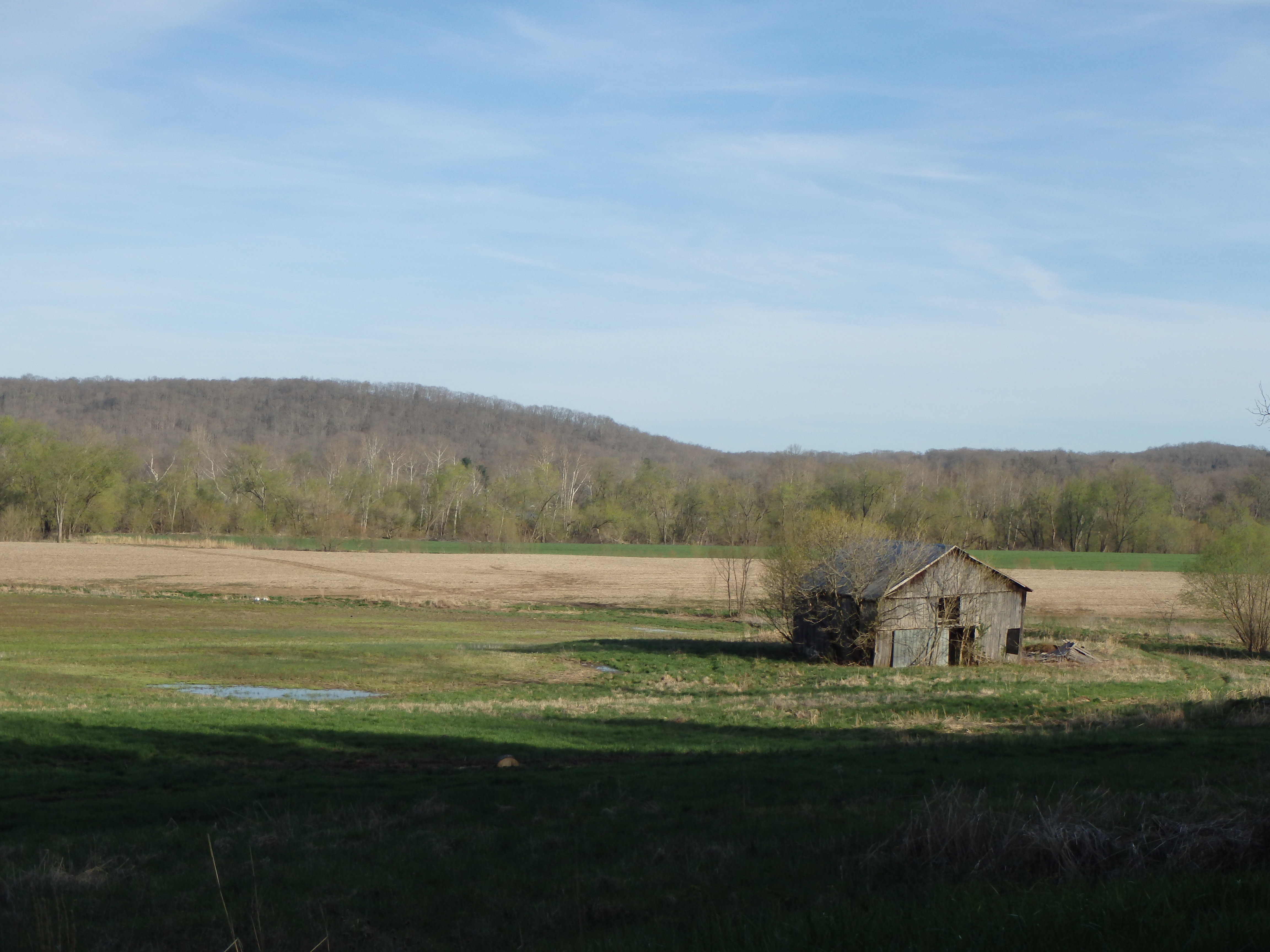
We drove around down on the river-bottoms, looking at old tobacco-barns falling apart; found a big redbud that had split and fallen, and Catherine got out to collect the blooming branches to bring back home.  My back hurt so much I dreaded having to get out myself, but I couldn’t pass up the opportunity to gather in such beauty, for nothing makes so fine a home display as the branches of a flowering tree.  We crossed a creek and found what I believe was Phlox bifida, an unusual plant; and Claytonia and even a pair of Delphiniums. We wandered around mapless for awhile, and pronounced everything good.  We hadn’t found Berry himself; but there was something right about that; we had come closer, close enough to know that he was real.  The archivist had given us Berry’s address; he received visitors on Sundays; I would write to him, and try to see him on a Sunday on my way back from the bike trip.  Now that I knew about the Berry center I could perhaps keep up with what they were doing; Berry himself had just been in New York a few weeks ago at Cooper Union, and I hadn’t known about it.

The Kentucky River bottoms.

We returned to New Castle, looked at the closed shops, marveled at this part of the world where there were no stores open at all, not even gas stations, and dropped off Berry’s maple syrup at the Berry Center.  We then drove back to Frankfort and ate dinner in a nice diner.  We would try yet again to leave for the Smokies tomorrow – and leave we would, though with the truck being what it is I suppose it is no surprise when I say we did not make it.